Results by title
84 books match the query 'Aims and objectives' and 2 start with m
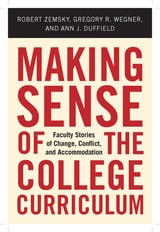
Making Sense of the College Curriculum
Faculty Stories of Change, Conflict, and AccommodationZemsky, Robert
Rutgers University Press, 2018
Readers of Making Sense of the College Curriculum expecting a traditional academic publication full of numeric and related data will likely be disappointed with this volume, which is based on stories rather than numbers. The contributors include over 185 faculty members from eleven colleges and universities, representing all sectors of higher education, who share personal, humorous, powerful, and poignant stories about their experiences in a life that is more a calling than a profession. Collectively, these accounts help to answer the question of why developing a coherent undergraduate curriculum is so vexing to colleges and universities. Their stories also belie the public’s and policymakers’ belief that faculty members care more about their scholarship and research than their students and work far less than most people.
[more]
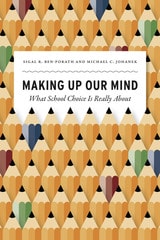
Making Up Our Mind
What School Choice Is Really AboutSigal R. Ben-Porath and Michael C. Johanek
University of Chicago Press, 2019
If free market advocates had total control over education policy, would the shared public system of education collapse? Would school choice revitalize schooling with its innovative force? With proliferating charters and voucher schemes, would the United States finally make a dramatic break with its past and expand parental choice?
Those are not only the wrong questions—they’re the wrong premises, argue philosopher Sigal R. Ben-Porath and historian Michael C. Johanek in Making Up Our Mind. Market-driven school choices aren’t new. They predate the republic, and for generations parents have chosen to educate their children through an evolving mix of publicly supported, private, charitable, and entrepreneurial enterprises. The question is not whether to have school choice. It is how we will regulate who has which choices in our mixed market for schooling—and what we, as a nation, hope to accomplish with that mix of choices. Looking beyond the simplistic divide between those who oppose government intervention and those who support public education, the authors make the case for a structured landscape of choice in schooling, one that protects the interests of children and of society, while also identifying key shared values on which a broadly acceptable policy could rest.
Those are not only the wrong questions—they’re the wrong premises, argue philosopher Sigal R. Ben-Porath and historian Michael C. Johanek in Making Up Our Mind. Market-driven school choices aren’t new. They predate the republic, and for generations parents have chosen to educate their children through an evolving mix of publicly supported, private, charitable, and entrepreneurial enterprises. The question is not whether to have school choice. It is how we will regulate who has which choices in our mixed market for schooling—and what we, as a nation, hope to accomplish with that mix of choices. Looking beyond the simplistic divide between those who oppose government intervention and those who support public education, the authors make the case for a structured landscape of choice in schooling, one that protects the interests of children and of society, while also identifying key shared values on which a broadly acceptable policy could rest.
[more]