Results by title
61 books match the query 'American West' and 2 start with m
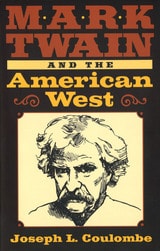
Mark Twain and the American West
Joseph L. Coulombe
University of Missouri Press, 2003
In Mark Twain and the American West, Joseph Coulombe explores how Mark Twain deliberately manipulated contemporary conceptions of the American West to create and then modify a public image that eventually won worldwide fame. He establishes the central role of the western region in the development of a persona that not only helped redefine American manhood and literary celebrity in the late nineteenth century, but also produced some of the most complex and challenging writings in the American canon.
Coulombe sheds new light on previously underappreciated components of Twain’s distinctly western persona. Gathering evidence from contemporary newspapers, letters, literature, and advice manuals, Coulombe shows how Twain’s persona in the early 1860s as a hard-drinking, low-living straight-talker was an implicit response to western conventions of manhood. He then traces the author’s movement toward a more sophisticated public image, arguing that Twain characterized language and authorship in the same manner that he described western men: direct, bold, physical, even violent. In this way, Twain capitalized upon common images of the West to create himself as a new sort of western outlaw—one who wrote.
Coulombe outlines Twain’s struggle to find the proper balance between changing cultural attitudes toward male respectability and rebellion and his own shifting perceptions of the East and the West. Focusing on the tension between these goals, Coulombe explores Twain’s emergence as the moneyed and masculine man-of-letters, his treatment of American Indians in its relation to his depiction of Jim in Adventures of Huckleberry Finn, the enigmatic connection of Huck Finn to the natural world, and Twain’s profound influence on Willa Cather’s western novels.
Mark Twain and the American West is sure to generate new interest and discussion about Mark Twain and his influence. By understanding how conventions of the region, conceptions of money and class, and constructions of manhood intersect with the creation of Twain’s persona, Coulombe helps us better appreciate the writer’s lasting effect on American thought and literature through the twentieth century and into the twenty-first.
[more]
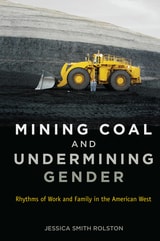
Mining Coal and Undermining Gender
Rhythms of Work and Family in the American WestJessica Smith Rolston
Rutgers University Press, 2014
Winner of the 2018 Distinguished Book Award from the Western Social Science Association
Though mining is an infamously masculine industry, women make up 20 percent of all production crews in Wyoming’s Powder River Basin—the largest coal-producing region in the United States. How do these women fit into a working culture supposedly hostile to females? This is what anthropologist Jessica Smith Rolston, herself a onetime mine worker and the daughter of a miner, set out to discover. Her answers, based on years of participant-observation in four mines and extensive interviews with miners, managers, engineers, and the families of mine employees, offer a rich and surprising view of the working “families” that miners construct. In this picture, gender roles are not nearly as straightforward—or as straitened—as stereotypes suggest.
Gender is far from the primary concern of coworkers in crews. Far more important, Rolston finds, is protecting the safety of the entire crew and finding a way to treat each other well despite the stresses of their jobs. These miners share the burden of rotating shift work—continually switching between twelve-hour day and night shifts—which deprives them of the daily rhythms of a typical home, from morning breakfasts to bedtime stories. Rolston identifies the mine workers’ response to these shared challenges as a new sort of constructed kinship that both challenges and reproduces gender roles in their everyday working and family lives.
Crews’ expectations for coworkers to treat one another like family and to adopt an “agricultural” work ethic tend to minimize gender differences. And yet, these differences remain tenacious in the equation of masculinity with technical expertise, and of femininity with household responsibilities. For Rolston, such lingering areas of inequality highlight the importance of structural constraints that flout a common impulse among men and women to neutralize the significance of gender, at home and in the workplace.
At a time when the Appalachian region continues to dominate discussion of mining culture, this book provides a very different and unexpected view—of how miners live and work together, and of how their lives and work reconfigure ideas of gender and kinship.
[more]