101 books match the query 'American drama' and 6 start with m
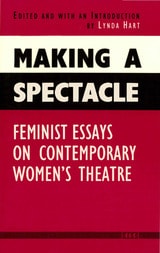
cover of Making a Spectacle: Feminist Essays on Contemporary Women's Theatre

Making a Spectacle

Feminist Essays on Contemporary Women's Theatre

Edited and with an Introduction by Lynda Hart

University of Michigan Press, 1988
Making a Spectacle: Feminist Essays on Contemporary Women's Theatre, edited by Lynda Hart, illuminates the dynamic intersection of feminism and theatre. This volume brings together scholars and practitioners to analyze, theorize, and celebrate the rich diversity and subversive power of contemporary women’s playwriting and performance.Spanning theoretical essays, close readings, and case studies, the book confronts both the historical marginalization and the creative strategies of women playwrights from the late twentieth century. Contributors explore how women have challenged patriarchal norms, re-envisioned dramatic structures, politicized theatrical space, and foregrounded issues of gender, sexuality, race, and class. Essays address influential artists and movements in American and British theatre, highlighting voices such as Caryl Churchill, Ntozake Shange, Maria Irene Fornes, Tina Howe, and groups like the WOW Café.From interrogating the male gaze and the politics of representation to celebrating collectivity and experimenting with language, Making a Spectacle considers the ways women theatre artists resist and reinvent the conventions of stage and story. Insightful, provocative, and accessible, this collection is essential reading for scholars, students, theatre-makers, and anyone interested in feminist performance, cultural criticism, or the artistry of women who have reclaimed the stage.
[more]
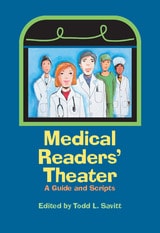
cover of Medical Readers' Theater: A Guide and Scripts

Medical Readers' Theater

A Guide and Scripts

Todd L. Savitt

University of Iowa Press, 2002
We have all had experiences with sickness, care giving, physicians, medical emergencies, hospitals, and doctors’ offices. Health concerns are not solely the domain of medical students, physicians, or nurses—we all deal with our personal well-being and the health of our loved ones on a daily basis. Sometimes these health problems cause us to consider larger social and ethical issues. How do we respond and relate to such matters? In order to help both lay people and medical professionals consider various health care issues, East Carolina University's Brody School of Medicine developed a medical readers' theater program. Compiled for the first time in a single text, Medical Readers’ Theater: A Guide and Scripts provides a vehicle for those who wish to engage in discussions among citizens and professionals about important, topical issues in contemporary medicine.
Consisting of fourteen readers’ theater scripts, a step-by-step guide to performing readers’ theater, and questions for post-performance discussions, this volume utilizes stories by William Carlos Williams, Susan Onthank Mates, Arthur Conan Doyle, Pearl Buck, and many more. Physician/patient relationships, organ donation, chronic illness, race and ethnicity, death and dying, and aging are just a few of the topics covered in this valuable text.
Medical Readers’ Theater can be used in classrooms, hospitals, libraries, or other community settings where citizens can consider views on issues of common concern in the medical world.
[more]
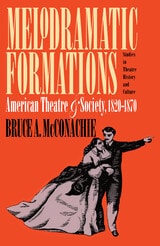
cover of Melodramatic Formations: American Theatre and Society, 1820-1870

Melodramatic Formations

American Theatre and Society, 1820-1870

Bruce A. Mcconachie

University of Iowa Press, 1992
The middle years of the nineteenth century were a time of dynamic artistic and social changes in America. Now, Melodramatic Formations is the first study to trace these changes in popular stage melodrama's production, dramatic form, and audience reception. Bruce McConachie shows how the theatrical mutability that characterized the years 1820 to 1870 is inextricably tied to the decline of elite paternalism and republicanism and the rise of bourgeois rationalism and respectability.
Taking a rigorous interdisciplinary approach, McConachie examines several historical regularities of production, genre, and audience. Here theatre (and its drama) has at long last been returned to its general culture, rather than being treated as an isolated phenomenon. Ultimately, he develops a new notion of a theatrical formation—a construct where groups of spectators and theatre performers produce each other as artists-to-be-experienced and audiences-to-be-entertained.
Throughout Melodramatic Formations McConachie illustrates how theatre both maintains and produces various ideologies; he convincingly shows that theatre is a major player in our social and cultural history. This book will be of interest to all in American studies, theatre history, and American cultural history.
[more]
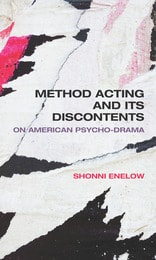
cover of Method Acting and Its Discontents: On American Psycho-Drama

Method Acting and Its Discontents

On American Psycho-Drama

Shonni Enelow

Northwestern University Press, 2015

Method Acting and Its Discontents: On American Psycho-Drama provides a new understanding of a crucial chapter in American theater history. Enelow’s consideration of the broader cultural climate of the late 1950s and early 1960s, specifically the debates within psychology and psychoanalysis, the period’s racial and sexual politics, and the rise of mass media, gives us a nuanced, complex picture of Lee Strasberg and the Actors Studio and contemporaneous works of drama. Combining cultural analysis, dramaturgical criticism, and performance theory, Enelow shows how Method acting’s contradictions reveal powerful tensions inside mid-century notions of individual and collective identity.
[more]
cover of Mimetic Disillusion: Eugene O'Neill, Tennessee Williams, and U.S. Dramatic Realism

Mimetic Disillusion

Eugene O'Neill, Tennessee Williams, and U.S. Dramatic Realism

Anne Fleche

University of Alabama Press, 1997

Reimagining American dramatic realism through the lenses of mimesis, theory, and theatrical innovation.

This volume focuses on two major writers of the 1930s and 1940s—Eugene O'Neill and Tennessee Williams—one whose writing career was just ending and the other whose career was just beginning. In new readings of their major works from this period, Long Day's Journey into Night, The Iceman Cometh, The Glass Menagerie, and A Streetcar Named Desire, Fleche develops connections to the writings of Jacques Derrida, Paul de Man, and Michel Foucault, among others, and discusses poststructuralism in the light of modern writers such as Bertolt Brecht, Antonin Artaud, and Walter Benjamin. Fleche also extends this discussion to the work of two contemporary playwrights, Adrienne Kennedy and Tony Kushner. The aim of Mimetic Disillusion is not to reject "mimetic" and "realistic" readings but to explore the rich complexities of these two ideas and the fruit of their ongoing relevance to U.S. theatre.
 

[more]
cover of Murder Most Queer: The Homicidal Homosexual in the American Theater

Murder Most Queer

The Homicidal Homosexual in the American Theater

Jordan Schildcrout

University of Michigan Press, 2014

The “villainous homosexual” has long stalked America’s cultural imagination, most explicitly in the figure of the queer murderer, a character in dozens of plays. But as society’s understanding of homosexuality has changed, so has the significance of these controversial characters, especially when employed by LGBT theater artists themselves to explore darker fears and desires. Murder Most Queer examines the shifting meanings of murderous LGBT characters in American theater over a century, showing how these representations wrestle with and ultimately subvert notions of gay villainy.

Murder Most Queer works to expose the forces that create the homophobic paradigm that imagines sexual and gender nonconformity as dangerous and destructive and to show how theater artists—and for the most part LGBT theater artists—have rewritten and radically altered the significance of the homicidal homosexual. Jordan Schildcrout argues that these figures, far from being simple reiterations of a homophobic archetype, are complex and challenging characters who enact trenchant fantasies of empowerment, replacing the shame and stigma of the abject with the defiance and freedom of the outlaw, giving voice to rage and resistance.  These bold characters also probe the darker anxieties and fears that can affect queer lives and relationships.  Instead of sentencing them to the prison of negative representations, this book analyzes the meanings in their acts of murder, confronting the real fears and desires condensed in those dramatic acts.
[more]