Results by title
64 books match the query 'American prose literature' and 2 start with m
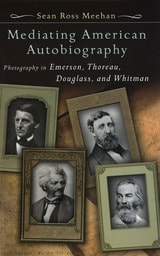
Mediating American Autobiography
Photography in Emerson, Thoreau, Douglass, and WhitmanSean Ross Meehan
University of Missouri Press, 2008
The emergence of photography in the mid-nineteenth century transformed ideas about how the self and nature could be pictured. Although the autobiographical potential of photography seems self-evident today, Sean Meehan takes us back to the birth of the medium when some of America’s preeminent authors began to think about photography’s implications for the representation of identity and the nature of autobiographical writing.
Both photography and autobiography involve a tension between disclosing and concealing their means of production: a chemical process for one, the writing process for the other. Meehan examines how four major authors—Ralph Waldo Emerson, Henry David Thoreau, Frederick Douglass, and Walt Whitman—were well aware of this tension and explored it in their work. By examining the implications of early photography in their writings, he shows how each engaged the new visual medium, how photography mediated their conceptions of self-representation, and how their appropriation of photographic thinking created a new kind of autobiography.
Examining the metonymic nature of photography, Meehan explores how the new medium influenced conceptions of visual and verbal representation. He intertwines these four writers’ reflections on photography—in Emerson’s Representative Men, Thoreau’s journals, Douglass’s narratives of slavery, and Whitman’s Specimen Days—with theories of photography as expounded by its inventors and observers, from Louis Daguerre and William Talbot in Europe to Oliver Wendell Holmes and Marcus Root in America.
As the first book to focus on the emergence of this new visual medium during the American Renaissance, Mediating American Autobiography shows us what photography means for American literature in general and for the genre most closely linked to it in particular. Because the engagement of these writers with photography has been neglected in previous scholarship, Meehan’s work provocatively bridges the study of two media and illuminates an important aspect of American thought and culture at the dawn of the technological era.
Minor Re/Visions
Asian American Literacy Narratives as a Rhetoric of CitizenshipMorris Young
Southern Illinois University Press, 2004
Through a blend of personal narrative, cultural and literary analysis, and discussions about teaching, Minor Re/Visions: Asian American Literacy Narratives as a Rhetoric of Citizenship shows how people of color use reading and writing to develop and articulate notions of citizenship. Morris Young begins with a narration of his own literacy experiences to illustrate the complicated relationship among literacy, race, and citizenship and to reveal the tensions that exist between competing beliefs and uses of literacy among those who are part of dominant American culture and those who are positioned as minorities.
Influenced by the literacy narratives of other writers of color, Young theorizes an Asian American rhetoric by examining the rhetorical construction of American citizenship in works such as Richard Rodriguez’s Hunger of Memory, Victor Villanueva’s Bootstraps: From an American Academic of Color, Carlos Bulosan’s America Is in the Heart, and Maxine Hong Kingston’s “Song for a Barbarian Reed Pipe” from Woman Warrior. These narratives, Young shows, tell stories of transformation through education, the acquisition of literacy, and cultural assimilation and resistance. They also offer an important revision to the American story by inserting the minor and creating a tension amid dominant discourses about literacy, race, and citizenship. Through a consideration of the literacy narratives of Hawai`i, Young also provides a context for reading literacy narratives as responses to racism, linguistic discrimination, and attempts at “othering” in a particular region.
As we are faced with dominant discourses that construct race and citizenship in problematic ways and as official institutions become even more powerful and prevalent in silencing minor voices, Minor Re/Visions reveals the critical need for revising minority and dominant discourses. Young’s observations and conclusions have important implications for the ways rhetoricians and compositionists read, teach, and assign literacy narratives.