Results by title
104 books match the query 'Animals & Nature' and 9 start with m
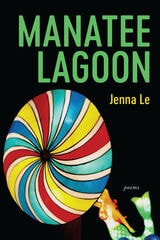
Manatee Lagoon
PoemsJenna Le
Acre Books, 2022
In Manatee Lagoon, sonnets, ghazals, pantoums, villanelles, and a “failed georgic” weave in contemporary subject matter, including social-media comment threads, Pap smears, eclipse glasses, and gun violence. A recurring motif throughout the collection, manatees become a symbol with meanings as wide-ranging as the book itself. Le aligns the genial but vulnerable sea cow with mermaids, neurologists, the month of November, harmful political speech, and even a family photo at the titular lagoon.
In these poems, Le also reflects on the experience of being the daughter of Vietnamese refugees in today’s sometimes tense and hostile America. The morning after the 2016 election, as three women of color wait for the bus, one says, “In this new world, we must protect each other.”
Manatee Lagoon is a treasury of voices, bringing together the personal and the persona, with poems dedicated to Kate Spade, John Ashbery, and Uruguayan poet Delmira Agustini. With this book, Le establishes herself as a talented transcriber of the human condition—and as one of the finest writers of formal verse today.
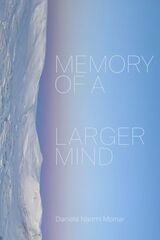
Memory of a Larger Mind
Daniela Naomi Molnar
Omnidawn, 2026
Poems written outdoors, in the presence of disappearing glaciers—a book of memory, grief, and transformation.
In her new poetry collection, Memory of a Larger Mind, Daniela Naomi Molnar sifts through memory and layered loss—planetary, cultural, familial, and personal—asking how we withstand and how we transform. These are plein air poems, written outdoors in the presence of disappearing glaciers and composed with shifting light, wind, sound, and scent: elegies and love songs, celebrations and laments. Braiding the slow death of glaciers with her grandmother's survival of the Holocaust, the book holds ecological and ancestral loss in a single frame. Alive to our current moment while keeping one foot in geologic time, Molnar exposes genocide and ecocide as expressions of the same logic, the same movement: ice to water to light, grief to love to joy to grief.
Memory of a Larger Mind is part of a larger interdisciplinary project that gathers pigments, language, and memory from “sacrifice zones”—glaciated landscapes, former concentration and incarceration camps, desecrated sacred sites—and transforms them into poems, paintings, and films. The result is work in which all bodies are understood as dynamic, part of a world in which difficult pasts might open toward more peaceful futures, and in which grief, handled with care, might shift to love.
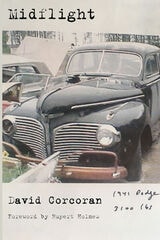
Midflight
David Corcoran
Four Way Books, 2022
A posthumous collection, Midflight collects the poems written by beloved science editor and journalist David Corcoran in the latter part of his life. Idling in a space between the pastoral and the ordinary, Corcoran’s lyrical world maps the sublime mundanity of nature while exploring memory, dreams, and consciousness itself. Corcoran’s lines abound with figures living and long deceased, with the dead walking onstage as if they never left. Describing the accident that killed his father when he was a toddler in “Here,” Corcoran writes, “the door [opens] in midflight / and [pitches] him out.” In “Last Questions,” he asks, “Are you my brother or / a mockingbird?” While these haunting, vivid poems have an aching prescience, imbued as they are with the awareness of human ephemerality, the gift they proffer, to the writer and the reader at once, is the sense of finding oneself midflight, in midair, betwixt sky and ground, in the free fall of being—going and going and never gone.
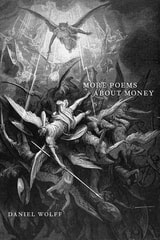
More Poems about Money
Daniel Wolff
Four Way Books, 2022
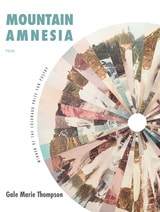
Mountain Amnesia
Gale Marie Thompson
University Press of Colorado, 2023
Mountain Amnesia also explores the question of how implicated or dependent we are on the lives and actions of others. What does it mean to be accountable to and responsible for those around you? How are we implicated in others’ crimes? What can we do in the aftermath? The poems in this collection explore the limits of knowing and seeing, and how we come to be known and seen: “I ask the world for its bandage /of meaning.” Mountain Amnesia both pursues and surrenders to these limits of knowing, narrowing the vast distances between ourselves and others.
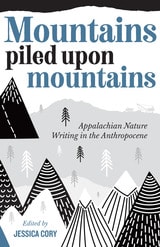
Mountains Piled upon Mountains
Appalachian Nature Writing in the AnthropoceneJessica Cory
West Virginia University Press, 2019
Mountains Piled upon Mountains features nearly fifty writers from across Appalachia sharing their place-based fiction, literary nonfiction, and poetry. Moving beyond the tradition of transcendental nature writing, much of the work collected here engages current issues facing the region and the planet (such as hydraulic fracturing, water contamination, mountaintop removal, and deforestation), and provides readers with insights on the human-nature relationship in an era of rapid environmental change.
This book includes a mix of new and recent creative work by established and emerging authors. The contributors write about experiences from northern Georgia to upstate New York, invite parallels between a watershed in West Virginia and one in North Carolina, and often emphasize connections between Appalachia and more distant locations. In the pages of Mountains Piled upon Mountains are celebration, mourning, confusion, loneliness, admiration, and other emotions and experiences rooted in place but transcending Appalachia’s boundaries.
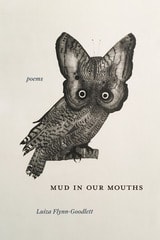
Mud in Our Mouths
PoemsLuiza Flynn-Goodlett
Northwestern University Press, 2025
An award-winning poet writing through violence, solace, and hope
Luiza Flynn-Goodlett’s Mud in Our Mouths illuminates how we are all enmeshed in a web of violence and love. As the speaker of the collection drives cross-country to visit her family of origin in Tennessee, she reckons with the tensions between her current and past selves and the many ways violence—interpersonal, societal, and environmental—has shaped her life. She struggles to find meaning, questioning the ethics of locating faith in a natural world she is unintentionally destroying, and grapples with her complicity in systems of power and oppression as a white Southern woman. Ultimately, she rejects the idea of genetic family as a place of solace; instead, she cleaves to the liberation and joy of connections forged outside those strictures, where intimacy is freely chosen rather than preordained.
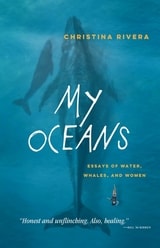
My Oceans
Essays of Water, Whales, and WomenChristina Rivera
Northwestern University Press, 2025
In a swell of sea-linked essays, Christina Rivera explores the kinship between marine animals, humans, and Earth’s blue womb. Rivera’s investigative questions begin with the toxic burden of her body and spiral out—to a grieving orca, a hunted manta ray, a pregnant sea turtle, a spawning salmon, an “endling” porpoise, and the “mother culture” of sperm whales—as she redefines what it means to mother and defend a collective future.
Braiding memoir with embodied climate science, Rivera challenges that it’s not anthropomorphism to feel deep connection to nonhuman species and proposes that gathering in collective grief is essential amid the sixth mass extinction. For ecofeminists, fans of Rachel Carson and Terry Tempest Williams—and for anyone who feels themself disintegrate in the presence of the sea—My Oceans offers a timely and wondrous descent into the deep waters of interconnection in which we swim.
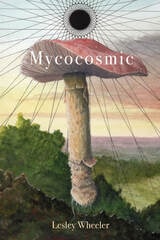
Mycocosmic
Lesley Wheeler
Tupelo Press, 2025
“Good things come to you through fire,” a Tarot reader told Lesley Wheeler as she was composing what became her sixth poetry collection, Mycocosmic. But how could that be true, while the planet was burning and life slamming her with one loss after another? Then she learned about pyrophilic fungi that lurk in soil until activated by fire. Enter mycelia and a teeming underground world that metabolizes death, changing what remains so that life can begin anew.
Mycocosmic offers intricately woven spell poems—prayers, hexes, charms, and invocations—that call for transformation. A parent’s death gives Wheeler the freedom to reveal difficult truths about family violence and her sexuality; a midlife mental health crisis transforms her sense of self. Incantatory language channeled through a wide variety of forms—including free verse, litany, sonnets, the bref double, the golden shovel, and the villanelle—empowers these shifts.
Beneath these poems runs a book-length essay in verse, “Underpoem [Fire Fungus],” sending tendrils across the footer of each page. This poetic mycelium nourishes metamorphosis and highlights its urgency. As Merlyn Sheldrake writes in Entangled Life, “Mycelium describes the most common of fungal habits, better thought of not as a thing but as a process: an exploratory, irregular tendency.” Poetry is rooted in real and imagined communities and conversations. Mycocosmic demonstrates how interdependence binds us together.