Results by title
99 books match the query 'Art, Modern' and 7 start with m
Making Ideas Visible in the Eighteenth Century
Jennifer Milam
University of Delaware Press, 2022
Making Memory Matter
Strategies of Remembrance in Contemporary ArtLisa Saltzman
University of Chicago Press, 2006
In an ancient account of painting’s origins, a woman traces the shadow of her departing lover on the wall in an act that anticipates future grief and commemoration. Lisa Saltzman shows here that nearly two thousand years after this story was first told, contemporary artists are returning to similar strategies of remembrance, ranging from vaudevillian silhouettes and sepulchral casts to incinerated architectures and ghostly processions.
Exploring these artists’ work, Saltzman demonstrates that their methods have now eclipsed painting and traditional sculpture as preeminent forms of visual representation. She pays particular attention to the groundbreaking art of Krzysztof Wodiczko, who is known for his projections of historical subjects; Kara Walker, who creates powerful silhouetted images of racial violence in American history; and Rachel Whiteread, whose work centers on making casts of empty interior spaces. Each of the artists Saltzman discusses is struggling with the roles that history and memory have come to play in an age when any historical statement is subject to question and doubt. In identifying this new and powerful movement, she provides a framework for understanding the art of our time.
Men of Steel, Women of Wonder
Modern American Superheroes in Contemporary ArtAlejo Benedetti
University of Arkansas Press, 2019
Saturated in patriotic colors, Superman and Wonder Woman are about as American as baseball and apple pie. Superman, created in 1938, materialized as the brawny answer to the Great Depression, and when Wonder Woman arrived three years later, she supported her adopted country by fighting alongside Allied troops in World War II. As the proverbial mother and father of the superhero genre, these icons appeared to a society in crisis as unwavering beacons of national morality, a quality that lent them success on the battlefield—and on the newsstand.
As new crises arise our comic-book champions continue to be called into action. They adapt and evolve but remain the same potent, if flawed, symbols of the American way. The artists in Men of Steel, Women of Wonder, an exhibition organized by Crystal Bridges Museum of American Art, wrestle with Wonder Woman’s standing as a feminist icon, position Superman as a Soviet-era weapon, and question the immigration status of both characters. Featuring more than seventy artworks that range from loving endorsements to brutal critiques of American culture, this exhibition catalog reveals the enduring presence of these characters and the diverse ways artists employ them.
Mirror Affect
Seeing Self, Observing Others in Contemporary ArtCristina Albu
University of Minnesota Press, 2016
For decades, contemporary artworks with reflective properties have stimulated public forms of spectatorship. According to Cristina Albu, these artworks, which can include elements such as mirrors, live video feedback, or sensors, draw attention to affective interdependence and mechanisms of social control.
In Mirror Affect, Albu provides a historical account of mirroring processes in contemporary art and offers insight into the phenomenological and sociopolitical concerns that have inspired artists to stage processes of affective, perceptual, and behavioral mirroring between art viewers. Beginning with the 1960s, Albu charts the rise of interpersonal modes of art spectatorship. She reveals contemporary artists’ strategic use of reflective and responsive interfaces to instill doubt in visual representation and appeal to active scrutiny of the changing social dynamics. She suggests that the mirroring processes envisioned by contemporary artists such as Joan Jonas, Dan Graham, Lynn Hershman Leeson, Olafur Eliasson, and Rafael Lozano-Hemmer trigger visual disjunctions to upset narcissistic inclinations. They invite viewers to see themselves in relation to others and to ponder their role within complex social systems.
From sculpture and performance to art and technology projects, video art, and installation art, Mirror Affect analyzes forms of interpersonal spectatorship, revising and expanding current historiographies of participatory art.
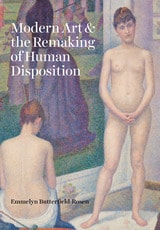
Modern Art and the Remaking of Human Disposition
Emmelyn Butterfield-Rosen
University of Chicago Press, 2021
With this book, Emmelyn Butterfield-Rosen brings a new formal and conceptual rubric to the study of turn-of-the-century modernism, transforming our understanding of the era’s canonical works. Butterfield-Rosen analyzes a hitherto unexamined formal phenomenon in European art: how artists departed from conventions for posing the human figure that had long been standard. In the decades around 1900, artists working in different countries and across different media began to present human figures in strictly frontal, lateral, and dorsal postures. The effect, both archaic and modern, broke with the centuries-old tradition of rendering bodies in torsion, with poses designed to simulate the human being’s physical volume and capacity for autonomous thought and movement. This formal departure destabilized prevailing visual codes for signifying the existence of the inner life of the human subject.
Exploring major works by Georges Seurat, Gustav Klimt, and the dancer and choreographer Vaslav Nijinsky— replete with new archival discoveries—Modern Art and the Remaking of Human Disposition combines intensive formal analysis with inquiries into the history of psychology and evolutionary biology. In doing so, it shows how modern understandings of human consciousness and the relation of mind to body were materialized in art through a new vocabulary of postures and poses.
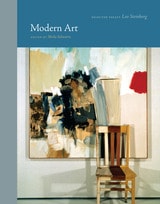
Modern Art
Selected EssaysLeo Steinberg
University of Chicago Press, 2023
Leo Steinberg was one of the most original art historians of the twentieth century, known for taking interpretive risks that challenged the profession by overturning reigning orthodoxies. In essays and lectures ranging from old masters to modern art, he combined scholarly erudition with eloquent prose that illuminated his subject and a credo that privileged the visual evidence of the image over the literature written about it. His writings, sometimes provocative and controversial, remain vital and influential reading. Steinberg’s perceptions evolved from long, hard looking at his objects of study. Almost everything he wrote included passages of formal analysis that were always put into the service of interpretation.
Following the series publication on Pablo Picasso, this volume focuses on other modern artists, including Cézanne, Monet, Matisse, Max Ernst, Jasper Johns, Robert Rauschenberg, Roy Lichtenstein, Hans Haacke, and Jeff Koons. Included are seven unpublished lectures and essays, Steinberg’s landmark essay “Encounters with Rauschenberg,” a survey of twentieth-century sculpture, and an examination of the role of authorial predilections in critical writing. The final chapter presents a collection of Steinberg’s humorous pieces, witty forays penned for his own amusement.
Modern Art is the fifth and final volume in a series that presents Steinberg’s writings, selected and edited by his longtime associate Sheila Schwartz.
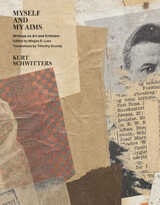
Myself and My Aims
Writings on Art and CriticismKurt Schwitters
University of Chicago Press, 2021
As the first anthology in English of the critical and theoretical writings of this influential artist, Myself and My Aims makes the case for Schwitters as one of the most creative thinkers of his generation. Including material that has never before been published, this volume presents the full range of his prolific writing on the art and attitudes of his time, joining existing translations of his children’s stories, poetry, and fiction to give new readers unprecedented access to his literary imagination. With an accessible introduction by Megan R. Luke and elegant English translations by Timothy Grundy, this book will prove an exceptional resource for artists, scholars, and enthusiasts of his art.