Results by title
138 books match the query 'Art and society' and 6 start with m
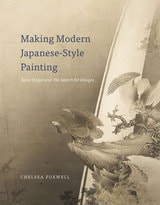
Making Modern Japanese-Style Painting
Kano Hogai and the Search for ImagesChelsea Foxwell
University of Chicago Press, 2015
Chelsea Foxwell sheds light on interlinked trends in Japanese nationalist discourse, government art policy, American and European commentary on Japanese art, and the demands of export. The seminal artist Kano Hogai (1828–88) is one telling example: originally a painter for the shogun, his art eventually evolved into novel, eerie images meant to satisfy both Japanese and Western audiences. Rather than simply absorbing Western approaches, nihonga as practiced by Hogai and others broke with pre-Meiji painting even as it worked to neutralize the rupture.
By arguing that fundamental changes to audience expectations led to the emergence of nihonga—a traditional interpretation of Japanese art for a contemporary, international market—Making Modern Japanese-Style Painting offers a fresh look at an important aspect of Japan’s development into a modern nation.
Meadows of Memory
Images of Time and Tradition in American Art and CultureBy Michael Kammen
University of Texas Press, 1992
"History painting," for many people, conjures up Washington Crossing the Delaware and other paintings of heroic historical events. But history has made its way into considerably more American art than such obvious examples, in the view of Michael Kammen. In three thought-provoking and innovative essays, Kammen ranges from the Renaissance to the twentieth century, from central Europe to the western United States, and from elegant oil painting to folk sculpture to show the transformations of Old World icons of time into New World images of social memory and tradition.
In the first essay, Kammen demonstrates how American artists and artisans modified European emblems of time in response to their New World setting. In the second essay concerning nineteenth-century landscape art, he explores how artists used space to represent the movement of American culture through time. In the final essay, he looks at two distinctively American motifs of collective memory and tradition—old houses and elm trees. Throughout this interdisciplinary study, Kammen draws his examples from well-known and lesser-known artists, as well as from diverse American writers. Over 100 black-and-white illustrations accompany the text.
Of interest to all students of American culture, Meadows of Memory raises intriguing questions about the American paradox of desiring to conquer mutability while yearning for emblems of a (perhaps imagined?) past.

Minor China
Method, Materialisms, and the AestheticHentyle Yapp
Duke University Press, 2021
Mobilizing Pedagogy
Two Social Practice Projects in the Americas by Pablo Helguera with Suzanne Lacy and Pilar Riaño-AlcaláEdited by Elyse A. Gonzales and Sara Reisman
Amherst College Press, 2018
Social practice artists offer a clear and unflinching answer to this question, setting before us works intended not merely to ask questions but to propose pathways toward large societal change.
In this volume, the work of two social practice artists of different generations and different social locations—Suzanne Lacy and Pablo Helguera—are brought into creative tension by two visionary curators: Elyse A. Gonzalez of the Art, Design & Architecture Museum of the University of California, Santa Barbara, and Sara Reisman of the Shelley and Donald Rubin Foundation of New York. Working together, Gonzales and Reisman bring the work of these two engaged and activist artists into dialogue, showing how art can be not merely the mirror of society but the means of making it more just, more inclusive, and more humane.
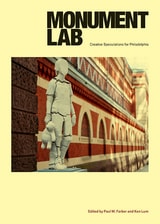
Monument Lab
Creative Speculations for PhiladelphiaPaul M. Farber
Temple University Press, 2020
What is an appropriate monument for the current city of Philadelphia? That was the question posed by the curators, artists, scholars, and students who comprise the Philadelphia-based public art and history studio Monument Lab. And in 2017, along with Mural Arts Philadelphia, they produced and organized a groundbreaking, city-wide exhibition of temporary, site-specific works that engaged directly with the community. The installations, by a cohort of diverse artists considering issues of identity, appeared in iconic public squares and neighborhood parks with research and learning labs and prototype monuments.
Monument Lab is a fabulous compendium of the exhibition and a critical reflection of the proceedings, including contributions from interlocutors and collaborators. The exhibition and this handbook were designed to generate new ways of thinking about monuments and public art as well as to find new, critical perspectives to reflect on the monuments we have inherited and to imagine those we have yet to build. Monument Lab energizes acivic dialogue about place and history as forces for a deeper questioning of what it means to be Philadelphian in a time of renewal and continuing struggle.
Contributors: Alexander Alberro, Alliyah Allen, Laurie Allen, Andrew Friedman, Justin Geller, Kristen Giannantonio, Jane Golden, Aviva Kapust, Fariah Khan, Homay King, Stephanie Mach, Trapeta B. Mayson, Nathaniel Popkin, Ursula Rucker, Jodi Throckmorton, Salamishah Tillet, Jennifer Harford Vargas, Naomi Waltham-Smith, Bethany Wiggin, Mariam I. Williams, Leslie Willis-Lowry, and the editors.
Artists: Tania Bruguera, Mel Chin, Kara Crombie, Tyree Guyton, Hans Haacke, David Hartt, Sharon Hayes, King Britt and Joshua Mays, Klip Collective, Duane Linklater, Emeka Ogboh, Karyn Olivier, Michelle Angela Ortiz, Kaitlin Pomerantz, RAIR, Alexander Rosenberg, Jamel Shabazz, Hank Willis Thomas, Shira Walinsky and Southeast by Southeast, and Marisa Williamson.
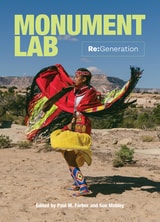
Monument Lab
Re:GenerationEdited by Paul M. Farber and Sue Mobley
Temple University Press, 2026
Monument Lab: Re:Generation presents case studies that travel across America, highlighting local commemorative campaigns dedicated to advancing public memory. Featuring articles and artwork from the country’s leading monument makers, each project includes a framing essay that provides insights into the varied contexts of location, culture, form, and subject matter.
Monument Lab: Re:Generation provides innovative, healing, and practical approaches to the United States’ unreconciled past and divided present facing our nation. In doing so, it invites readers to engage with a broader discourse of monuments and public memory.
Contributors: Thomas J. Adams, Kareal Amenumey, Sháńdíín Brown, Jonathan Jae-an Crisman, Kristen Dorsey, Aruna D'Souza, Mariluz Franco Ortiz, Jacqui Germain, Grace Sanders Johnson, Dani R. Merriman, Deirdre Cooper Owens, Naima Murphy Salcido, Kirk Savage, Clint Smith, Tsione Wolde-Michael, Eric Zimmer, and the editors