197 books match the query 'Arts' and 8 start with m
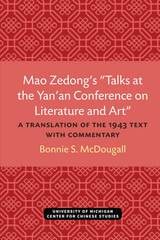
cover of Mao Zedong’s “Talks at the Yan’an Conference on Literature and Art”: A Translation of the 1943 Text with Commentary

Mao Zedong’s “Talks at the Yan’an Conference on Literature and Art”

A Translation of the 1943 Text with Commentary

Bonnie S. McDougall

University of Michigan Press, 1980
The writings of Mao Zedong have been circulated throughout the world more widely, perhaps, than those of any other single person this century. The “Talks at the Yan’an Conference on Literature and Art” has occupied a prominent position among his many works and has been the subject of intense scrutiny both within and outside China. This text has undoubted importance to modern Chinese literature and history. In particular, it reveals Mao’s views on such questions as the relationship between writers or works of literature and their audience, or the nature and value of different kinds of literary products.
In this translation and commentary, Bonnie S. McDougall finds that Mao was in fact ahead of many of his critics in the West and his Chinese contemporaries in his discussion of literary issues. Unlike the majority of modern Chinese writers deeply influenced by Western theories of literature and society (including Marxism), Mao remained close to traditional patterns of thought and avoided the often mechanical or narrowly literal interpretations that were the hallmark of Western schools current in China in the early twentieth century.
Many of the detailed discussions on the “Talks” in the West have been concerned with their political and historical significance. However, since Mao is a literary figure of some importance in twentieth-century China, McDougall finds it worthwhile to follow up his published remarks on the nature and source of literature and the means of its evaluation. By better understanding the complex and revolutionary ideas contained in the “Talks,” McDougall suggests we may acquire the necessary analytical tools for a more fruitful investigation into contemporary Chinese literature.
[more]
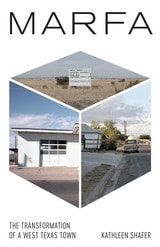
cover of Marfa: The Transformation of a West Texas Town

Marfa

The Transformation of a West Texas Town

By Kathleen Shafer

University of Texas Press, 2019

A small town in the vast desert of West Texas, Marfa attracts visitors from around the world to its art foundations and galleries, film and music festivals, and design and architecture symposiums. While newcomers sometimes see it as “another Santa Fe,” long-time residents often take a bemused, even disapproving attitude toward the changes that Marfa has undergone since artist Donald Judd came to town in the 1970s and began creating spaces for his own and other artists’ work. They remember when ranching and the military formed the basis of the town’s economy, even as they acknowledge that tourist dollars are now essential to Marfa’s sustainability

Marfa tells an engaging story of how this isolated place became a beacon in the art world, like the famous Marfa Lights that draw curious spectators into the West Texas night. As Kathleen Shafer delves into the town’s early history, the impact of Donald Judd, the expansion of arts programming, and the increase in tourism, she unlocks the complex interplay between the particularities of the place, the forces of commerce and growth, the textures of local culture and tradition, and the transformative role of artists and creative work. Bookending her story between two iconic artworks—the whimsical Prada Marfa and the crass Playboy Marfa—Shafer illuminates the shifting cultural landscape of Marfa, showing why this place has become a mecca for so many and how the influx of newcomers has transformed its character.
[more]
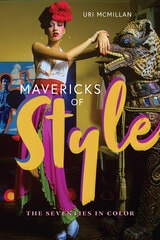
cover of Mavericks of Style: The Seventies in Color

Mavericks of Style

The Seventies in Color

Uri McMillan

Duke University Press, 2025
In Mavericks of Style, Uri McMillan tells the story of New York City’s downtown art and fashion scene of the 1970s through the lives and careers of experimental Black and Brown artists. McMillan focuses on model and musician Grace Jones, fashion illustrator Antonio Lopez, fashion designer Stephen Burrows, and their orbit of friends, showing how they restlessly moved across genres and disciplines, transgressing boundaries between the commercial and the avant-garde. Bypassing the exclusive art world and cultivating uniquely personal styles, these artists thrived on friendship and collaboration in their experimental use of bold color, gold lamé, and Instamatic photography. McMillan transports readers to the spaces Jones, Lopez, and Burrows frequented and worked in, from hair salons, nondescript artist studios, and buzzy boutiques to funky discos and high fashion runways. By foregrounding their impact on the decade’s aesthetics, McMillan complicates and expands the understanding of these artists, offering a new vision of New York’s art world in sultry, bombastic color.
[more]
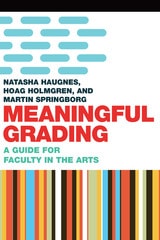
cover of Meaningful Grading: A Guide for Faculty in the Arts

Meaningful Grading

A Guide for Faculty in the Arts

Hoag Holmgren

West Virginia University Press, 2018

College and university faculty in the arts (visual, studio, language, music, design, and others) regularly grade and assess undergraduate student work but often with little guidance or support. As a result, many arts faculty, especially new faculty, adjunct faculty, and graduate student instructors, feel bewildered and must “reinvent the wheel” when grappling with the challenges and responsibilities of grading and assessing student work.

Meaningful Grading: A Guide for Faculty in the Arts enables faculty to create and implement effective assessment methodologies—research based and field tested—in traditional and online classrooms. In doing so, the book reveals how the daunting challenges of grading in the arts can be turned into opportunities for deeper student learning, increased student engagement, and an enlivened pedagogy.
[more]
cover of Mobility of Imagination: A companion guide to international cultural cooperation

Mobility of Imagination

A companion guide to international cultural cooperation

Dragan Klaic

Central European University Press, 2006
This concise guidebook explains the purpose and expected benefits of international cultural cooperation, its risks and strategic issues, models and success factors. International cultural cooperation is analyzed here as a trajectory of professional development of individual and institutional operators and as a strategy to build an integrated, inclusive cultural space that will enhance the notion of European citizenship. Examples are offered from all parts of Europe and all disciplines. Cultural cooperation has been traditionally conceived as a matter of national governments and national cultural and foreign policy, not in a broad supranational perspective and not from the point of view of cultural operators themselves. Students previously had to rely on occasional articles and some governmental and academic studies of a rather narrow focus and national perspective.
[more]
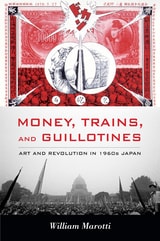
cover of Money, Trains, and Guillotines: Art and Revolution in 1960s Japan

Money, Trains, and Guillotines

Art and Revolution in 1960s Japan

William Marotti

Duke University Press, 2013
During the 1960s a group of young artists in Japan challenged official forms of politics and daily life through interventionist art practices. William Marotti situates this phenomenon in the historical and political contexts of Japan after the Second World War and the international activism of the 1960s. The Japanese government renewed its Cold War partnership with the United States in 1960, defeating protests against a new security treaty through parliamentary action and the use of riot police. Afterward, the government promoted a depoliticized everyday world of high growth and consumption, creating a sanitized national image to present in the Tokyo Olympics of 1964. Artists were first to challenge this new political mythology. Marotti examines their political art, and the state's aggressive response to it. He reveals the challenge mounted in projects such as Akasegawa Genpei's 1,000-yen prints, a group performance on the busy Yamanote train line, and a plan for a giant guillotine in the Imperial Plaza. Focusing on the annual Yomiuri Indépendant exhibition, he demonstrates how artists came together in a playful but powerful critical art, triggering judicial and police response. Money, Trains, and Guillotines expands our understanding of the role of art in the international 1960s, and of the dynamics of art and policing in Japan.
[more]
cover of Music, the Arts, and Ideas: Patterns and Predictions in Twentieth-Century Culture

Music, the Arts, and Ideas

Patterns and Predictions in Twentieth-Century Culture

Leonard B. Meyer

University of Chicago Press, 1994
Meyer makes a valuable statement on aesthetics, criteria for assessing great works of music, compositional practices and theories of the present day, and predictions of the future of Western culture. His postlude, written for the book's twenty-fifth anniversary, looks back at his thoughts on the direction of music in 1967.
[more]
cover of Muslim Rap, Halal Soaps, and Revolutionary Theater: Artistic Developments in the Muslim World

Muslim Rap, Halal Soaps, and Revolutionary Theater

Artistic Developments in the Muslim World

Edited by Karin van Nieuwkerk

University of Texas Press, 2011

From "green" pop and "clean" cinema to halal songs, Islamic soaps, Muslim rap, Islamist fantasy serials, and Suficized music, the performing arts have become popular and potent avenues for Islamic piety movements, politically engaged Islamists, Islamic states, and moderate believers to propagate their religio-ethical beliefs. Muslim Rap, Halal Soaps, and Revolutionary Theater is the first book that explores this vital intersection between artistic production and Islamic discourse in the Muslim world.

The contributors to this volume investigate the historical and structural conditions that impede or facilitate the emergence of a "post-Islamist" cultural sphere. They discuss the development of religious sensibilities among audiences, which increasingly include the well-to-do and the educated young, as well as the emergence of a local and global religious market. At the heart of these essays is an examination of the intersection between cultural politics, performing art, and religion, addressing such questions as where, how, and why pop culture and performing arts have been turned into a religious mission, and whether it is possible to develop a new Islamic aesthetic that is balanced with religious sensibilities. As we read about young Muslims and their quest for a "cool Islam" in music, their struggle to quell their stigmatized status, or the collision of morals and the marketplace in the arts, a vivid, varied new perspective on Muslim culture emerges.

[more]