Results by title
82 books match the query 'Arts and society' and 2 start with m
Marking Modern Movement
Dance and Gender in the Visual Imagery of the Weimar RepublicSusan Funkenstein
University of Michigan Press, 2020
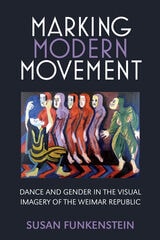
Imagine yourself in Weimar Germany: you are visually inundated with depictions of dance. Perusing a women’s magazine, you find photograph after photograph of leggy revue starlets, clad in sequins and feathers, coquettishly smiling at you. When you attend an art exhibition, you encounter Otto Dix’s six-foot-tall triptych Metropolis, featuring Charleston dancers in the latest luxurious fashions, or Emil Nolde’s watercolors of Mary Wigman, with their luminous blues and purples evoking her choreographies’ mystery and expressivity. Invited to the Bauhaus, you participate in the Metallic Festival, and witness the school’s transformation into a humorous, shiny, technological total work of art; you costume yourself by strapping a metal plate to your head, admire your reflection in the tin balls hanging from the ceiling, and dance the Bauhaus’ signature step in which you vigorously hop and stomp late into the night.
Yet behind the razzle dazzle of these depictions and experiences was one far more complex involving issues of gender and the body during a tumultuous period in history, Germany’s first democracy (1918-1933). Rather than mere titillation, the images copiously illustrated and analyzed in Marking Modern Movement illuminate how visual artists and dancers befriended one another and collaborated together. In many ways because of these bonds, artists and dancers forged a new path in which images revealed artists’ deep understanding of dance, their dynamic engagement with popular culture, and out of that, a possibility of representing women dancers as cultural authorities to be respected. Through six case studies, Marking Modern Movement explores how and why these complex dynamics occurred in ways specific to their historical moment.
Extensively illustrated and with color plates, Marking Modern Movement is a clearly written book accessible to general readers and undergraduates. Coming at a time of a growing number of major art museums showcasing large-scale exhibitions on images of dance, the audience exists for a substantial general-public interest in this topic. Conversing across German studies, art history, dance studies, gender studies, and popular culture studies, Marking Modern Movement is intended to engage readers coming from a wide range of perspectives and interests.
[more]
Money, Trains, and Guillotines
Art and Revolution in 1960s JapanWilliam Marotti
Duke University Press, 2013
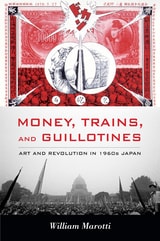
During the 1960s a group of young artists in Japan challenged official forms of politics and daily life through interventionist art practices. William Marotti situates this phenomenon in the historical and political contexts of Japan after the Second World War and the international activism of the 1960s. The Japanese government renewed its Cold War partnership with the United States in 1960, defeating protests against a new security treaty through parliamentary action and the use of riot police. Afterward, the government promoted a depoliticized everyday world of high growth and consumption, creating a sanitized national image to present in the Tokyo Olympics of 1964. Artists were first to challenge this new political mythology. Marotti examines their political art, and the state's aggressive response to it. He reveals the challenge mounted in projects such as Akasegawa Genpei's 1,000-yen prints, a group performance on the busy Yamanote train line, and a plan for a giant guillotine in the Imperial Plaza. Focusing on the annual Yomiuri Indépendant exhibition, he demonstrates how artists came together in a playful but powerful critical art, triggering judicial and police response. Money, Trains, and Guillotines expands our understanding of the role of art in the international 1960s, and of the dynamics of art and policing in Japan.
[more]