Results by title
70 books match the query 'Authority' and 4 start with m
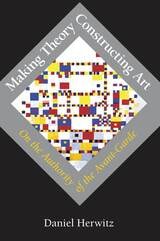
Making Theory/Constructing Art
On the Authority of the Avant-GardeDaniel Herwitz
University of Chicago Press, 1993
Artists and critics regularly enlist theory in the creation and assessment of artworks, but few have scrutinized the art theories themselves. Here, Daniel examines and critiques the norms, assumptions, historical conditions, and institutions that have framed the development and uses of art theory.
Spurred by the theoretical claims of Arthur Danto, a leader in the philosophy of the avant-garde, Herwitz reexamines the art and theory of major figures in the avant-garde movement including John Cage, Jean-François Lyotard, Jean Baudrillard, and Andy Warhol.
Spurred by the theoretical claims of Arthur Danto, a leader in the philosophy of the avant-garde, Herwitz reexamines the art and theory of major figures in the avant-garde movement including John Cage, Jean-François Lyotard, Jean Baudrillard, and Andy Warhol.
[more]
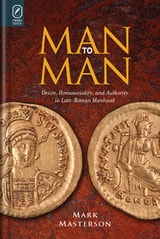
Man to Man
Desire, Homosociality, and Authority in Late-Roman ManhoodMark Masterson
The Ohio State University Press, 2014
In an analysis that promises to be controversial, Man to Man: Desire, Homosociality, and Authority in Late-Roman Manhood surveys the presence of same-sex desire between men in the later Roman empire. Most accounts of recent years have either noted that sexual desire between men was forbidden or they have ignored it. This book argues that desire between men was known and that it was a way to express friendship, patronage, solidarity, and other important relationships among elite males in late antiquity. The evocation of this desire and its possible attendant corporeal satisfactions made it a compelling metaphor for friendship. A man’s grandeur could also be portrayed metaphorically as sexual attractiveness, and the substantial status differences often seen in late antiquity could be ameliorated by a superior using amatory language to address an inferior.
At the same time, however, there was a marked ambivalence about same-sex desire and sexual behavior between men, and indeed same-sex sexual behavior was criminalized as it had never been before. While rejection and condemnation may seem to indicate a decisive distancing between authority and this desire and behavior, authority gained power from maintaining a relation to them. Demonstrating knowledge of the actual mechanics of sex between men suggested to a witness that there was nothing unknown to the authority making the demonstration: authority that knew of scandalous masculine sexual pleasure could project its power pretty much anywhere.
This startling dissonance between positive uses of same-sex desire between men and its criminalization in one and the same moment—a dissonance which recent discussions have been unable to address—requires further investigation, and this book supplies it.
[more]
Managing "Modernity"
Work, Community, and Authority in Late-Industrializing Japan and RussiaRudra Sil
University of Michigan Press, 2002
In Managing "Modernity," Rudra Sil examines how institution-builders respond to the competing influences of institutional models and inherited social legacies as they attempt to generate and sustain authority in late-industrializing societies. Through a historical and comparative study of large-scale enterprises in Japan and Russia, the book examines the impact of different institution-building strategies on managerial authority, invoking the experience of postwar Japan to highlight the benefits of a syncretic approach that selectively integrates adaptable features of borrowed institutions with portable norms inherited from preexisting communities.
Managing "Modernity" engages a variety of intellectual perspectives in the social sciences. The theoretical approach represents a conscious effort to overcome the contentious debates in political science and sociology among proponents of historical institutionalism, cultural analysis, and rational-choice theory. The substantive argument draws on, and partially integrates, concepts and findings from comparative politics, economic sociology, industrial relations, organization theory, business management, and the political economy of Japan and Russia.
In light of ongoing debates over the significance and impact of "globalization," the eclectic and integrative approach in Managing "Modernity" offers a fresh and provocative contribution that will interest scholars and graduate students across a variety of disciplines and subfields. It offers compelling insights to anyone generally concerned with the social forces that facilitate or hinder the diffusion of ideas and institutions across national boundaries.
Rudra Sil is Janice and Julian Bers Assistant Professor in the Social Sciences, Department of Political Science, University of Pennsylvania.
[more]
Models of Management
Work, Authority, and Organization in a Comparative PerspectiveMauro F. Guillén
University of Chicago Press, 1994
In this book, Mauro F. Guillén explores differing historical patterns in the adoption of the three major models of organizational management: scientific management, human relations, and structural analysis. Moving beyond Reinhard Bendix's classic Work and Authority, Models of Management takes a fresh look at how managers have used these models in four countries during the twentieth century.
Guillén's study of two liberal-democratic societies (the United States and Great Britain) and two corporatist societies (Germany and Spain) reveals significant differences in the way managerial elites and firms have adopted the three models. His data show that ideas themselves—independent of material interests and technology—can cause organizational change. Throughout the book, contrasts between modernist-technocratic and liberal-humanist mentalities, as well as between Protestant and Catholic religious backgrounds, emerge as decisive factors in determining managerial ideology and practice.
In addition to analyzing management methods in organizations, Guillén explores larger issues: the interaction among managerial, government, and labor elites; the impact of the state and the professions on managerial behavior; and the role that managers play in modern societies.
[more]