Results by title
208 books match the query 'Autobiography' and 7 start with m
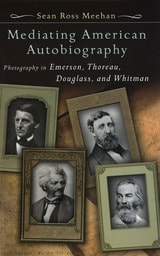
Mediating American Autobiography
Photography in Emerson, Thoreau, Douglass, and WhitmanSean Ross Meehan
University of Missouri Press, 2008
The emergence of photography in the mid-nineteenth century transformed ideas about how the self and nature could be pictured. Although the autobiographical potential of photography seems self-evident today, Sean Meehan takes us back to the birth of the medium when some of America’s preeminent authors began to think about photography’s implications for the representation of identity and the nature of autobiographical writing.
Both photography and autobiography involve a tension between disclosing and concealing their means of production: a chemical process for one, the writing process for the other. Meehan examines how four major authors—Ralph Waldo Emerson, Henry David Thoreau, Frederick Douglass, and Walt Whitman—were well aware of this tension and explored it in their work. By examining the implications of early photography in their writings, he shows how each engaged the new visual medium, how photography mediated their conceptions of self-representation, and how their appropriation of photographic thinking created a new kind of autobiography.
Examining the metonymic nature of photography, Meehan explores how the new medium influenced conceptions of visual and verbal representation. He intertwines these four writers’ reflections on photography—in Emerson’s Representative Men, Thoreau’s journals, Douglass’s narratives of slavery, and Whitman’s Specimen Days—with theories of photography as expounded by its inventors and observers, from Louis Daguerre and William Talbot in Europe to Oliver Wendell Holmes and Marcus Root in America.
As the first book to focus on the emergence of this new visual medium during the American Renaissance, Mediating American Autobiography shows us what photography means for American literature in general and for the genre most closely linked to it in particular. Because the engagement of these writers with photography has been neglected in previous scholarship, Meehan’s work provocatively bridges the study of two media and illuminates an important aspect of American thought and culture at the dawn of the technological era.
Memory and Narrative
The Weave of Life-WritingJames Olney
University of Chicago Press, 1998
"This is an elegant work of scholarship." —Jason Berry, Chicago Tribune
"Examines how the fascinating, reciprocal relationship between memory and narrative has evolved over the course of 17 centuries. . . . Olney's work is a valuable companion to his subjects' primary texts." —Booklist
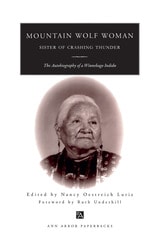
Mountain Wolf Woman, Sister of Crashing Thunder
The Autobiography of a Winnebago IndianEdited by Nancy Oestreich Lurie
University of Michigan Press, 1961
From pony to airplane, from medicine dance to Christian worship, Mountain Wolf Woman, Sister of Crashing Thunder is the life story of a Winnebago woman, told in her own words to her adopted kinswoman, Nancy Lurie. This retelling of more than seventy-five years of Native American life is both a candid and compelling account of how one woman lived through a period of cultural crisis.
Mountain Wolf Woman tells of her childhood in Wisconsin, her brief stay at a mission school, her marriage to "Bad Soldier," and her religious experiences with peyote. Her struggle to maintain her family against many hardships---odds that would have defeated a less vigorous and self-confident person---underscores her perseverance and tenacity. Whether she is describing her wanderings as a child or her misfortunes later in life, Mountain Wolf Woman sets forth her views in honest and perceptive terms, adding all the more power to her narrative.
This book is a valuable companion to the story of Mountain Wolf Woman's brother, immortalized by Paul Radin in Crashing Thunder, a classic of anthropological literature. It will also be of interest to those interested in ethnographic records, the role of women in native cultures, and Midwestern Native Americans, in general.
" . . . a superb human document."
---Chicago Sun-Times
" . . . one of those rare books . . . ."
---Saturday Review
". . . a notable contribution to the literature of culture change and culture and personality."
---American Anthropologist
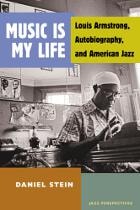
Music Is My Life
Louis Armstrong, Autobiography, and American JazzDaniel Stein
University of Michigan Press, 2012
Music Is My Life is the first comprehensive analysis of Louis Armstrong's autobiographical writings (including his books, essays, and letters) and their relation to his musical and visual performances. Combining approaches from autobiography theory, literary criticism, intermedia studies, cultural history, and musicology, Daniel Stein reconstructs Armstrong's performances of his life story across various media and for different audiences, complicating the monolithic and hagiographic views of the musician.
The book will appeal to academic readers with an interest in African American studies, jazz studies, musicology, and popular culture, as well as general readers interested in Armstrong's life and music, jazz, and twentieth-century entertainment. While not a biography, it provides a key to understanding Armstrong's oeuvre as well as his complicated place in American history and twentieth-century media culture.
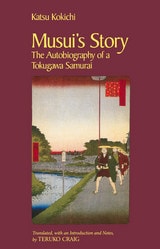
Musui's Story
The Autobiography of a Tokugawa SamuraiKokichi Katsu; Translated by Teruko Craig
University of Arizona Press, 1988
From childhood, Katsu was given to mischief. He ran away from home, once at thirteen, making his way as a beggar on the great trunk road between Edo and Kyoto, and again at twenty, posing as the emissary of a feudal lord. He eventually married and had children but never obtained official preferment and was forced to supplement a meager stipend by dealing in swords, selling protection to shopkeepers, and generally using his muscle and wits.
Katsu's descriptions of loyalty and kindness, greed and deception, vanity and superstition offer an intimate view of daily life in nineteenth-century Japan unavailable in standard history books. Musui's Story will delight not only students of Japan's past but also general readers who will be entranced by Katsu's candor and boundless zest for life.
My Life in Vaudeville
The Autobiography of Ed LowryEd Lowry, Edited by Paul M. Levitt
Southern Illinois University Press, 2011
Normal0falsefalsefalseEN-USX-NONEX-NONE
An entertaining record of a life and a time
Ed Lowry joined the vaudeville circuit in 1910 at the age of fourteen. He never achieved stardom equal to the likes of Fred Allen, Jack Benny, George Burns, Buster Keaton, or Eddie Cantor, and he never considered himself an “artiste.” Instead, he saw himself as a hoofer and comic simply trying to make a living on the vaude scene. My Life in Vaudeville recounts Lowry’s long career in entertainment from the viewpoint of a foot soldier with a big dream.
Lowry’s story begins in the heyday of vaudeville in the early twentieth century and follows its gradual decline. Unlike many of his associates, he recognized that movies and other forms of entertainment were the future, and thus branched out into other venues. He took gigs in radio in Philadelphia, Newark, New York, and Los Angeles; explored revues, cabarets, burlesque, and film; and organized USO road shows. With wit and perception, he reveals his stage roots as an entertainer playing to his audience, and editor Paul M. Levitt’s introduction beautifully sets the stage for Lowry’s gags-to-riches tale, providing much-needed historical perspective.
My Life in Vaudeville is an unpretentious record of a time when thousands of young people went into show business to escape the boredom of daily life, and Lowry’s story is a view of vaudeville not often encountered. Lowry does much more than recall the daily life of a working actor, musician, and comedian. His story brings vaudeville to life and places it within the larger narratives of popular culture and popular entertainment of the twentieth century.
My Lord, What a Morning
An AutobiographyMarian Anderson
University of Illinois Press, 2002
My Lord, What a Morning is a gentle and engrossing memoir, abounding with the tender and inspiring stories of Marian Anderson's life in her own modest words. From her humble but proud beginnings in south Philadelphia to international vocal renown, the legendary contralto writes of triumph and adversity, of being grounded in faith and surrounded by family, and of the music that shaped her career.
Anderson published My Lord, What a Morning in 1956 on the heels of her groundbreaking role as the first African American to perform at the Metropolitan Opera. In it are bittersweet reminiscences of a working-class childhood, from her first job scrubbing the neighbors' steps to the sorrow and upheaval of her father's untimely death. Here are the stories of a young girl with prodigious talent and her warm remembrances of the teachers, managers, friends, accompanists, and fans who worked to foster it. In addition, she provides a veritable travelogue of her concerts across the globe and rare glimpses at the personal life of a woman more concerned with family than celebrity.
With eleven photographs and a touching new foreword by Anderson's nephew, famed conductor and poet James DePreist, this edition of My Lord, What a Morning revives the classic portrait of a musical legend who was resilient in the bullying face of bigotry and gracious in the unfaltering glow of fame.