Results by title
53 books match the query 'Capital punishment' and 3 start with m
Murder and Its Consequences
Essays on Capital Punishment in AmericaLeigh B Bienen
Northwestern University Press, 2010
The essays in Murder and Its Consequences span several periods in the history of capital punishment in America and the professional career of Leigh Bienen, a leading researcher on the death penalty. “A Good Murder” describes the subtle relationship between high-profile murders and the death penalty, while “The Proportionality Review of Capital Cases” places the well-known study of proportionality in New Jersey within a nationwide context.
“Anomalies” suggests that the arcane protocols written for lethal injection have little to do with insuring humane executions, but rather are concerned with protecting the sensibilities of witnesses and the liability of corrections officials. Other essays address the groundbreaking developments surrounding the death penalty in Illinois, and take a retrospective look at the evolution of her own and the country’s thinking about this complex, divisive topic.
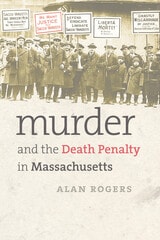
Murder and the Death Penalty in Massachusetts
Alan Rogers
University of Massachusetts Press, 2008
For more than 300 years Massachusetts executed men and women convicted of murder, but with a sharp eye on “due proceeding” and against the backdrop of popular ambivalence about the death penalty's morality, cruelty, efficacy, and constitutionality. In this authoritative book, Alan Rogers offers a comprehensive account of how the efforts of reformers and abolitionists and the Supreme Judicial Court's commitment to the rule of law ultimately converged to end the death penalty in Massachusetts.
In the seventeenth century, Governor John Winthrop and the Massachusetts General Court understood murder to be a sin and a threat to the colony's well-being, but the Puritans also drastically reduced the crimes for which death was the prescribed penalty and expanded a capital defendant's rights. Following the Revolution, Americans denounced the death penalty as “British and brutish” and the state's Supreme Judicial Court embraced its role as protector of the rights extended to all men by the Massachusetts Constitution. In the 1830s popular opposition nearly stopped the machinery of death and a vote in the Massachusetts House fell just short of abolishing capital punishment.
A post–Civil War effort extending civil rights to all men also stimulated significant changes in criminal procedure. A “monster petition” begging the governor to spare the life of a murderer convicted on slight circumstantial evidence and the grim prospect of executing nine Chinese men found guilty of murder fueled a passionate debate about the death penalty in the decade before World War I.
The trials and executions of Sacco and Vanzetti focused unwanted international and national attention on Massachusetts. This was a turning point. Sara Ehrmann took charge of the newly formed Massachusetts Council Against the Death Penalty, relentlessly lobbied the legislature, and convinced a string of governors not to sign death warrants. In the 1970s the focus shifted to the courts, and eventually, in 1980, the Supreme Judicial Court abolished the death penalty on the grounds that it violated the Massachusetts Constitution.
Murder on the Mountain
Crime, Passion, and Punishment in Gilded Age New JerseyPeter J. Wosh
Rutgers University Press, 2022
Was Margaret the calculating murderess and adulteress portrayed by the press? Or was she a battered wife pushed to the edge? Or was she, as she claimed to the end, innocent? Murder on the Mountain considers all sides of this fascinating and mysterious true crime story. In turn, it examines why this murder trial became front-page news, as it resonated with public discussions about capital punishment, mental health, anti-immigrant sentiment, domestic violence, and women’s independence. This is a gripping and thought-provoking study of a murder that shocked the nation.