Results by title
165 books match the query 'Caribbean Area' and 6 start with m
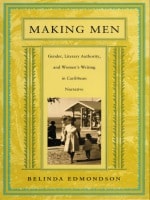
Making Men
Gender, Literary Authority, and Women’s Writing in Caribbean NarrativeBelinda Edmondson
Duke University Press, 1998
Discussing the canonical Caribbean narrative as it reflects national identity under the domination of English cultural authority, Belinda Edmondson focuses particularly on the pervasive influence of Victorian sensibilities in the structuring of twentieth-century national identity. She shows that issues of race and English constructions of masculinity not only are central to West Indian identity but also connect Caribbean authorship to the English literary tradition. This perspective on the origins of West Indian literary nationalism then informs Edmondson’s search for female subjectivity in current literature by West Indian women immigrants in America. Making Men compares the intellectual exile of men with the economic migration of women, linking the canonical male tradition to the writing of modern West Indian women and exploring how the latter write within and against the historical male paradigm in the continuing process of national definition.
With theoretical claims that invite new discourse on English, Caribbean, and American ideas of exile, migration, race, gender identity, and literary authority, Making Men will be informative reading for those involved with postcolonial theory, African American and women’s studies, and Caribbean literature.

Masking And Power
Carnival And Popular Culture In The CaribbeanGerard Aching
University of Minnesota Press, 2002
An ambitious reassessment of the political uses of masking.
Does the mask reveal more than it conceals? What, this book asks, becomes visible and invisible in the masking practiced in Caribbean cultures-not only in the familiar milieu of the carnival but in political language, social conduct, and cultural expressions that mimic, misrepresent, and mislead? Focusing on masking as a socially significant practice in Caribbean cultures, Gerard Aching’s analysis articulates masking, mimicry, and misrecognition as a means of describing and interrogating strategies of visibility and invisibility in Cuba, Trinidad and Tobago, Martinique, and beyond.
Masking and Power uses ethnographic fieldwork, psychoanalysis, and close literary readings to examine encounters between cultural insiders as these locals mask themselves and one another either to counter the social invisibility imposed on them or to maintain their socioeconomic privileges. Aching exposes the ways in which strategies of masking and mimicry, once employed to negotiate subjectivities within colonial regimes, have been appropriated for state purposes and have become, with the arrival of self-government in the islands, the means by which certain privileged locals make a show of national and cultural unity even as they engage in the privatization of popular culture and its public performances.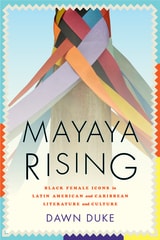
Mayaya Rising
Black Female Icons in Latin American and Caribbean Literature and CultureDawn Duke
Bucknell University Press, 2023
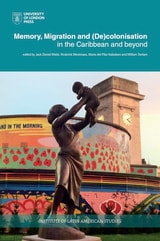
Memory, migration and (de)colonisation in the Caribbean and beyond
Edited by Jack Daniel Webb, Roderick Westmaas, Maria del Pilar Kaladeen, and William Tantam
University of London Press, 2019
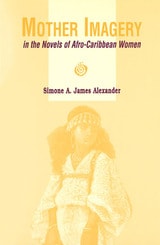
Mother Imagery in the Novels of Afro-Caribbean Women
Simone A. James Alexander
University of Missouri Press, 2000
Focusing on specific texts by Jamaica Kincaid, Maryse Condé, and Paule Marshall, this fascinating study explores the intricate trichotomous relationship between the mother (biological or surrogate), the motherlands Africa and the Caribbean, and the mothercountry represented by England, France, and/or North America. The mother-daughter relationships in the works discussed address the complex, conflicting notions of motherhood that exist within this trichotomy. Although mothering is usually socialized as a welcoming, nurturing notion, Alexander argues that alongside this nurturing notion there exists much conflict. Specifically, she argues that the mother-daughter relationship, plagued with ambivalence, is often further conflicted by colonialism or colonial intervention from the "other," the colonial mothercountry.
Mother Imagery in the Novels of Afro-Caribbean Women offers an overview of Caribbean women's writings from the 1990s, focusing on the personal relationships these three authors have had with their mothers and/or motherlands to highlight links, despite social, cultural, geographical, and political differences, among Afro-Caribbean women and their writings. Alexander traces acts of resistance, which facilitate the (re)writing/righting of the literary canon and the conception of a "newly created genre" and a "womanist" tradition through fictional narratives with autobiographical components.
Exploring the complex and ambiguous mother-daughter relationship, she examines the connection between the mother and the mother's land. In addition, Alexander addresses the ways in which the absence of a mother can send an individual on a desperate quest for selfhood and a home space. This quest forces and forges the creation of an imagined homeland and the re-validation of "old ways and cultures" preserved by the mother. Creating such an imagined homeland enables the individual to acquire "wholeness," which permits a spiritual return to the motherland, Africa via the Caribbean. This spiritual return or homecoming, through the living and practicing of the old culture, makes possible the acceptance and celebration of the mother's land.
Alexander concludes that the mothers created by these authors are the source of diasporic connections and continuities. Writing/righting black women's histories as Kincaid, Condé, and Marshall have done provides a clearing, a space, a mother's land, for black women. Mother Imagery in the Novels of Afro-Caribbean Women will be of great interest to all teachers and students of women's studies, African American studies, Caribbean literature, and diasporic literatures.
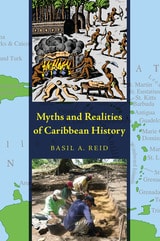
Myths and Realities of Caribbean History
Basil A. Reid
University of Alabama Press, 2009
This book seeks to debunk eleven popular and prevalent myths about Caribbean history. Using archaeological evidence, it corrects many previous misconceptions promulgated by history books and oral tradition as they specifically relate to the pre-Colonial and European-contact periods. It informs popular audiences, as well as scholars, about the current state of archaeological/historical research in the Caribbean Basin and asserts the value of that research in fostering a better understanding of the region’s past.
Contrary to popular belief, the history of the Caribbean did not begin with the arrival of Europeans in 1492. It actually started 7,000 years ago with the infusion of Archaic groups from South America and the successive migrations of other peoples from Central America for about 2,000 years thereafter. In addition to discussing this rich cultural diversity of the Antillean past, Myths and Realities of Caribbean History debates the misuse of terms such as "Arawak" and "Ciboneys," and the validity of Carib cannibalism allegations.