99 books match the query 'Censorship' and 5 start with m
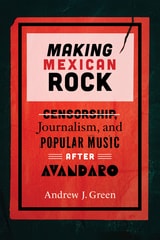
cover of Making Mexican Rock: Censorship, Journalism, and Popular Music after Avándaro

Making Mexican Rock

Censorship, Journalism, and Popular Music after Avándaro

Andrew J. Green

Vanderbilt University Press, 2024

The history of Mexican rock is one of censorship. A number of cultural histories recount how rock was repressed, censored, and marginalized by Mexico’s single-party regime in the twentieth century, often focusing on the authoritarian crackdown that followed a mediatized moral panic after the Avándaro Festival of 1971. The popular 2020 Netflix documentary Break It All, for example, positions Mexican rock as a potent expression of resistance in the late twentieth century, forging a strong association with Mexico’s transition away from authoritarian rule and toward neoliberal democracy.

Yet in light of the failures of successive democratically elected governments in Mexico, these histories are worth critically revisiting and updating. What stories about music censorship can be told after Mexico’s transition to multi-party democracy? Placing history and ethnography into dialogue, Making Mexican Rock explores historical and recent experiences of censorship and repression against popular music, focusing on the independent rock scene (or “escena independiente”) in Mexico City.

Informed by the so-called new censorship theory, ethnomusicologist Andrew J. Green challenges historical accounts that equate acts of censorship with state activity. The open-ended account of censorship assumed here helps us to understand, instead, how conceptions of censorship and expressive freedom transformed toward the end of single-party rule; how practices of policing live rock adapted to neoliberal securitization; and how histories of rock censorship have been invoked by those seeking to construct and protect emergent music scenes. Making Mexican Rock thus both decenters histories of music censorship from the state, and extends them into the country’s recent history.
[more]
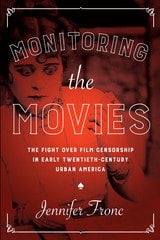
cover of Monitoring the Movies: The Fight over Film Censorship in Early Twentieth-Century Urban America

Monitoring the Movies

The Fight over Film Censorship in Early Twentieth-Century Urban America

By Jennifer Fronc

University of Texas Press, 2017

As movies took the country by storm in the early twentieth century, Americans argued fiercely about whether municipal or state authorities should step in to control what people could watch when they went to movie theaters, which seemed to be springing up on every corner. Many who opposed the governmental regulation of film conceded that some entity—boards populated by trusted civic leaders, for example—needed to safeguard the public good. The National Board of Review of Motion Pictures (NB), a civic group founded in New York City in 1909, emerged as a national cultural chaperon well suited to protect this emerging form of expression from state incursions.

Using the National Board’s extensive files, Monitoring the Movies offers the first full-length study of the NB and its campaign against motion-picture censorship. Jennifer Fronc traces the NB’s Progressive-era founding in New York; its evolving set of “standards” for directors, producers, municipal officers, and citizens; its “city plan,” which called on citizens to report screenings of condemned movies to local officials; and the spread of the NB’s influence into the urban South. Ultimately, Monitoring the Movies shows how Americans grappled with the issues that arose alongside the powerful new medium of film: the extent of the right to produce and consume images and the proper scope of government control over what citizens can see and show.
[more]
cover of Movies, Censorship, and the Law

Movies, Censorship, and the Law

Ira H. Carmen

University of Michigan Press, 1966
Who decides what movies we should see? In some of the nation's largest cities motion pictures are screened by review boards meeting in secret. Their files are seldom open to inspection, and they often wield a nearly absolute power over what the public is shown.This is the story of motion-picture censorship in America. It begins in 1915 when the Supreme Court denied freedom of the press to movies. In a fast-moving account of court cases and behind-the-scenes skirmishes, Ira Carmen follows the history of movie censorship to the present day. He shows how very recent court decisions reflect new thinking on censorship and the nature of obscenity.Today, forty-seven states and countless cities and towns have obscenity laws on their statute books. Are the censors stout guardians of the public morality . . . or witch-hunters? In a series of dramatic interviews with film censors in major cities, Carmen captures the flavor of the struggle between censor and exhibitor. The interviews reveal how censors think—what kinds of films they suppress and for what reasons, how they feel about foreign films as opposed to American, how they are influenced by court decisions, and how well they abide by those decisions.This pioneering book reveals what effect court decisions really have at the grassroots level. It examines the role of the constitution in the censorship debate and asks how effective the American political and judicial systems have been in coping with the problem. Finally, it offers a challenging analysis of what kind of censorship, if any, is needed in a free society.
[more]
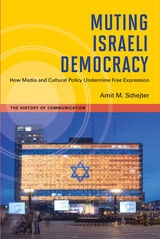
cover of Muting Israeli Democracy: How Media and Cultural Policy Undermine Free Expression

Muting Israeli Democracy

How Media and Cultural Policy Undermine Free Expression

Amit M. Schejter

University of Illinois Press, 2009
The result of years of critical analysis of Israeli media law, this book argues that the laws governing Israeli electronic media are structured to limit the boundaries of public discourse. Amit M. Schejter posits the theory of a "mute democracy," one in which the media are designed to provide a platform for some voices to be heard over others. While Israel's institutions may be democratic, and while the effect of these policies may be limited, this book contends that free speech in Israel is institutionally muted to ensure the continued domination of the Jewish majority and its preferred interpretation of what Israel means as a Jewish-democratic state. Analyzing a wide range of legal documents recorded in Israel from 1961 to 2007, Muting Israeli Democracy demonstrates in scrupulous detail how law and policy are used to promote the hegemonic national culture through the constraints and obligations set on electronic media.
[more]
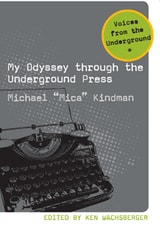
cover of My Odyssey Through the Underground Press

My Odyssey Through the Underground Press

Michael Kindman

Michigan State University Press, 2011

In 1963, Michigan State University, the nation’s first land grant college, attracted a record number of National Merit Scholars by offering competitive scholarships. One of these exceptional students was Michael Kindman. After the beginning of the Free Speech Movement in Berkeley, Kindman, in line to be editor-in-chief of the official MSU student newspaper, felt compelled to seek a more radical forum of intellectual debate. In 1965, he dropped out of school and founded The Paper, one of the first five members of Underground Press Syndicate. This gripping autobiography follows Kindman’s inspiring journey of self-discovery, from MSU to Boston, where he joined the staff of Avatar, unaware that the large commune that controlled the paper was a charismatic cult. Five years later, he fled the commune’s outpost in Kansas and headed to San Francisco, where he came out as a gay man, changed his name to Mica, and continued his work as an activist and visionary.
[more]