50 books match the query 'Child' and 8 start with m
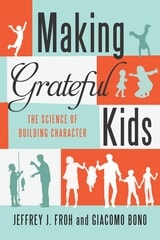
cover of Making Grateful Kids: The Science of Building Character

Making Grateful Kids

The Science of Building Character

Jeffrey Froh

Templeton Press, 2014

If there was a new wonder drug on the market that got kids to behave better, improve their grades, feel happier, and avoid risky behaviors, many parents around the world would be willing to empty their bank accounts to acquire it. Amazingly, such a product actually does exist. It’s not regulated by the FDA, it has no ill side-effects, and it’s absolutely free and avail­able to anyone at any time. This miracle cure is gratitude.

Over the past decade, science has shown that gratitude is one of the most valuable and important emotions we possess, and it is a virtue that anyone can cultivate. In fact, researchers have developed many different methods people can use to foster an attitude of gratitude, and the science shows that many of them really work.

In Making Grateful Kids, two of the leading authorities on gratitude among young people, Jeffrey J. Froh and Giacomo Bono, introduce their latest and most compelling research, announce groundbreaking findings, and share real-life stories from adults and youth to show parents, teachers, mentors, and kids themselves how to achieve greater life satisfaction through gratitude. Most importantly perhaps, they expand on this groundbreaking research to offer practical and effec­tive common-sense plans that can be used in day-to-day interactions between kids and adults to enhance success and wellbeing.

Their unique, scientifically-based approach for producing grateful youth works whether these kids are very young ele­mentary school students or troubled teenagers. Not only does the purposeful practice of gratitude increase their happiness, but the research indicates that grateful kids also report more self-discipline, fulfilling relationships, and engagement with their schools and communities when compared to their less grateful counterparts. After reading Making Grateful Kids, parents, teachers, and anyone who works with youth will be able to connect more mean­ingfully with kids so that all parties can focus on the things that matter most and, in turn, create a more cooperative and thriving society.


[more]
cover of Matters of Significance: Replication, Translation and Academic Freedom in developmental science

Matters of Significance

Replication, Translation and Academic Freedom in developmental science

Marinus H. van IJzendoorn and Marian J. Bakermans-Kranenburg

University College London, 2024

A thorough examination of field-shaping research on attachment that serves as a valuable resource for understanding child developmental science and ethically applying its insights in practice.

Application of scientific findings to effective practice and informed policymaking is an aspiration for much research in the biomedical, behavioral, and developmental sciences. But too often translations of science to practice are conceptually narrow and developed quickly as salves to an urgent problem. For developmental science, widely implemented parenting interventions are prime examples of technical translations from knowledge about the causes of children’s mental distress. Aiming to support family relationships and facilitate adaptive child development, these programs are rushed through when the scientific findings on which they are based remain contested and without enough evidence of success from randomized controlled trials.

In Matters of Significance, the authors draw on forty years of experience with theoretical, empirical, meta-analytic, and translational work in child development research to highlight the complex relations between replication, translation, and academic freedom. They argue that challenging fake facts promulgated by under-replicated and underpowered studies is also a method of translation. Such a challenge can, in the highlighted field of attachment and emotion regulation research, bust popular myths about the decisive role of genes, hormones, or the brain on parenting and child development, with a balancing impact on practice and policy making. The authors argue that academic freedom from interference by pressure groups, stakeholders, funders, or university administrators in the core stages of research is a necessary but besieged condition for adversarial research and myth-busting.

 
[more]
cover of Minnesota Symposia on Child Psychology: Volume 1

Minnesota Symposia on Child Psychology

Volume 1

John Hill

University of Minnesota Press, 1968

Minnesota Symposia on Child Psychology: Volume 1 was first published in 1968.This volume introduces a series which will make available in book form the papers given at the annual symposia on child psychology sponsored by the Institute of Child Development at the University of Minnesota. Each volume will present the papers from one symposium. For each symposium a number of outstanding child psychologists are invited to present papers dealing with their own programs of research. Each participant is given the opportunity of summarizing and integrating the findings of several studies and discussing the conceptual framework or rationale for the series of studies.This volume, based on the program of the 1966 symposium, includes six papers by nine contributors: Jacob L. Gewirtz, Robert D. Hess, Virginia C. Shipman, E. Mavis Hetherington, O. Ivar Lovaas, Patrick Suppes, Lester Hyman, Max Jerman, and Burton L. White. The papers reflect current research trends in both child psychology and psychology in general, including discussions of the socialization of the child in the culture of poverty (Hess and Shipman); extensions in behavior theory based on the study of children (Gewirtz); the application of behavior theory to clinical intervention (Lovaas); the role of imitation in human learning (Lovaas, Hetherington); the use of computers in instruction and basic research (Suppes, et al.); environmental influences on cognitive processes (White, Hess and Shipman, Suppes, et al.); infant development (White); parental influences in socialization (Hetherington, Hess); and the clarification of stimulus functions (Gewirtz, Lovaas, White).
[more]
cover of Minnesota Symposia on Child Psychology: Volume 2

Minnesota Symposia on Child Psychology

Volume 2

John Hill

University of Minnesota Press, 1969

Minnesota Symposia on Child Psychology: Volume 2 was first published in 1969.This is the second volume in the series which is based on papers from the annual Minnesota Symposia on Child Psychology, sponsored by the Institute of Child Development at the University of Minnesota. Volume 2 presents material from five papers given at the 1967 symposium. For each symposium a number of outstanding child psychologists are invited to give papers dealing with their own programs of research. Each participant is provided with the opportunity of summarizing and integrating the findings of several studies and discussing the conceptual framework or rationale for the series of studies.This volume includes five papers ten contributors: “Stable Patterns of Behavior: The Significance of Enduring Orientations for Personality Development” by Wanda C. Bronson; “The Child’s Grammar from I to III” by Roger Brown, Courtney Cazden, and Ursula Bellugi-Klima; “A New APPROACH to Behavioral Ecology” by Bettye M. Caldwell; “Effects of Cognition on Perception: A Problem and a Paradigm for Developmental Study” by Maurice Hershenson; and “Cross-Cultural Longitudinal Research on Child Development: Studies of American and Mexican Schoolchildren” by Wayne H. Holtzman, Rogelio Diaz-Guerrero, Jon D. Swartz, and Luis Lara Tapia.
[more]
cover of Minnesota Symposia on Child Psychology: Volume 3

Minnesota Symposia on Child Psychology

Volume 3

John Hill

University of Minnesota Press, 1969

Minnesota Symposia on Child Psychology: Volume 3 was first published in 1969.This is the third volume in the series which is based on papers from the annual Minnesota Symposia on Child Psychology, sponsored by the Institute of Child Development at the University of Minnesota. The material in this volume is based on six papers presented at the 1968 symposium. For each symposium a number of outstanding child psychologists are invited to give papers dealing with their respective programs of research.The contents of this volume are: “Effects of Stimulus Familiarization on Child Behavior” by Gordon N. Cantor, University of Iowa; “Animal Studies of Early Experience: Some Principles Which Have Implication for Human Development” by Victor H. Denenberg, University of Connecticut; “Early Stimulation and Cognitive Development” by Wendell E. Jeffrey, University of California, Los Angeles; “The Development of Stimulus Selection” by Eleanor E. Maccoby, Stanford University; “Adolescent Attitudes and Behavior in Their Reference Groups within Differing Sociocultural Settings” by Muzafer Sherif and Carolyn W. Sherif, both of Pennsylvania State University; “Modeling and Reactive Components of Sibling Interaction” by Brian Sutton-Smith, Teachers College, Columbia University, and B.G. Rosenberg, Bowling Green State University. John P. Hill, the editor, comments on each of the papers in a preface.
[more]
cover of Minnesota Symposia on Child Psychology: Volume 4

Minnesota Symposia on Child Psychology

Volume 4

John Hill

University of Minnesota Press, 1970

Minnesota Symposia on Child Psychology: Volume 4 was first published in 1970.This is the fourth volume in a series which is based on papers from the annual Minnesota Symposia on Child Psychology, sponsored by the Institute of Child Development at the University of Minnesota. The basis for this book is the material from the 1969 symposium. For each symposium a number of outstanding child psychologists are invited to give papers dealing with their respective programs of research.This volume contains six papers by eight contributors: “The Effects of Early Life Experiences on Developmental Processes and Susceptibility to Disease in Animals” by Robert Ader, University of Rochester Medical Center; “The Antecedents and Adult Correlates of Academic and Intellectual Achievement Effort” by Virginia C. Crandall and Esther S. Battle, Fels Research Institute; “The Role of Peer-Group Experience in Moral Development” by Edward C. Devereux, Jr., Cornell University; “The Development of Motor Skills and Social Relationships among Primates through Play” by Phyllis Jay Dolhinow and Naomi Bishop, University of California, Berkeley; “Systems of Perceptual and Perceptual-Motor Development” by Herbert L. Pick, Jr., University of Minnesota; and “Mental Elaboration and Proficient Learning” by William D. Rohwer, Jr., University of California, Berkeley.
[more]
cover of Minnesota Symposia on Child Psychology: Volume 5

Minnesota Symposia on Child Psychology

Volume 5

John Hill

University of Minnesota Press, 1971
Minnesota Symposia on Child Psychology: Volume 5 was first published in 1971.This volume, like the previous volumes in this series, is based on the papers given at an annual Minnesota Symposium on Child Psychology sponsored by the Institute of Child Development at the University of Minnesota. The content of this book is based on the papers of the 1970 symposium. For each symposium a number of outstanding child psychologists are invited to present papers dealing with their respective programs of research.Six papers by ten contributors are published here: “The Role of Modalities in Perceptual Cognitive Development” by Jacqueline J. Goodnow, George Washington University; “Hypnosis and Childlikeness” by Ernest R. Hilgard, Stanford University; “Explorations into Patterns of Mental Development and Prediction from the Bayley Scales of Infant Development” by Jane V. Hunt and Nancy Bayley, both of the University of California, Berkeley; “A Dyadic Analysis of ‘Aggressive’ Behaviors” by Gerald R. Patterson and J. A. Cobb, both of the Oregon Research Institute; “Development of Hierarchical, Configurational Conceptual Models for Parent Behavior and Child Behavior” by Earl S. Schaefer, National Institute of Mental Health; and “Some Aspects of the Development of Space Perception” by Seymour Wapner, Leonard Cirillo, and A. Harvey Baker, all of Clark University.
[more]
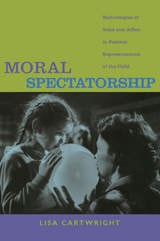
cover of Moral Spectatorship: Technologies of Voice and Affect in Postwar Representations of the Child

Moral Spectatorship

Technologies of Voice and Affect in Postwar Representations of the Child

Lisa Cartwright

Duke University Press, 2008

Why were theories of affect, intersubjectivity, and object relations bypassed in favor of a Lacanian linguistically oriented psychoanalysis in feminist film theory in the 1980s and 1990s? In Moral Spectatorship, Lisa Cartwright rethinks the politics of spectatorship in film studies. Returning to impasses reached in late-twentieth-century psychoanalytic film theory, she focuses attention on theories of affect and object relations seldom addressed during that period. Cartwright offers a new theory of spectatorship and the human subject that takes into account intersubjective and affective relationships and technologies facilitating human agency. Seeking to expand concepts of representation beyond the visual, she develops her theory through interpretations of two contexts in which adult caregivers help bring children to voice. She considers several social-problem melodramas about deaf and nonverbal girls and young women, including Johnny Belinda, The Miracle Worker, and Children of a Lesser God. Cartwright also analyzes the controversies surrounding facilitated communication, a technological practice in which caregivers help children with communication disorders achieve “voice” through writing facilitated by computers. This practice has inspired contempt among professionals and lay people who charge that the facilitator can manipulate the child’s speech.

For more than two decades, film theory has been dominated by a model of identification tacitly based on the idea of feeling what the other feels or of imagining oneself to be the other. Building on the theories of affect and identification developed by André Green, Melanie Klein, Donald W. Winnicott, and Silvan Tomkins, Cartwright develops a model of spectatorship that takes into account and provides a way of critically analyzing the dynamics of a different kind of identification, one that is empathetic and highly intersubjective.

[more]