Results by title
152 books match the query 'Childhood and youth' and 12 start with m
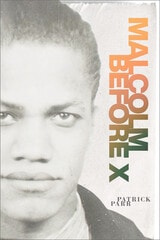
Malcolm Before X
Patrick Parr
University of Massachusetts Press, 2024
A Kirkus Reviews Best Nonfiction Book of 2024
A Spectator Best Book of the Year
Finalist for the 2025 ASALH Book Prize
Drawing upon interviews, correspondence, and nearly 2000 pages of never-before-used prison records, Malcolm Before X is the definitive examination of the prison years of civil rights icon Malcolm X.
In February 1946, when 20-year-old Malcolm Little was sentenced to eight to ten years in a maximum-security prison, he was a petty criminal and street hustler in Boston. By the time he was paroled in August 1952, he had transformed into a voracious reader, joined the Black Muslims, and was poised to become Malcolm X, one of the most prominent and important intellectuals of the civil rights era. While scholars and commentators have exhaustively detailed, analyzed, and debated Malcolm X’s post-prison life, they have not explored these six and a half transformative years in any depth.
Paying particular attention to his time in prison, Patrick Parr’s Malcolm Before X provides a comprehensive and groundbreaking examination of the first twenty-seven years of Malcolm X’s life (1925–1965). Parr traces Malcolm’s African lineage, explores his complicated childhood in the Midwest, and follows him as he moves east to live with his sister Ella in Boston’s Roxbury neighborhood, where he is convicted of burglary and sentenced.
Parr utilizes a trove of previously overlooked documents that include prison files and prison newspapers to immerse the reader into the unique cultures—at times brutal and at times instructional—of Charlestown State Prison, the Concord Reformatory, and the Norfolk Prison Colony. It was at these institutions that Malcolm devoured books, composed poetry, boxed, debated, and joined the Nation of Islam, changing the course of his life and setting the stage for a decade of antiracist activism that would fundamentally reshape American culture.
In this meticulously researched and beautifully written biography, the inspiring story of how Malcolm Little became Malcolm X is finally told.
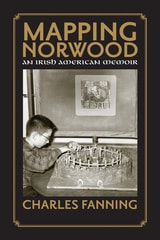
Mapping Norwood
An Irish-American MemoirCharles Fanning
University of Massachusetts Press, 2010
This memoir is an act of map making, of plotting out overlapping territories—topographical, temporal, and psychological. Centered on family life in a Massachusetts town from the 1920s to the 1960s, the author's investigation extends outward to include the Boston area from colonial times to the recent past, encounters with Boston's Museum of Fine Arts and with Harvard College, the American Civil War, and Ireland and Germany in the nineteenth century.
Charles Fanning re-creates the landscape of childhood and adolescence in a place and time both ordinary and rich with possibility. An expert on Irish immigration, he was born and raised in Norwood, Massachusetts, twelve miles outside of Boston, where Yankee and Irish cultures bumped against each other. The narrative traces his personal growth, shaped by family, school, baseball, radio drama, and art. He was the first in his family to attend college, and the book ends with his undergraduate experience at Harvard, class of 1964.
Along with this coming-of-age story, Mapping Norwood features forays back in time, including chapters on each of Fanning's parents and historical excavations and meditations on three ancestors. Guided by his own experience as a scholar, the pressure of these chapters is epistemological—the thrill of the hunt toward knowing. Fanning's great-grandfather, John Fanning, disappeared from the family in the late 1880s, and a chapter chronicles the discovery of “Walking John's” fifty years of hidden later life in East St. Louis, Illinois, where he died alone in 1946. Fanning's great-great-grandfather, Winslow Radcliffe, was a veteran of the 35th Massachusetts Infantry in the Civil War, and the author traces this regiment through the horrors of Antietam and Fredericksburg, by means of diaries and letters by four men from Winslow's company. The evidence gleaned helps explain Winslow's suicide after the war. An Irish immigrant ancestor, Phillip Fanning, came to Boston from County Monaghan just after the Great Famine of the late 1840s. Relying on historical research, Fanning imagines vividly the lives led by Phillip's family and thousands like them in the wake of Ireland's nineteenth-century catastrophe.
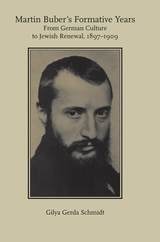
Martin Buber's Formative Years
From German Culture to Jewish Renewal, 1897–1909Gilya Gerda Schmidt
University of Alabama Press, 1995
Martin Buber (1878–1965) has had a tremendous impact on the development of Jewish thought as a highly influential figure in 20th-century philosophy and theology. However, most of his key publications appeared during the last forty years of his life and little is known of the formative period in which he was searching for, and finding, the answers to crucial dilemmas affecting Jews and Germans alike. Now available in paperback, Martin Buber’s Formative Years illuminates this critical period in which the seeds were planted for all of his subsequent work.
During the period from 1897 to 1909, Buber's keen sense of the crisis of humanity, his intimate knowledge of German culture and Jewish sources, and his fearlessness in the face of possible ridicule challenged him to behave in a manner so outrageous and so contrary to German-Jewish tradition that he actually achieved a transformation of himself and those close to him. Calling on spiritual giants of great historical periods in German, Christian, and Jewish history—such as Nicolas of Cusa, Jakob Boehme, Israel Baal Shem Tov, Rabbi Nachman of Brazlav, Johann Wolfgang von Goethe, and Friedrich Nietzsche—Buber proceeded to subvert the existing order by turning his upside-down world of slave morality right side up once more.
By examining the multitude of disparate sources that Buber turned to for inspiration, Gilya Gerda Schmidt elucidates Buber's creative genius and his contribution to turn-of-the-century Jewish renewal. This comprehensive study concludes that Buber was successful in creating the German-Jewish symbiosis that emancipation was to have created for the two peoples but that this synthesis was tragic because it came too late for practical application by Jews in Germany.
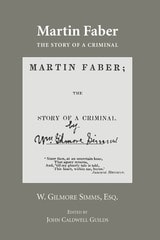
Martin Faber
The Story of a Criminal with "Confessions of a Murder"William Gilmore Simms
University of Arkansas Press, 2006
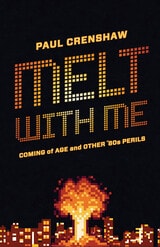
Melt with Me
Coming of Age and Other ’80s PerilsPaul Crenshaw
The Ohio State University Press, 2023
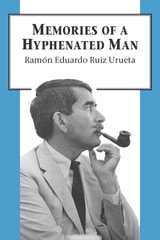
Memories of a Hyphenated Man
Ramón Eduardo Ruiz Urueta
University of Arizona Press, 2003
Historian, author, and intellectual, Ruiz has established himself through such books as Triumphs and Tragedy: A History of the Mexican People and Cuba: The Making of a Revolution, and in 1998 he was awarded the National Humanities Medal by President Clinton. Now he turns his pen on his own life to offer a personal look at what it really means to be American by birth but Mexican by culture.
Little has been written by or about persons of Mexican origin who have achieved the academic stature of Ruiz, and his memoir provides insights not found in the more common biographies of labor leaders and civil rights activists. His early life straddled the social worlds of his parent's Mexico and semi-rural America, where his father's success as an entrepreneur and property owner set his family's experiences apart from those of most other Mexican Americans at the time. His parents reinforced in their children an identity as mexicanos, and that connection with his ancestral roots was for Ruiz a lifejacket in the days of acute bigotry in America.
In making an early, self-conscious commitment to a life of the mind, Ruiz became aware of his unique nature, and while not immune to prejudice he was able to make a name for himself in several endeavors. As a student, he attended college when few Mexican Americans were given that opportunity, and he was one of the first of his generation to earn a Ph.D. As an Army Air Force officer during World War II, he served as a pilot in the Pacific theatre. And as an intellectual, he navigated the currents of the historical profession and charted new directions in Latin American research through his prolific writing.
Ruiz's career teaching took him to Mexico, Massachusetts, Texas, Oregon—often as the lone "Mexican professor," and ultimately back to his native California. While teaching at Smith, he exulted in being "free to interpret Spanish American life and culture to my heart's content," and at the University of California, San Diego, he saw the era of campus racial barrier give way to the birth of affirmative action. While at UCSD, he taught hundreds of Chicanos and trained one of the largest groups of Chicano Ph.D's.
Memories of a Hyphenated Man is the story of a unique individual who, while shaped by his upbringing and drawing on deep cultural roots, steadfastly followed his own compass in life. It tells of a singular man who beat the odds as it poignantly addresses the ambiguities associated with race, class, citizenship, and nationality for Mexicans and Mexican Americans.
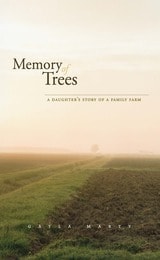
Memory of Trees
A Daughter’s Story of a Family FarmGayla Marty
University of Minnesota Press, 2013
Memory of Trees is a multigenerational story of Gayla Marty’s family farm near Rush City, Minnesota. Cleared from woodlands by her great-grandfather Jacob in the 1880s, the farm passed to her father, Gordon, and his brother, Gaylon. Hewing to a conservative Swedish Baptist faith, the two brothers worked the farm, raising their families in side-by-side houses.
As the years go by, the families grow—and slowly grow apart. Uncle Gaylon, more doctrinaire in his faith, rails against the permissiveness of Gayla’s parents. Financial tensions arise as well when the farm economy weakens and none of the children is willing or able to take over. Gayla is encouraged to leave for college, international travel, and city life, but the farm remains essential to her sense of self, even after the family decides to sell the land.
When Gaylon has an accident on a tractor, Gayla becomes driven to reconnect with him and to find out why she and her uncle—once so close but now estranged—were the only two members of the family who had resisted selling the land. Guided by vivid images of the farm’s many beautiful trees, she pores over sacred and classical works as well as layers of her own memory to understand the forces that have transformed the American landscape and culture in the last half of the twentieth century. Beneath the belief in land as a giver of life and blessing, she discovers a powerful anxiety born of human uprootedness and loss. Movingly written, Memory of Trees will resonate for many with attachments to small towns or farms, whether they continue to work the land or, like so many, have left for a different life.
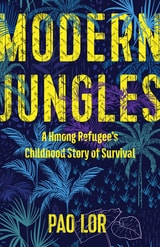
Modern Jungles
A Hmong Refugee’s Childhood Story of SurvivalPao Lor
Wisconsin Historical Society Press, 2021
Born in a small farming village, Pao was destined to be a Hmong clan leader, wedding negotiator, or shaman. But the course of his life changed dramatically in the 1970s, when the Hmong faced persecution for their role in helping US forces fighting communism in the region. After more than two years in Thai refugee camps, Pao and his surviving family members boarded the belly of an “iron eagle” bound for the United States, where he pictured a new life of comfort and happiness. Instead, Pao found himself navigating a frightening and unfamiliar world, adjusting to a string of new schools and living situations while struggling to fulfill the hopes his parents had once held for his future. Now in Modern Jungles, Pao Lor shares his inspiring coming-of-age tale about perseverance, grit, and hope.
Included are discussion questions for use by book clubs, in classrooms, or around the dinner table.
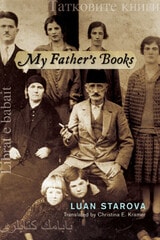
My Father’s Books
Luan Starova; Translated by Christina E. Kramer
University of Wisconsin Press, 2012
In My Father’s Books, the first volume in Luan Starova’s multivolume Balkan Saga, he explores themes of history, displacement, and identity under three turbulent regimes—Ottoman, Fascist, and Stalinist—in the twentieth century. Weaving a story from the threads of his parents’ lives from 1926 to 1976, he offers a child’s-eye view of personal relationships in shifting political landscapes and an elegiac reminder of the enduring power of books to sustain a literate culture.
Through lyrical waves of memory, Starova reveals his family’s overlapping religious, linguistic, national, and cultural histories. His father left Constantinople as the Ottoman Empire collapsed, and the young family fled from Albania to Yugoslav Macedonia when Luan was a boy. His parents, cosmopolitan and well-traveled in their youth, and steeped in the cultures of both Orient and Occident, find themselves raising their children in yet another stagnant and repressive state. Against this backdrop, Starova remembers the protected spaces of his childhood—his mother’s walled garden, his father’s library, the cupboard holding the rarest and most precious of his father’s books. Preserving a lost heritage, these books also open up a world that seems wide, deep, and boundless.
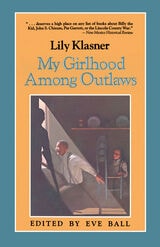
My Girlhood Among Outlaws
Lily Klasner
University of Arizona Press, 1972
In My Girlhood Among Outlaws, Lily recalls her experiences with Billy the Kid and other desperadoes, and sets the record straight on popular misrepresentations of events. Of particular interest to historians is her preservation of the diary of famous cattleman and family friend John Chisum.
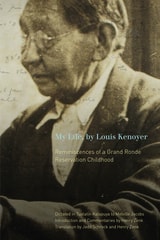
My Life, by Louis Kenoyer
Reminiscences of a Grand Ronde Reservation ChildhoodLouis Kenoyer
Oregon State University Press, 2017
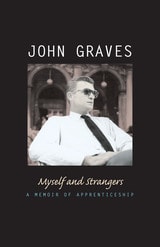
Myself and Strangers
A Memoir of ApprenticeshipBy John Graves
University of Texas Press, 2005
In Myself and Strangers, John Graves, the highly regarded author of Goodbye to a River and other classic works, recalls the decade-long apprenticeship in which he found his voice as a writer. He recounts his wanderings from Texas to Mexico, New York, and Spain, where, like Hemingway, he hoped to find the material with which to write books that mattered. With characteristic honesty, Graves admits the false starts and dead ends that dogged much of his writing, along with the exhilaration he felt when the words finally flowed. He frankly describes both the pleasures and the restlessness of expatriate life in Europe after World War II—as well as his surprising discovery, when family obligations eventually called him home to Texas, that the years away had prepared him to embrace his native land as the fit subject matter for his writing. For anyone seeking the springs that fed John Graves' best-loved books, this memoir of apprenticeship will be genuinely rewarding.