208 books match the query 'Christian Church' and 6 start with m
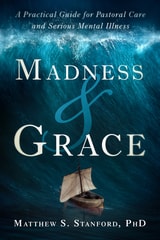
cover of Madness and Grace: A Practical Guide for Pastoral Care and Serious Mental Illness

Madness and Grace

A Practical Guide for Pastoral Care and Serious Mental Illness

Matthew Stanford

Templeton Press, 2021

Research tells us that when most people suffer from a mental health crisis, the first person they turn to for help is not a physician, a psychiatrist, or a social worker, but a pastor, a priest, or a minister. In other words, a leader in their church. Unfortunately, many church leaders are not trained to recognize mental illness and don’t know when to refer someone to a mental health professional. The consequence—unintended yet tragic—is continued and unnecessary suffering.

Madness and Grace is a comprehensive guide for church ministry to alleviate this situation. Written by Dr. Matthew Stanford, the book is carefully constructed to help build competency in detecting a wide spectrum of mental disorders, such as knowing when a person is contemplating suicide based on telltale patterns of speech. It also explodes common discriminatory myths that stigmatize people with mental illness, such as the myth that they are more prone to violence than others.

Dr. Stanford has treated clients throughout his career who were afflicted with all manner of mental disorders. In Madness and Grace, he takes the full extent of his experience and makes it accessible and actionable for the lay reader. He begins by explaining what constitutes a mental illness and how these disorders are classified according to science. He next teaches how to notice the presence of a mental illness by listening carefully to phraseology, observing behavior, and asking discerning questions. He goes on to discuss methods of treatment, common religious concerns about mental health, and ways church communities can support people on the road to recovery.

As a Christian, Dr. Stanford wants his fellow believers to know that acknowledging and seeking help for a mental illness is not a sign of weak faith. That’s why, in addition to sharing his medical expertise with church leaders, he commends pertinent biblical passages that underscore God’s concern for our mental wellbeing. These passages provide strength and comfort as complements to clinically-derived treatment and are essential to Dr. Stanford’s approach. “When working with those in severe psychological distress,” he writes, “compassion and grace are always the first line of pastoral care.”

[more]
cover of Marriage on Trial

Marriage on Trial

Ludwig Schmugge

Catholic University of America Press, 2012
This work vividly describes many of the individual cases and offers new insight into the social and legal pressures on marriage in the Middle Ages.
[more]
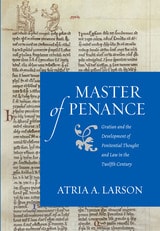
cover of Master of Penance

Master of Penance

Arrai A. Larson

Catholic University of America Press, 2014
This book presents the first full-scale study of the Tractatus de penitentia (C.33 q.3) in Gratian's Decretum, which became the textbook for canon law and served as the basis of the church's developing jurisprudence, in theory and in practice
[more]
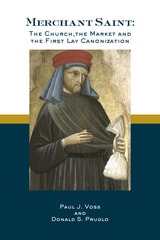
cover of Merchant Saint: The Church, the Market, and the First Lay Canonization

Merchant Saint

The Church, the Market, and the First Lay Canonization

prudlo

St. Augustine's Press, 2024

Paul Voss and Donald Prudlo trace Western attitudes to money, merchants, and the market through 3,000 years of history. They focus their attention on one person in particular, Omobono of Cremona (1117–1197), as an axial figure in the wholesale reappraisal of the value of business, entrepreneurship, and white-collar work in Christian Europe. More precisely, Voss and Prudlo examine the evolution of the mentality of wealth and economics in the Catholic Church, beginning from the Scriptural disdain for material pursuits and moving to the eventually declared sainthood of Omobono, a lay merchant living amid the hectic rhythm of a life of business. As the authors note, "His story resonates today with an unexpected poignancy for the contribution it makes to the pressing issues of economic justice, free markets, work-life balance, the 'theology of work,' and Catholic history." The reconstruction of the socio-theological perspective of wealth is a fascinating contribution to contemporary attempts to reconcile culture, capitalism, and the common good. Omobono stands as the first lay individual proposed by the Catholic Church as a model of heroic virtue, and thought him commercial life came thereby also to be 'canonized' as a possible path to sanctity. 

Voss and Prudlo provide a rich resource for readers concerned with the proper aims and boundaries of a life in the world of commerce, the nature of work, the ethics of profit, the problem of money-lending, the virtues needed for moral capitalism, and the tension between otium and negotium. Voss and Prudlo have accumulated a veritable trove of primary text materials relating to the life of Omobono, and provide translations and commentary to complete their analysis. This fascinating account crosses the threshold of pure history and stimulates inquiry in the fields of philosophy, economics, and theology. 
 
[more]
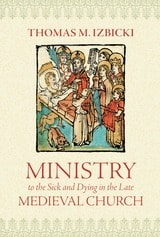
cover of Ministry to the Sick and Dying in the Late Medieval Church

Ministry to the Sick and Dying in the Late Medieval Church

Thomas M. Izbicki

Catholic University of America Press, 2023
The focus of this volume is on ministry to the sick and dying in the later Middle Ages, especially providing them with the sacraments. Medieval writers linked illness to sin and its forgiveness. The priest, as physician of souls, was expected to heal the soul, preparing it for the hereafter. His ministry might also effect healing of bodies, when that healing did not endanger the soul. This book treats how a priest prepared to visit sick persons and went to them in procession with the Eucharist and oil of the sick. The priest was to comfort the patient and, if death was imminent, prepare the soul for the hereafter. Canon law, theology, and ritual sources are employed. Three sacraments, penance, viaticum, (final communion) and extreme unction (anointing of the sick) are treated in detail. Sickbed confession was designed to forgive the ailing person's mortal sins. A priest could absolve a dying person of all sins, even those reserved to a bishop or the pope. Viaticum was to strengthen a suffering Christian for life's last conflict, that between angels and demons for the soul of the dying person. The deathbed thus was a spiritual battlefield. Extreme unction was reserved for those in danger of death, relieving the soul of venial sins or "the remains of sin," even after confession and absolution. The commendatio animae (commendation of the soul) used with the dying was to usher the soul into the afterlife. Many works have been written about attitudes toward death, dying, and the afterlife in the Middle Ages. Likewise, there is a good deal of literature about individual sacraments. This study aims at bridging between these literatures, with a focus on the priest and parishioner in both theory and practice at the sickbed.
[more]
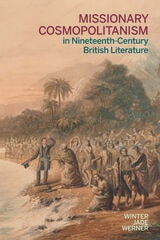
cover of Missionary Cosmopolitanism in Nineteenth-Century British Literature

Missionary Cosmopolitanism in Nineteenth-Century British Literature

Winter Jade Werner

The Ohio State University Press, 2020

Missionary Cosmopolitanism in Nineteenth-Century British Literature explores the notion that missionaries, often perceived as only evangelically motivated in the British imperial project, were also spurred on by cosmopolitan ideals. Winter Jade Werner makes this surprising connection in order to write against standard understandings of missionary work as well as typical understandings of cosmopolitanism as a deeply secular project.
Missionary Cosmopolitanism identifies the nineteenth-century novel as thematically and formally attuned to the tension between missionaries’ cosmopolitan values and the moral impoverishment of their imperialist and expansionist practices. Werner’s chapters interact with canonical works such as Charlotte Brontë’s Jane Eyre and Charles Dickens’s Bleak House, along with lesser-known works by Robert Southey and Sydney Owenson. Ultimately, Missionary Cosmopolitanism demonstrates that nineteenth-century literature both illustrated and helped define missionary discourses regarding cosmopolitan ideas, showing how global evangelicalism continues to tap into the “new cosmopolitanisms” of today.
 
[more]