Results by title
63 books match the query 'Christian Ministry' and 3 start with m

Madness and Grace
A Practical Guide for Pastoral Care and Serious Mental IllnessMatthew Stanford
Templeton Press, 2021
Research tells us that when most people suffer from a mental health crisis, the first person they turn to for help is not a physician, a psychiatrist, or a social worker, but a pastor, a priest, or a minister. In other words, a leader in their church. Unfortunately, many church leaders are not trained to recognize mental illness and don’t know when to refer someone to a mental health professional. The consequence—unintended yet tragic—is continued and unnecessary suffering.
Madness and Grace is a comprehensive guide for church ministry to alleviate this situation. Written by Dr. Matthew Stanford, the book is carefully constructed to help build competency in detecting a wide spectrum of mental disorders, such as knowing when a person is contemplating suicide based on telltale patterns of speech. It also explodes common discriminatory myths that stigmatize people with mental illness, such as the myth that they are more prone to violence than others.
Dr. Stanford has treated clients throughout his career who were afflicted with all manner of mental disorders. In Madness and Grace, he takes the full extent of his experience and makes it accessible and actionable for the lay reader. He begins by explaining what constitutes a mental illness and how these disorders are classified according to science. He next teaches how to notice the presence of a mental illness by listening carefully to phraseology, observing behavior, and asking discerning questions. He goes on to discuss methods of treatment, common religious concerns about mental health, and ways church communities can support people on the road to recovery.
As a Christian, Dr. Stanford wants his fellow believers to know that acknowledging and seeking help for a mental illness is not a sign of weak faith. That’s why, in addition to sharing his medical expertise with church leaders, he commends pertinent biblical passages that underscore God’s concern for our mental wellbeing. These passages provide strength and comfort as complements to clinically-derived treatment and are essential to Dr. Stanford’s approach. “When working with those in severe psychological distress,” he writes, “compassion and grace are always the first line of pastoral care.”
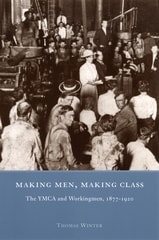
Making Men, Making Class
The YMCA and Workingmen, 1877-1920Thomas Winter
University of Chicago Press, 2002
Starting in the 1870s, the leaders ("secretaries") of the YMCA sought to reduce political radicalism and labor unrest by instilling new ideals of manliness among workers. By involving workingmen in a range of activities on the job and off, the YMCA hoped to foster team spirit, moral conduct, and new standards of manhood that would avoid conflict and instead encourage cooperation along the lines of a Christian, pious manliness. In their efforts to make better men, the secretaries of the YMCA also crafted new ideals of middle-class manliness for themselves that involved a sense of mission and social purpose. In doing so, they ended up "making" class, too, as they began to speak a language of manhood structured by class differences.

Missionaries in Hawai'i
The Lives of Peter and Fanny Gulick, 1797-1883Clifford Putney
University of Massachusetts Press, 2010
Ever since Protestant missionaries from the United States first reached Hawai'i in 1820, they have inspired conflicting passions. In evangelical circles, the missionaries are praised for Christianizing Hawai'i, transforming Hawaiian into a written language, and inoculating the islanders against smallpox. But this celebratory assessment is rejected by modern-day Hawaiian nationalists, who excoriate the missionaries as advance agents of U.S. imperialism.
In this biography of pioneer missionaries Peter and Fanny Gulick, Clifford Putney offers a balanced view of their contributions. He says the nationalists are right to credit the missionaries with drawing Hawai'i into America's political orbit, but argues that the missionary enterprise helped in some ways to preserve key elements of Hawaiian culture.
Based primarily on letters, journals, and other archival materials, Putney's book provides readers with a detailed portrait of the lives of Peter and Fanny Gulick. Inspired by America's Second Great Awakening to spread the Gospel overseas, the Gulicks voyaged to Hawai'i in 1828 and lived there for the next forty-six years, actively proselytizing and working to change the islands. On Kaua'i, they helped to ensure the success of Hawai'i's first sugar plantation and acquainted Hawaiians with inventions such as the wagon. On Moloka'i (later the site of a leper colony) the couple struggled merely to survive. And on O'ahu, they took up ranching and helped to found Punahou School, the alma mater of President Barack Obama.
While laboring in Hawai'i, the Gulicks interacted with kings, queens, and other historically important figures, and Putney chronicles those relationships. He also explores issues of race and gender, and sheds new light on the democratization of government, the spread of capitalism, and the privatization of land. From these last two developments, a number of missionaries grew immensely rich, but the Gulicks did not, and neither did their descendants. A group that includes influential missionaries, educators, and physical fitness experts, the descendants of Peter and Fanny have had numerous books written about them, but Putney is the first to write extensively about the progenitors of the Gulick clan.