Results by title
496 books match the query 'Christian Theology' and 8 start with m
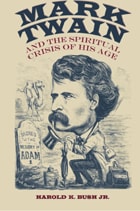
Mark Twain and the Spiritual Crisis of His Age
Harold K. Bush
University of Alabama Press, 2007
Discover the spiritual depths behind America’s greatest humorist.
Mark Twain is often pictured as a severe critic of religious piety, shaking his fist at God and mocking the devout. Such a view, however, is only partly correct. It ignores the social realities of Twain’s major period as a writer and his own spiritual interests: his participation in church activities, his socially progressive agenda, his reliance on religious themes in his major works, and his friendships with clergymen, especially his pastor and best friend, Joe Twichell. It also betrays a conception of religion that is more contemporary than that of the period in which he lived.
Harold K. Bush Jr. highlights Twain’s attractions to and engagements with the wide variety of religious phenomena of America in his lifetime, and how these matters affected his writings. Though Twain lived in an era of tremendous religious vigor, it was also a time of spiritual upheaval and crisis. The rise of biological and psychological sciences, the criticism of biblical texts as literary documents, the influx of world religions and immigrant communities, and the trauma of the Civil War all had dramatic effects on America’s religious life. At the same time mass urban revivalism, the ecumenical movement, Social Christianity, and occultic phenomena, like spiritualism and mind sciences, all rushed in to fill the voids. The rapid growth of agnosticism in the 1870s and 1880s is also clearly reflected in Twain’s life and writings. Thus Twain’s career reflects in an unusually resonant way the vast changes in American belief during his lifetime.
Bush’s study offers both a new and more complicated understanding of Twain and his literary output and serves as the cultural biography of an era.
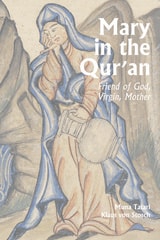
Mary in the Qur'an
Friend of God, Virgin, MotherMuna Tatari and Klaus von Stosch
Gingko, 2025
An entire chapter (surah) is dedicated to her, and she is the only woman mentioned by name in the Qur’an—indeed, her name appears more frequently than that of either Muhammad or Jesus. From the earliest times to the present day, Mary, the mother of Jesus, continues to be held in high regard by Christians and Muslims alike, yet she has also been the cause of much tension between these two religions.
In this groundbreaking study, Muna Tatari and Klaus von Stosch painstakingly reconstruct the picture of Mary that is presented in the Qur’an and show how veneration of the Blessed Virgin Mary in the Roman Catholic Church intersects and interacts with the testimony of the Qur’an. This sensitive and scholarly treatise offers a significant contribution to contemporary interfaith dialogue.
Mary, Mother of God's Word Made Flesh
Dylan Schrader
Catholic University of America Press, 2025
Modernists and Mystics
C. J. T Talar
Catholic University of America Press, 2009
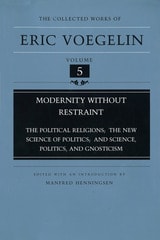
Modernity without Restraint (CW5)
Political Religions; The New Science of Politics; and Science, Politics and GnosticismEric Voegelin, Edited & Intro by Manfred Henningsen
University of Missouri Press, 2000
Published together for the first time in one volume are Eric Voegelin's Political Religions, The New Science of Politics, and Science, Politics, and Gnosticism.Political Religions was first published in 1938 in Vienna, the year of Voegelin's forced emigration from Austria to the United States. The New Science of Politics was written in 1952 and established Voegelin's reputation as a political philosopher in America. Science, Politics, and Gnosticism was Voegelin's Inaugural Lecture at the University of Munich in 1958 and introduced him to the West German intellectual public.
Although these books were written during remarkably different historical circumstances of Voegelin's life, all three present an analysis of modern Western civilization that has lost its spiritual foundations and is challenged by various ideological persuasions. Voegelin critiques in these texts a "modernity without restraint." It is a modernity with Hegelian, Marxian, Nietzschean, Heideggerian, positivist, Fascist, and other predominantly German characteristics. The author confronts this modernity with Western meaning as it emerged in ancient Greece, Rome, Israel, and Christianity and became transformed in the European Middle Ages, the Italian Renaissance, and the Anglo- American political formation.
This three-in-one volume delves into the intellectual and spiritual complications of modernity, tracing its evolution from the ancient civilizations to the twentieth century. In his substantial new introduction, Manfred Henningsen explores the experiential background that motivated Voegelin's theoretical analyses and the new relevance that his work has gained in recent years with the unexpected collapse of state socialism in East Germany, Eastern Europe, and the Soviet Union. Modernity without Restraint will be a valuable addition to intellectual history and Voegelin studies.
Moral Absolutes
Tradition, Revision, and Truth (Michael J. McGivney Lectures of the John Paul II Institute)John Finnis
Catholic University of America Press, 1991
Morality
The Catholic ViewServais O.P. Pinckaers
St. Augustine's Press, 2003
Fr. Servais Pinckaers’s work is well on its way to being accepted as the work on Catholic moral thinking for the coming generation of laymen and students. Pinckaers sharply distinguishes this view of morality from modern “moralities of obligation,” which regard the moral life primarily as obedience to rules that limit human freedom and curb human desires. Pinckaers sees moralities of obligation as the logical outcome of a new understanding of human freedom. Instead of regarding freedom as the capacity to engage in excellent acts of virtue (freedom for excellence), the modern view understands freedom as the radical ability to do good or evil indifferently (freedom of indifference). Pinckaers argues convincingly that this view of freedom and the morality of obligation that flows from it have impoverished the Catholic understanding of the moral life. This work offers the reader a compelling itinerary of moral development, rooted in the theology of St. Paul and the morality of the Gospels.
Now, for a new generation of students, the book is made available in an ebook version.
In addition, under the direction of Fr. Michael Sherwin, a teacher’s edition of the work is to be published, which will greatly aid the teacher in high school or home school to help his or her students to gain the most from this seminal work.
“As Alasdair MacIntyre notes in the preface, the work of Pinckaers attracted strong and fully justified notice in this country with the publication in English of his The Sources of Christian Ethics. As Pinckaers himself notes in the text, excellently translated by Michael Sherwin, the interest should in no way be limited to Roman Catholics. Morality recasts the earlier book in an argument that is both lower and upper case ‘catholic,’ and is accessible to readers and teachers outside the limited circle of moral theologians and academic ethicists. Pinckaers contends that Christian morality is not first of all about obligations but about happiness, understanding that the happiness of union with God is our natural destiny made possible by grace. The Sermon on the Mount is at the center of an approach to morality that turns on the distinction between ‘freedom for excellence’ and ‘freedom of indifference,’ the former understood as human flourishing and the latter as a ‘neutral’ capacity to choose between controversies. The proposal of Morality is thoroughly Christ-centered, humanistic, and faithful to the magisterial teaching of the Church. Warmly recommended.” - First Things
“If you want to have the experience of reflecting on Catholic morality as though you were reading about it for the first time, treat yourself to Father Servais Pinckaers’ Morality: The Catholic View. He has recovered the classical view of the moral life as the quest for happiness and has presented it with disarming simplicity. Bringing us back to the Sermon on the Mount and Romans 12–15, the writings of Augustine and Aquinas, and the theme of natural law, he has freed those texts from the layers of legalism which has hidden their liberating, spiritual powers for moral living. By distinguishing freedom of indifference from freedom for excellence, he has restored a wise vision of freedom. No one has shown better the role of virtues as building blocks for morality. Catechists need to read this book.” Rev. Alfred McBride, O.Praem., Professor of Homilectics and Catechetics at Blessed Pope John XXIII Seminary, Weston, Massachusetts
“Father Pinckaers has given us a masterful exposition of Christian living. The clarity and brevity of his presentation – captured well by the translator – make this book ideal for classroom and parish use. “Readers will find the historical and systematic observations very informative.” Romanus Cessario, St. John’s Seminary, Brighton, Massachusetts
Mysteries of the Lord's Prayer
Wisdom from the Early ChurchJohn Gavin
Catholic University of America Press, 2021