Results by title
172 books match the query 'Citizenship' and 14 start with m
MANHOOD, CITIZENSHIP, AND THE NATIONAL GUARD
ILLINOIS, 1870–1917ELEANOR L HANNAH
The Ohio State University Press, 2007
Makeover TV
Selfhood, Citizenship, and CelebrityBrenda R. Weber
Duke University Press, 2009
Based on her analysis of more than 2,500 hours of makeover TV, Weber argues that the much-desired After-body speaks to and makes legible broader cultural narratives about selfhood, citizenship, celebrity, and Americanness. Although makeovers are directed at both male and female viewers, their gendered logic requires that feminized subjects submit to the controlling expertise wielded by authorities. The genre does not tolerate ambiguity. Conventional (middle-class, white, ethnically anonymous, heterosexual) femininity is the goal of makeovers for women. When subjects are male, makeovers often compensate for perceived challenges to masculine independence by offering men narrative options for resistance or control. Foregoing a binary model of power and subjugation, Weber provides an account of makeover television that is as appreciative as it is critical. She reveals the makeover show as a rich and complicated text that expresses cultural desires and fears through narratives of selfhood.
Making Patriots
Walter Berns
University of Chicago Press, 2001
Although Samuel Johnson once remarked that "patriotism is the last refuge of scoundrels," over the course of the history of the United States we have seen our share of heroes: patriots who have willingly put their lives at risk for this country and, especially, its principles. And this is even more remarkable given that the United States is a country founded on the principles of equality and democracy that encourage individuality and autonomy far more readily than public spiritedness and self-sacrifice.
Walter Berns's Making Patriots is a pithy and provocative essay on precisely this paradox. How is patriotism inculcated in a system that, some argue, is founded on self-interest? Expertly and intelligibly guiding the reader through the history and philosophy of patriotism in a republic, from the ancient Greeks through contemporary life, Berns considers the unique nature of patriotism in the United States and its precarious state. And he argues that while both public education and the influence of religion once helped to foster a public-minded citizenry, the very idea of patriotism is currently under attack.
Berns finds the best answers to his questions in the thought and words of Abraham Lincoln, who understood perhaps better than anyone what the principles of democracy meant and what price adhering to them may exact. The graves at Arlington and Gettysburg and Omaha Beach in Normandy bear witness to the fact that self-interested individuals can become patriots, and Making Patriots is a compelling exploration of how this was done and how it might be again.
Managing African Portugal
The Citizen-Migrant DistinctionKesha Fikes
Duke University Press, 2009
The ethnographic focus is a former undocumented fish market that at one time employed both Portuguese and Cape Verdean women. Both groups eventually sought work in low-wage professions as maids, nannies, and restaurant-kitchen help. The visibility of poor Portuguese women as domestics was thought to undermine the appearance of Portuguese modernity; by contrast, the association of poor African women with domestic work confirmed it. Fikes argues that we can better understand how Portugal interpreted its economic absorption into the EU by attending to the different directions in which working-poor Portuguese and Cape Verdean women were routed in the mid-1990s and by observing the character of the new work relationships that developed among them. In Managing African Portugal, Fikes pushes for a study of migrant phenomena that considers not only how the enactment of citizenship by the citizen manages the migrant, but also how citizens are simultaneously governed through their uptake and assumption of new EU citizen roles.
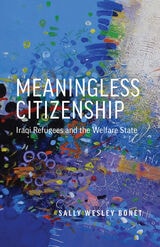
Meaningless Citizenship
Iraqi Refugees and the Welfare StateSally Wesley Bonet
University of Minnesota Press, 2022
A searing critique of the “freedom” that America offers to the victims of its imperialist machinations of war and occupation
Meaningless Citizenship traces the costs of America’s long-term military involvement around the world by following the forced displacement of Iraqi families, unveiling how Iraqis are doubly displaced: first by the machinery of American imperialism in their native countries and then through a more pernicious war occurring on U.S. soil—the dismantling of the welfare state.
Revealing the everyday struggles and barriers that texture the lives of Iraqi families recently resettled to the United States, Sally Wesley Bonet draws from four years of deep involvement in the refugee community of Philadelphia. An education scholar, Bonet’s analysis moves beyond the prevalent tendency to collapse schooling into education. Focusing beyond the public school to other critical institutions, such as public assistance, resettlement programs, and healthcare, she shows how encounters with institutions of the state are an inherently educative process for both refugee youths and adults, teaching about the types of citizenship they are expected to enact and embody while simultaneously shaping them into laboring subjects in service of capitalism.
An intimate, in-depth ethnography, Meaningless Citizenship exposes how the veneer of American values—freedom, democracy, human rights—exported to countries like Iraq, disintegrates to uncover what is really beneath: a nation-state that prioritizes the needs of capitalism above the survival and wellbeing of its citizens.
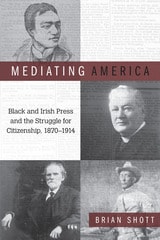
Mediating America
Black and Irish Press and the Struggle for Citizenship, 1870-1914Brian Shott
Temple University Press, 2019
Until recently, print media was the dominant force in American culture. The power of the paper was especially true in minority communities. African Americans and European immigrants vigorously embraced the print newsweekly as a forum to move public opinion, cohere group identity, and establish American belonging.
Mediating America explores the life and work of T. Thomas Fortune and J. Samuel Stemons as well as Rev. Peter C. Yorke and Patrick Ford—respectively two African American and two Irish American editor/activists in the late nineteenth and early twentieth centuries. Historian Brian Shott shows how each of these “race men” (the parlance of the time) understood and advocated for his group’s interests through their newspapers. Yet the author also explains how the newspaper medium itself—through illustrations, cartoons, and photographs; advertisements and page layout; and more—could constrain editors’ efforts to guide debates over race, religion, and citizenship during a tumultuous time of social unrest and imperial expansion.
Black and Irish journalists used newspapers to recover and reinvigorate racial identities. As Shott proves, minority print culture was a powerful force in defining American nationhood.
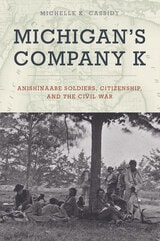
Michigan's Company K
Anishinaabe Soldiers, Citizenship, and the Civil WarMichelle K Cassidy
Michigan State University Press, 2023

Migrating Borders and Citizenship in Law
Scales, Locales, Themes and PracticesDevyani Prabhat
University of London Press, 2026
Borders not only demarcate nations and territories but also transform people into migrants. Together with law and law enforcement, borders create residents and foreigners. The law ascertains who crosses borders and who does not, and determines who remains foreign despite being within national borders. Migrating Borders and Citizenship in Law argues that law has multiple roles and mechanisms for breathing life into borders, operating at different locales and scales (from worldwide to the nation, and from the family to the workplace), and through different practices, including preventing entry and withholding access to resources.
This book examines case law, legislation, and press accounts relating to several key events in recent times that have changed the legal landscape on migration control, such as the Immigration and Nationality Acts in the United Kingdom, the end of the empire, the arrival of Empire Windrush, Brexit, the COVID-19 pandemic, and the case of Shamima Begum. Focusing on race and ethnicity, gender, and class, as well as crime and control, Migrating Borders and Citizenship in Law contextualizes the legal debates around these historical and political developments, the question of who belongs, the consequences of behavior for immigration status and citizenship, and the links with conduct and national security.
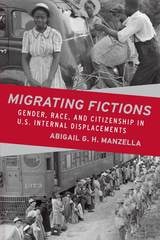
Migrating Fictions
Gender, Race, and Citizenship in U.S. Internal DisplacementsAbigail G. H. Manzella
The Ohio State University Press, 2018
Winner, 2021 CCCC Outstanding Book Award
Migrating Fictions analyzes the role of race, gender, and citizenship in the major internal displacements of the 20th century in history and in narrative. Surveying the particular tactics employed by the United States during the Great Migration, the Dust Bowl, the Japanese American incarceration, and the migrant labor of the Southwest, Abigail G. H. Manzella reveals how the country’s past is imbued with governmentally (en)forced movements that diminished access to full citizenship rights for the laboring class, people of color, and women.
This work is the first book-length study to examine all of these movements together along with their literature, including Zora Neale Hurston’s Their Eyes Were Watching God, Sanora Babb’s Whose Names Are Unknown, Julie Otsuka’s When the Emperor Was Divine, Helena María Viramontes’s Under the Feet of Jesus, and Jesmyn Ward’s Salvage the Bones. Manzella shows how the United States’ history of spatial colonization within its own borders extends beyond isolated incidents into a pattern based on ideology about nation-building, citizenship, and labor. This book seeks to theorize a Thirdspace, an alternate location for social justice that acknowledges the precarity of the internally displaced person.
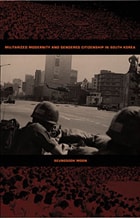
Militarized Modernity and Gendered Citizenship in South Korea
Seungsook Moon
Duke University Press, 2005
Moon situates militarized modernity in the historical context of colonialism and nationalism in the twentieth century. She follows the course of militarized modernity in South Korea from its development in the early 1960s through its peak in the 1970s and its decline after rule by military dictatorship ceased in 1987. She highlights the crucial role of the Cold War in South Korea’s militarization and the continuities in the disciplinary tactics used by the Japanese colonial rulers and the postcolonial military regimes. Moon reveals how, in the years since 1987, various social movements—particularly the women’s and labor movements—began the still-ongoing process of revitalizing South Korean civil society and forging citizenship as a new form of membership in the democratizing nation.
Minor Re/Visions
Asian American Literacy Narratives as a Rhetoric of CitizenshipMorris Young
Southern Illinois University Press, 2004
Through a blend of personal narrative, cultural and literary analysis, and discussions about teaching, Minor Re/Visions: Asian American Literacy Narratives as a Rhetoric of Citizenship shows how people of color use reading and writing to develop and articulate notions of citizenship. Morris Young begins with a narration of his own literacy experiences to illustrate the complicated relationship among literacy, race, and citizenship and to reveal the tensions that exist between competing beliefs and uses of literacy among those who are part of dominant American culture and those who are positioned as minorities.
Influenced by the literacy narratives of other writers of color, Young theorizes an Asian American rhetoric by examining the rhetorical construction of American citizenship in works such as Richard Rodriguez’s Hunger of Memory, Victor Villanueva’s Bootstraps: From an American Academic of Color, Carlos Bulosan’s America Is in the Heart, and Maxine Hong Kingston’s “Song for a Barbarian Reed Pipe” from Woman Warrior. These narratives, Young shows, tell stories of transformation through education, the acquisition of literacy, and cultural assimilation and resistance. They also offer an important revision to the American story by inserting the minor and creating a tension amid dominant discourses about literacy, race, and citizenship. Through a consideration of the literacy narratives of Hawai`i, Young also provides a context for reading literacy narratives as responses to racism, linguistic discrimination, and attempts at “othering” in a particular region.
As we are faced with dominant discourses that construct race and citizenship in problematic ways and as official institutions become even more powerful and prevalent in silencing minor voices, Minor Re/Visions reveals the critical need for revising minority and dominant discourses. Young’s observations and conclusions have important implications for the ways rhetoricians and compositionists read, teach, and assign literacy narratives.
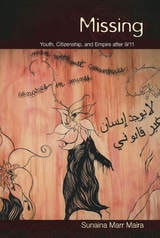
Missing
Youth, Citizenship, and Empire after 9/11Sunaina Marr Maira
Duke University Press, 2009
Bringing grounded ethnographic analysis to the critique of U.S. empire, Maira teases out the ways that imperial power affects the everyday lives of young immigrants in the United States. She illuminates the paradoxes of national belonging, exclusion, alienation, and political expression facing a generation of Muslim youth coming of age at this particular moment. She also sheds new light on larger questions about civil rights, globalization, and U.S. foreign policy. Maira demonstrates that a particular subjectivity, the “imperial feeling” of the present historical moment, is linked not just to issues of war and terrorism but also to migration and work, popular culture and global media, family and belonging.
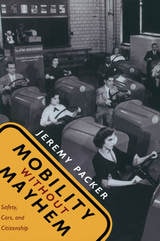
Mobility without Mayhem
Safety, Cars, and CitizenshipJeremy Packer
Duke University Press, 2007
Packer focuses on cultural figures that have been singled out as particularly dangerous. Women drivers, hot-rodders, bikers, hitchhikers, truckers, those who “drive while black,” and road ragers have all been targets of fear. As Packer debunks claims about the dangers posed by each figure, he exposes biases against marginalized populations, anxieties about social change, and commercial and political desires to profit by fomenting fear. Certain populations have been labeled as dangerous or deviant, he argues, to legitimize monitoring and regulation and, ultimately, to curtail access to automotive mobility. Packer reveals how the boundary between personal freedom and social constraint is continually renegotiated in discussions about safe, proper driving.
Muslim Land, Christian Labor
Transforming Ottoman Imperial Subjects into Bulgarian National Citizens, c. 1878-1939Anna M. Mirkova
Central European University Press, 2017