Results by title
188 books match the query 'City planning' and 16 start with m
MAKING SENSE OF THE CITY
LOCAL GOVERNMENT, CIVIC CULTURE, AND COMMUNITY LIFE IN URBAN AMERICAROBERT B. FAIRBANKS
The Ohio State University Press, 2001
Making Sense of the City explores the ways in which urbanites have attempted to confront the challenges of urban life during the nineteenth and twentieth centuries. In the spirit of Zane L. Miller, whom this volume honors, the nine contributors focus closely on the words and actions of individuals, institutions, and organizations who participated in the public discourse about what the city was or could be. Through an examination of such topics as city charters, city planning texts, neighborhood organizations, municipal recreation programs, urban government reforms, urban identity, and fair housing campaigns, the authors offer insight into the process through which ideas about the nature of the city have affected action in the urban environment.
Contributing authors are
- Robert B. Fairbanks
- Patricia Mooney-Melvin
- Judith Spraul-Schmidt
- Alan I. Marcus
- Robert A. Burnham
- Andrea Tuttle Kornbluh
- Bradley D. Cross
- Charles F. Casey-Leininger
- Roger W. Lotchin
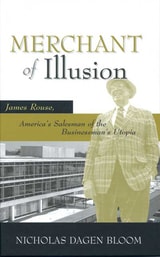
MERCHANT OF ILLUSION
James Rouse, America’s Salesman of the Businessman’s UtopiaNicholas Dagen Bloom
The Ohio State University Press, 2004
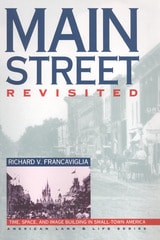
Main Street Revisited
Time, Space, and Image Building in Small-Town AmericaRichard V. Francaviglia
University of Iowa Press, 1996
As an archetype for an entire class of places, Main Street has become one of America's most popular and idealized images. In Main Street Revisited, the first book to place the design of small downtowns in spatial and chronological context, Richard Francaviglia finds the sources of romanticized images of this archetype, including Walt Disney's Main Street USA, in towns as diverse as Marceline, Missouri, and Fort Collins, Colorado.
Francaviglia interprets Main Street both as a real place and as an expression of collective assumptions, designs, and myths; his Main Streets are treasure troves of historic patterns. Using many historical and contemporary photographs and maps for his extensive fieldwork and research, he reveals a rich regional pattern of small-town development that serves as the basis for American community design. He underscores the significance of time in the development of Main Street's distinctive personality, focuses on the importance of space in the creation of place, and concentrates on popular images that have enshrined Main Street in the collective American consciousness.
Making Equity Planning Work
Leadership in the Public SectorNorman Krumholz and John Forester, foreword by Alan A. Altshuler
Temple University Press, 1990
Making Plans
How to Engage with Landscape, Design, and the Urban EnvironmentBy Frederick R. Steiner
University of Texas Press, 2018
“Community and regional planning involve thinking ahead and formally envisioning the future for ourselves and others,” according to Frederick R. Steiner. “Improved plans can lead to healthier, safer, and more beautiful places to live for us and other species. We can also plan for places that are more just and more profitable. Plans can help us not only to sustain what we value but also to transcend sustainability by creating truly regenerative communities, that is, places with the capacity to restore, renew, and revitalize their own sources of energy and materials.”
In Making Plans, Steiner offers a primer on the planning process through a lively, firsthand account of developing plans for the city of Austin and the University of Texas campus. As dean of the UT School of Architecture, Steiner served on planning committees that addressed the future growth of the city and the university, growth that inevitably overlapped because of UT’s central location in Austin. As he walks readers through the planning processes, Steiner illustrates how large-scale planning requires setting goals and objectives, reading landscapes, determining best uses, designing options, selecting courses for moving forward, taking actions, and adjusting to changes. He also demonstrates that planning is an inherently political, sometimes messy, act, requiring the intelligence and ownership of the affected communities. Both wise and frank, Making Plans is an important philosophical and practical statement on planning by a leader in the field.
Mediterranean Crossroads
Marseille and Modern ArchitectureSheila Crane
University of Minnesota Press, 2010
Drawing together a cast of both world-renowned and less familiar architects, photographers, and cultural theorists, including Le Corbusier, Sigfried Giedion, Walter Benjamin, and László Moholy-Nagy, Mediterranean Crossroads examines how mythic ideas about Marseille helped to shape its urban landscape. Tracing successive planning proposals in tandem with shifting representations of the city in photographs, film, guidebooks, and postcards, Sheila Crane reconstructs the history and politics of architecture in Marseille from the 1920s through the years of rebuilding after World War II.
By exploring how architects and planners negotiated highly localized pressures, evolving imperial visions, and transnational aspirations at the borders of Europe and the Mediterranean region, Mediterranean Crossroads brings to life a lost chapter in the history of modern architecture.
Metropolis 1890-1940
Edited by Anthony Sutcliffe
University of Chicago Press, 1984
Metropolitan Governance
Different Paths in Contrasting Contexts: Germany and IsraelEdited by Hubert Heinelt, Eran Razin, and Karsten Zimmermann
Campus Verlag, 2011
As urban areas have grown and sprawl has spread in recent decades, metropolitan governments around the world have begun to look beyond city borders, establishing regional partnerships to help them deal with issues of transit, resource use, and more. Metropolitan Governance examines this trend through a close comparative study of seven metropolitan areas in Israel and Germany. While not neglecting the reasons behind these changes in governance, the authors pay particular attention to their effects on—and diminishing of—democratic participation and accountability.
Metropolitan Resilience in a Time of Economic Turmoil
Edited by Michael A. Pagano
University of Illinois Press, 2013
Cities, counties, school districts and other local governments have suffered a long-lasting period of fiscal challenges since the beginning of the Great Recession. Metropolitan governments continue to adjust to the "new normal" of sharply lower property values, consumer sales, and personal income. Contributors to this volume include elected officials, academics, key people in city administrations, and other nationally recognized experts who discuss solutions to the urban problems created by the Great Recession.
Metropolitan Resilience in a Time of Economic Turmoil looks at the capacity of local governments to mobilize resources efficiently and effectively, as well as the overall effects of the long-term economic downturn on quality of life. Introducing the reader to the fiscal effects of the Great Recession on cities, the book examines the initial fraying and subsequent mending of the social safety net, the opportunities for pursuing economic development strategies, the challenges of inter-jurisdictional cooperation, and the legacy costs of pension liabilities and infrastructure decay.
Contributors are Phil Ashton, Raphael Bostic, Richard Feiock, Rachel A. Gordon, Rebecca Hendrick, Geoffrey J.D. Hewings, David Merriman, Richard Nathan, Michael A. Pagano, Breeze Richardson, Annette Steinacker, Nik Theodore, Rachel Weber, and Margaret Weir.
Miami in the Anthropocene
Rising Seas and Urban ResilienceStephanie Wakefield
University of Minnesota Press, 2025
Reimagining adaptation amidst climate change–driven mutations of urban space and life
Between its susceptibility to flooding and an ever-expanding real estate market powered by global surges of people and capital, Miami is an epicenter of the urban Anthropocene and a living laboratory for adaptation to sea level rise. Miami in the Anthropocene explores the social, environmental, and technical transformations involved in climate adaptation infrastructure and imaginaries in a global city seen as climate change ground zero.
Using Miami as a compelling microcosm for understanding the complex interplay between urbanization and environmental upheaval in the twenty-first century, Stephanie Wakefield shows how “aqua-urban futures” are being imagined for the city, from governmental scenario exercises for severe weather events to proposals to transform the city’s metropolitan area into an archipelago of islands connected by bridges. She examines the shifts reweaving the fabric of urban life and presents designs that imagine dramatic new ways of living with water.
Grounded in the dynamic landscape of Miami but reaching far beyond its shores, Miami in the Anthropocene delves into the broader debates shaping urban thought and practice in the Anthropocene. Focusing on postresilience urban designs, Wakefield illuminates the path toward a future where cities embrace opportunities for evolution rather than merely for survival.
Migrants and City-Making
Dispossession, Displacement, and Urban RegenerationAyse Caglar and Nina Glick Schiller
Duke University Press, 2018
Mobile Urbanism
Cities and Policymaking in the Global AgeEugene McCann
University of Minnesota Press, 2010
The essays in this volume argue for a theorizing of both urban policymaking and place-making that understands them as groups of territorial and relational geographies. It broadens our comprehension of agents of transference, reconceiving how policies are made mobile, and acknowledging the importance of interlocal policy mobility. Through the richness of its empirical examples from Europe, North America, South America, Africa, Asia, and Australia, contributors bring to light the significant methodological challenges that researchers face in the study of an urban–global, territorial–relational conceptualization of cities and suggest productive new approaches to understanding urbanism in a networked world.
Contributors: S. Harris Ali, York U, Toronto; Allan Cochrane, Open U; Roger Keil , York U, Toronto; Doreen Massey, Open U; Donald McNeill, U of Western Sydney; Jamie Peck, U of British Columbia; Jennifer Robinson, University College London.
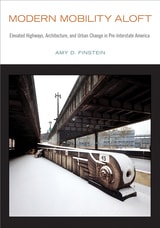
Modern Mobility Aloft
Elevated Highways, Architecture, and Urban Change in Pre-Interstate AmericaAmy D. Finstein
Temple University Press, 2020
In the first half of the twentieth century, urban elevated highways were much more than utilitarian infrastructure, lifting traffic above the streets; they were statements of civic pride, asserting boldly modern visions for a city’s architecture, economy, and transportation network. Yet three of the most ambitious projects, launched in Chicago, New York, and Boston in the spirit of utopian models by architects such as Le Corbusier and Hugh Ferriss, ultimately fell short of their ideals.
Modern Mobility Aloft is the first study to focus on pre-Interstate urban elevated highways within American architectural and urban history. Amy Finstein traces the idealistic roots of these superstructures, their contrasting realities once built, their impacts on successive development patterns, and the recent challenges they have posed to contemporary urban designers.
Filled with more than 100 historic photographs and illustrations of beaux arts and art deco architecture, Modern Mobility Aloft provides a critical understanding of urban landscapes, transportation, and technological change as cities moved into the modern era.
Modernism’s Magic Hat
Architecture and the Illusion of Development without CapitalIjlal Muzaffar
University of Texas Press, 2024
Examines the role of architecture in the history of global development and decolonization.
In Modernism’s Magic Hat, Ijlal Muzaffar examines how modern architects and planners help resolve one of the central dilemmas of the mid-twentieth-century world order: how to make decolonization plausible without accounting for centuries of capital drain under colonial rule. In the years after World War II, architects and planners found extensive opportunities in new international institutions—such as the World Bank, the UN, and the Ford Foundation—and helped shape new models of global intervention that displaced the burden of change onto the inhabitants. Muzaffar argues that architecture in this domain didn’t just symbolically represent power, but formed the material domain through which new modes of power acquired sense. Looking at a series of architectural projects across the world, from housing in Ghana to village planning in Nigeria and urban planning in Venezuela and Pakistan, Muzaffar explores how architects and planners shaped new ideas of time, land, climate, and the decolonizing body, making them appear as sources of untapped value. What resulted, Muzaffar argues, is a widespread belief in spontaneous Third World “development” without capital, which continues to foreclose any global discussion of colonial theft.
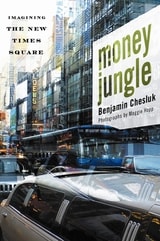
Money Jungle
Imagining the New Times SquareChesluk, Benjamin
Rutgers University Press, 2008
For more than a century, Times Square has mesmerized the world with the spectacle of its dazzling supersigns, its theaters, and its often-seedy nightlife. New York City’s iconic crossroads has drawn crowds of revelers, thrill-seekers, and other urban denizens, not to mention lavish outpourings of advertising and development money.
Many have hotly debated the recent transformation of this legendary intersection, with voices typically falling into two opposing camps. Some applaud a blighted red-light district becoming a big-budget, mainstream destination. Others lament an urban zone of lawless possibility being replaced by a Disneyfied, theme-park version of New York. In Money Jungle, Benjamin Chesluk shows that what is really at stake in Times Square are fundamental questions about city life—questions of power, pleasure, and what it means to be a citizen in contemporary urban space.
Chesluk weaves together surprising stories of everyday life in and around the Times Square redevelopment, tracing the connections between people from every level of this grand project in social and spatial engineering: the developers, architects, and designers responsible for reshaping the urban public spaces of Times Square and Forty-second Street; the experimental Midtown Community Court and its Times Square Ink. job-training program for misdemeanor criminals; encounters between NYPD officers and residents of Hell’s Kitchen; and angry confrontations between city planners and neighborhood activists over the future of the area.
With an eye for offbeat, telling details and a perspective that is at once sympathetic and critical, Chesluk documents how the redevelopment has tried, sometimes successfully and sometimes not, to reshape the people and places of Times Square. The result is a colorful and engaging portrait, illustrated by stunning photographs by long-time local photographer Maggie Hopp, of the street life, politics, economics, and cultural forces that mold America’s urban centers.

Morgan Park
Duluth, U.S. Steel, and the Forging of a Company TownArnold R. Alanen
University of Minnesota Press, 2008
From 1915 to 1971 the large U.S. Steel plant was a major part of Duluth’s landscape and life. Just as important was Morgan Park—an innovatively planned and close-knit community constructed for the plant’s employees and their families. In this new book Arnold R. Alanen brings to life Morgan Park, the formerly company-controlled town that now stands as a city neighborhood, and the U.S. Steel plant for which it was built.
Planned by renowned landscape architects, architects, and engineers, and provided with schools, churches, and recreational and medical services by U.S. Steel, Morgan Park is an iconic example—like Lowell, Massachusetts, and Pullman, Illinois—of a twentieth-century company town, as well as a window into northeastern Minnesota’s industrial roots.
Starting with the intense political debates that preceded U.S. Steel’s decision to build a plant in Duluth, Morgan Park follows the town and its residents through the boom years to the closing of the outmoded facility—an event that foreshadowed industrial shutdowns elsewhere in the United States—and up to today, as current residents work to preserve the community’s historic character.
Through compelling archival and contemporary photographs and vibrant stories of a community built of concrete and strong as steel, Alanen shows the impact both the plant and Morgan Park have had on life in Duluth.
Arnold R. Alanen is professor of landscape architecture at the University of Wisconsin–Madison. His previous books include Main Street Ready-Made: The New Deal Community of Greendale, Wisconsin and Preserving Cultural Landscapes in America.