Results by title
90 books match the query 'Civilization, Modern' and 6 start with m
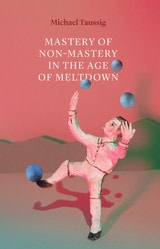
Mastery of Non-Mastery in the Age of Meltdown
Michael Taussig
University of Chicago Press, 2020
Taussig seeks to move us away from the manipulation of nature and reorient us to different metaphors and sources of inspiration to develop a new ethical stance toward the world. His ultimate goal is to undo his readers’ sense of control and engender what he calls “mastery of non-mastery.” This unique book developed out of Taussig’s work with peasant agriculture and his artistic practice, which brings performance art together with aspects of ritual. Through immersive meditations on Walter Benjamin, D. H. Lawrence, Emerson, Bataille, and Proust, Taussig grapples with the possibility of collapse and with the responsibility we bear for it.
Metaculture
How Culture Moves through the WorldGreg Urban
University of Minnesota Press, 2001
It is one thing to comprehend how culture makes its way through the world in those cases where something old is reproduced in the same physical shape-where, for example, a song is sung or a story retold. It is another thing altogether, as Greg Urban demonstrates, to think about cultural motion when something new is created-a new song or a new story. And this, the creating of new culture, is the overarching value of the contemporary world, as well as the guiding principle of the capitalist entrepreneur.
From the Declaration of Independence to the movie Babe, from the Amazon River to the film studio, from microscopic studies of the words making up myths and books to the large-scale forces of conquest, conversion, and globalization that drive history, Urban follows the clues to a startling revelation: "metaculture" makes the modern, entrepreneurial form of culture possible. In Urban’s work we see how metaculture, in its relationship to newness, explains the peculiar shape of modern society and its institutions, from the prevalence of taste and choice to the processes of the public sphere, to the centrality of persuasion and hegemony within the nation.
Moderately Modern
Rémi Brague
St. Augustine's Press, 2017
Modern Tragedy and the End of Worlds
Lillo, Leopardi, IbsenLeonardo F. Lisi
Northwestern University Press, 2026
The emergence of a distinctly modern form of tragedy is often associated with the introduction of middle-class characters and settings to high drama during the early eighteenth century. What has not been explored previously, however, is how such tragedy uses modernity’s social circumstances to stage metaphysical conditions that are destructive to human worlds. Leonardo F. Lisi pursues this argument by focusing on three central yet distinct figures in the history of modern thought and theater: eighteenth-century English dramatist George Lillo, early nineteenth-century Italian poet Giacomo Leopardi, and late nineteenth-century Norwegian iconoclast Henrik Ibsen. Modern Tragedy and the End of Worlds: Lillo, Leopardi, Ibsen shows that their works share a critical theme: the impossibility of sustaining human forms of meaning in the face of modern materialism, finance, and reason. Viewed in this light, Lisi argues that modern tragedy requires thinking together the incommensurable scales of human existence and the inhuman processes on which it rests—a task that continues to have profound relevance for imagining the end of worlds in the Anthropocene.
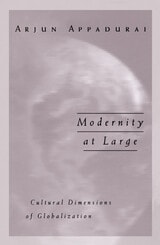
Modernity At Large
Cultural Dimensions of GlobalizationArjun Appadurai
University of Minnesota Press, 1996
Examines the role of imagination in the cultural development of our shrinking world.
The world is growing smaller. Every day we hear this idea expressed and witness its reality in our lives-through the people we meet, the products we buy, the foods we eat, and the movies we watch. In this bold look at the cultural effects of a shrinking world, leading cultural theorist Arjun Appadurai places these challenges and pleasures of contemporary life in a broad global perspective.
Offering a new framework for the cultural study of globalization, Modernity at Large shows how the imagination works as a social force in today's world, providing new resources for identity and energies for creating alternatives to the nation-state, whose era some see as coming to an end. Appadurai examines the current epoch of globalization, which is characterized by the twin forces of mass migration and electronic mediation, and provides fresh ways of looking at popular consumption patterns, debates about multiculturalism, and ethnic violence. He considers the way images-of lifestyles, popular culture, and self-representation-circulate internationally through the media and are often borrowed in surprising (to their originators) and inventive fashions.
Appadurai simultaneously explores and explodes boundaries-between how we imagine the world and how that imagination influences our self-understanding, between social institutions and their effects on the people who participate in them, between nations and peoples that seem to be ever more homogeneous and yet ever more filled with differences. Modernity at Large offers a path to move beyond traditional oppositions between culture and power, tradition and modernity, global and local, pointing out the vital role imagination plays in our construction of the world of today-and tomorrow.
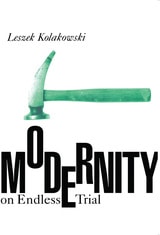
Modernity on Endless Trial
Leszek Kolakowski
University of Chicago Press, 1990
"Exemplary. . . . It should be celebrated." —Arthur C. Danto, New York Times Book Review
"This book . . . express[es] Kolakowski's thought on God, man, reason, history, moral truth and original sin, prompted by observation of the dramatic struggle among Christianity, the Enlightenment and modern totalitarianism. It is a wonderful collection of topics." —Thomas Nagel, Times Literary Supplement
"No better antidote to bumper-sticker thinking exists than this collection of 24 'appeals for moderation in consistency,' and never has such an antidote been needed more than it is now." —Joseph Coates, Chicago Tribune
"Whether learned or humorous, these essays offer gems in prose of diamond hardness, precision, and brilliance." —Thomas D'Evelyn, The Christian Science Monitor
A "Notable Books of the Year 1991" selection, New York Times Book Review—a "Noted with Pleasure" selection, New York Times Book Review—a "Summer Reading 1991" selection, New York Times Book Review—a "Books of the Year" selection, The Times.