Results by title
52 books match the query 'Cognitive Science' and 4 start with m

Metaphors We Live By
George Lakoff and Mark Johnson
University of Chicago Press, 1981
The now-classic Metaphors We Live By changed our understanding of metaphor and its role in language and the mind. Metaphor, the authors explain, is a fundamental mechanism of mind, one that allows us to use what we know about our physical and social experience to provide understanding of countless other subjects. Because such metaphors structure our most basic understandings of our experience, they are "metaphors we live by"—metaphors that can shape our perceptions and actions without our ever noticing them.
In this updated edition of Lakoff and Johnson's influential book, the authors supply an afterword surveying how their theory of metaphor has developed within the cognitive sciences to become central to the contemporary understanding of how we think and how we express our thoughts in language.
In this updated edition of Lakoff and Johnson's influential book, the authors supply an afterword surveying how their theory of metaphor has developed within the cognitive sciences to become central to the contemporary understanding of how we think and how we express our thoughts in language.
[more]
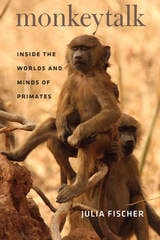
Monkeytalk
Inside the Worlds and Minds of PrimatesJulia Fischer
University of Chicago Press, 2017
Monkey see, monkey do—or does she? Can the behavior of non-human primates—their sociality, their intelligence, their communication—really be chalked up to simple mimicry? Emphatically, absolutely: no. And as famed primatologist Julia Fischer reveals, the human bias inherent in this oft-uttered adage is our loss, for it is only through the study of our primate brethren that we may begin to understand ourselves.
An eye-opening blend of storytelling, memoir, and science, Monkeytalk takes us into the field and the world’s primate labs to investigate the intricacies of primate social mores through the lens of communication. After first detailing the social interactions of key species from her fieldwork—from baby-wielding male Barbary macaques, who use infants as social accessories in a variety of interactions, to aggression among the chacma baboons of southern Africa and male-male tolerance among the Guinea baboons of Senegal—Fischer explores the role of social living in the rise of primate intelligence and communication, ultimately asking what the ways in which other primates communicate can teach us about the evolution of human language.
Funny and fascinating, Fischer’s tale roams from a dinner in the field shared with lionesses to insights gleaned from Rico, a border collie with an astonishing vocabulary, but its message is clear: it is humans who are the evolutionary mimics. The primate heritage visible in our species is far more striking than the reverse, and it is the monkeys who deserve to be seen. “The social life of macaques and baboons is a magnificent opera,” Fischer writes. “Permit me now to raise the curtain on it.”
[more]
Moral Politics
How Liberals and Conservatives Think, Third EditionGeorge Lakoff
University of Chicago Press, 2016
When Moral Politics was first published two decades ago, it redefined how Americans think and talk about politics through the lens of cognitive political psychology. Today, George Lakoff’s classic text has become all the more relevant, as liberals and conservatives have come to hold even more vigorously opposed views of the world, with the underlying assumptions of their respective worldviews at the level of basic morality. Even more so than when Lakoff wrote, liberals and conservatives simply have very different, deeply held beliefs about what is right and wrong.
Lakoff reveals radically different but remarkably consistent conceptions of morality on both the left and right. Moral worldviews, like most deep ways of understanding the world, are unconscious—part of our “hard-wired” brain circuitry. When confronted with facts that don’t fit our moral worldview, our brains work automatically and unconsciously to ignore or reject these facts, and it takes extraordinary openness and awareness of this phenomenon to pay critical attention to the vast number of facts we are presented with each day. For this new edition, Lakoff has added a new preface and afterword, extending his observations to major ideological conflicts since the book's original publication, from the Affordable Care Act to the wars in Iraq and Afghanistan, the recent financial crisis, and the effects of global warming. One might have hoped such massive changes would bring people together, but the reverse has actually happened; the divide between liberals and conservatives has become stronger and more virulent.
To have any hope of bringing mutual respect to the current social and political divide, we need to clearly understand the problem and make it part of our contemporary public discourse. Moral Politics offers a much-needed wake-up call to both the left and the right.
[more]
Morality for Humans
Ethical Understanding from the Perspective of Cognitive ScienceMark Johnson
University of Chicago Press, 2014
What is the difference between right and wrong? This is no easy question to answer, yet we constantly try to make it so, frequently appealing to some hidden cache of cut-and-dried absolutes, whether drawn from God, universal reason, or societal authority. Combining cognitive science with a pragmatist philosophical framework in Morality for Humans: Ethical Understanding from the Perspective of Cognitive Science, Mark Johnson argues that appealing solely to absolute principles and values is not only scientifically unsound but even morally suspect. He shows that the standards for the kinds of people we should be and how we should treat one another—which we often think of as universal—are in fact frequently subject to change. And we should be okay with that. Taking context into consideration, he offers a remarkably nuanced, naturalistic view of ethics that sees us creatively adapt our standards according to given needs, emerging problems, and social interactions.
Ethical naturalism is not just a revamped form of relativism. Indeed, Johnson attempts to overcome the absolutist-versus-relativist impasse that has been one of the most intractable problems in the history of philosophy. He does so through a careful and inclusive look at the many ways we reason about right and wrong. Much of our moral thought, he shows, is automatic and intuitive, gut feelings that we follow up and attempt to justify with rational analysis and argument. However, good moral deliberation is not limited merely to intuitive judgments supported after the fact by reasoning. Johnson points out a crucial third element: we imagine how our decisions will play out, how we or the world would change with each action we might take. Plumbing this imaginative dimension of moral reasoning, he provides a psychologically sophisticated view of moral problem solving, one perfectly suited for the embodied, culturally embedded, and ever-developing human creatures that we are.
Ethical naturalism is not just a revamped form of relativism. Indeed, Johnson attempts to overcome the absolutist-versus-relativist impasse that has been one of the most intractable problems in the history of philosophy. He does so through a careful and inclusive look at the many ways we reason about right and wrong. Much of our moral thought, he shows, is automatic and intuitive, gut feelings that we follow up and attempt to justify with rational analysis and argument. However, good moral deliberation is not limited merely to intuitive judgments supported after the fact by reasoning. Johnson points out a crucial third element: we imagine how our decisions will play out, how we or the world would change with each action we might take. Plumbing this imaginative dimension of moral reasoning, he provides a psychologically sophisticated view of moral problem solving, one perfectly suited for the embodied, culturally embedded, and ever-developing human creatures that we are.
[more]