Results by title
233 books match the query 'Cold War' and 9 start with m
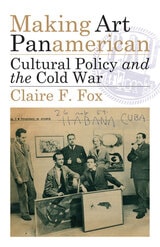
Making Art Panamerican
Cultural Policy and the Cold WarClaire F. Fox
University of Minnesota Press, 2013
Among the buildings on the National Mall in Washington, D.C., only the Pan American Union (PAU) houses an international organization. The first of many anticipated “peace palaces”constructed in the early twentieth century, the PAU began with a mission of cultural diplomacy, and after World War II its Visual Arts Section became a leader in the burgeoning hemispheric arts scene, proclaiming Latin America’s entrée into the international community as it forged connections between a growing base of middle-class art consumers on one hand and concepts of supranational citizenship and political and economic liberalism on the other.
Making Art Panamerican situates the ambitious visual arts programs of the PAU within the broader context of hemispheric cultural relations during the cold war. Focusing on the institutional interactions among aesthetic movements, cultural policy, and viewing publics, Claire F. Fox contends that in the postwar years, the PAU Visual Arts Section emerged as a major transfer point of hemispheric American modernist movements and played an important role in the consolidation of Latin American art as a continental object of study.
As it traces the careers of individual cultural policymakers and artists who intersected with the PAU in the two postwar decades—such as Concha Romero James, Charles Seeger, José Gómez Sicre, José Luis Cuevas, and Rafael Squirru—the book also charts the trajectories and displacements of sectors of the U.S. and Latin American intellectual left during a tumultuous interval that spans the Mexican Revolution, the Spanish Civil War, the New Deal, and the early cold war. Challenging the U.S. bias of conventional narratives about Panamericanism and the postwar shift in critical values from realism to abstraction, Making Art Panamerican illuminates the institutional dynamics that helped shape aesthetic movements in the critical decades following World War II.
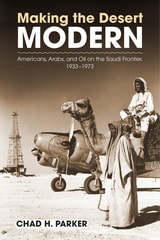
Making the Desert Modern
Americans, Arabs, and Oil on the Saudi Frontier, 1933–1973Chad Parker
University of Massachusetts Press, 2015
In 1933 American oilmen representing what later became the Arabian American Oil Company (Aramco) signed a concession agreement with the Saudi Arabian king granting the company sole proprietorship over the oil reserves in the country's largest province. As drilling commenced and wells proliferated, Aramco soon became a major presence in the region. In this book Chad H. Parker tells Aramco's story, showing how an American company seeking resources and profits not only contributed to Saudi “nation building” but helped define U.S. foreign policy during the early Cold War.
In the years following World War II, as Aramco expanded its role in Saudi Arabia, the idea of “modernization” emerged as a central component of American foreign policy toward newly independent states. Although the company engaged in practices supportive of U.S. goals, its own modernizing efforts tended to be pragmatic rather than policy-driven, more consistent with furthering its business interests than with validating abstract theories. Aramco built the infrastructure necessary to extract oil and also carved an American suburb out of the Arabian desert, with all the air-conditioned comforts of Western modern life. At the same time, executives cultivated powerful relationships with Saudi government officials and, to the annoyance of U.S. officials, even served the monarchy in diplomatic disputes. Before long the company became the principal American diplomatic, political, and cultural agent in the country, a role it would continue to play until 1973, when the Saudi government took over its operation.
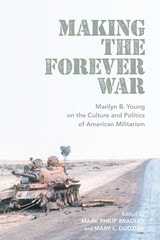
Making the Forever War
Marilyn B. Young on the Culture and Politics of American MilitarismMary L. Dudziak
University of Massachusetts Press, 2021
Making the Forever War brings Young's articles and essays on American war together for the first time, including never before published works. Moving from the first years of the Cold War to Korea, Vietnam, and more recent "forever" wars in Iraq and Afghanistan, Young reveals the ways in which war became ever-present, yet more covert and abstract, particularly as aerial bombings and faceless drone strikes have attained greater strategic value. For Young, U.S. empire persisted because of, not despite, the inattention of most Americans. The collection concludes with an afterword by prominent military historian Andrew Bacevich.
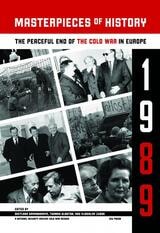
Masterpieces of History
The Peaceful End of the Cold War in Europe, 1989The National Security Archive Savranskaya
Central European University Press, 2010
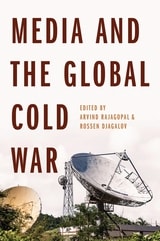
Media and the Global Cold War
Edited by Rossen Djagalov and Arvind Rajagopal
University of Illinois Press, 2027
Arvind Rajagopal and Rossen Djagalov present essays on the uses of Cold War media. Focusing on the Global South, the contributors illuminate how postcolonial nations and others defied superpower pressure to use media for nation-building and international cooperation. At the same time, communication infrastructures linked global regions in unequal ways that often reinforced the power of the United States. Throughout, the essays show how Cold War media practices like secrecy, propaganda, and cultural diplomacy cemented patterns that still influence global communication systems and international politics today.
Cutting-edge and timely, Media and the Global Cold War reveals the workings of media beyond the superpower rivalry.
Memoirs Of A Cold War Son
Post, Gaines, Jr.
University of Iowa Press, 2000
In 1951 Gaines Post was a gangly, bespectacled, introspective teenager preparing to spend a year in Paris with his professorial father and older brother; his mother, who suffered from extreme depression, had been absent from the family for some time. Ten years later, now less gangly but no less introspective, he was finishing a two-year stint in the army in West Germany and heading toward Oxford on a Rhodes scholarship, having narrowly escaped combat in the Berlin crisis of 1961. His quietly intense coming-of-age story is both self-revealing and reflective of an entire generation of young men who came to adulthood before the Cuban Missile Crisis and the Vietnam War.
Post's experiences in high school in Madison, Wisconsin, and Paris, his Camus-influenced undergraduate years at Cornell University, and his army service in Germany are set very effectively against the events of the Cold War. McCarthyism and American crackdowns on dissidents, American foreign and military policy in Western Europe in the nuclear age, French and German life and culture, crises in Paris and Berlin that nearly bring the West to war and the Post family to dissolution—these are the larger scenes and subjects of his self-disclosure as a contemplative, conflicted "Cold War agnostic."
His intelligent, talented mother and her fragile health hover over Post's narrative, informing his hesitant relationships with women and his acutely questioning sense of self-worth. His story is strongly academic and historical as well as political and military; his perceptions and judgments lean toward no ideological extreme but remain true to the heroic ideals of his boyhood during the Second World War.
Military Intervention after the Cold War
The Evolution of Theory and PracticeAndrea Kathryn Talentino
Ohio University Press, 2005
Military Intervention After the Cold War explores how and why this change took place, looking at how both ideas and actions changed in the post-Cold War period to make military intervention a tool of international security and a defining characteristic of the international system. Although it is often touted as a strategy to rebuild collapsed states, the examples of success are few and far between. Andrea Kathryn Talentino argues that standards of human rights and responsible governance have become part of the definition of international security. She addresses questions that are vital in the post-9/11 world, where weak and collapsed states are recognized as permissive and at times supportive environments for criminal actors.
The specter of terrorism has placed even greater emphasis on the need to understand why military intervention happens and how it could be more effective. With the news full of stories on intervention and nation-building, scholars, graduate and undergraduate students, and readers interested in understanding global interdependence will find Military Intervention After the Cold War an indispensable book.Andrea Kathryn Talentino is an assistant professor of international relations at Tulane University, New Orleans.The author of numerous articles on military intervention and post- conflict rebuilding, she is currently focusing on the link between nation-building and political violence.
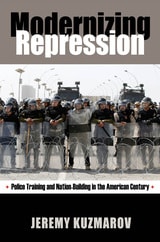
Modernizing Repression
Police Training and Nation-Building in the American CenturyJeremy Kuzmarov
University of Massachusetts Press, 2012
As American troops became bogged down first in Iraq and then Afghanistan, a key component of U.S. strategy was to build up local police and security forces in an attempt to establish law and order. This approach, Jeremy Kuzmarov shows, is consistent with practices honed over more than a century in developing nations within the expanding orbit of the American empire. From the conquest of the Philippines and Haiti at the turn of the twentieth century through Cold War interventions and the War on Terror, police training has been valued as a cost-effective means of suppressing radical and nationalist movements, precluding the need for direct U.S. military intervention and thereby avoiding the public opposition it often arouses.
Unlike the spectacular but ephemeral pyrotechnics of the battlefield, police training programs have had lasting consequences for countries under the American imperial umbrella, fostering new elites, creating powerful tools of social control, and stifling political reform. These programs have also backfired, breeding widespread resistance, violence, and instability—telltale signs of “blowback” that has done more to undermine than advance U.S. strategic interests abroad.
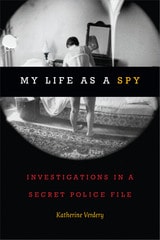
My Life as a Spy
Investigations in a Secret Police FileKatherine Verdery
Duke University Press, 2018