Results by title
83 books match the query 'College students' and 3 start with m
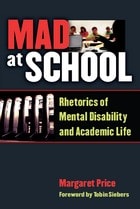
Mad at School
Rhetorics of Mental Disability and Academic LifeMargaret Price
University of Michigan Press, 2011
"A very important study that will appeal to a disability studies audience as well as scholars in social movements, social justice, critical pedagogy, literacy education, professional development for disability and learning specialists in access centers and student counseling centers, as well as the broader domains of sociology and education."
---Melanie Panitch, Ryerson University
"Ableism is alive and well in higher education. We do not know how to abandon the myth of the 'pure (ivory) tower that props up and is propped up by ableist ideology.' . . . Mad at School is thoroughly researched and pathbreaking. . . . The author's presentation of her own experience with mental illness is woven throughout the text with candor and eloquence."
---Linda Ware, State University of New York at Geneseo
Mad at School explores the contested boundaries between disability, illness, and mental illness in the setting of U.S. higher education. Much of the research and teaching within disability studies assumes a disabled body but a rational and energetic (an "agile") mind. In Mad at School, scholar and disabilities activist Margaret Price asks: How might our education practices change if we understood disability to incorporate the disabled mind?
Mental disability (more often called "mental illness") is a topic of fast-growing interest in all spheres of American culture, including popular, governmental, aesthetic, and academic. Mad at School is a close study of the ways that mental disabilities impact academic culture. Investigating spaces including classrooms, faculty meeting rooms, and job searches, Price challenges her readers to reconsider long-held values of academic life, including productivity, participation, security, and independence. Ultimately, she argues that academic discourse both produces and is produced by a tacitly privileged "able mind," and that U.S. higher education would benefit from practices that create a more accessible academic world.
Mad at School is the first book to use a disability-studies perspective to focus specifically on the ways that mental disabilities impact academic culture at institutions of higher education. Individual chapters examine the language used to denote mental disability; the role of "participation" and "presence" in student learning; the role of "collegiality" in faculty work; the controversy over "security" and free speech that has arisen in the wake of recent school shootings; and the marginalized status of independent scholars with mental disabilities.
Margaret Price is Associate Professor of English at Spelman College.
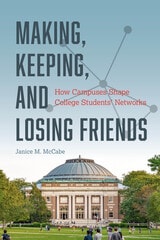
Making, Keeping, and Losing Friends
How Campuses Shape College Students' NetworksJanice M. McCabe
University of Chicago Press, 2025
We’re all familiar with the sentiment that “college is the best time of your life.” Along with a newfound sense of freedom, students have a unique opportunity to forge lifelong friendships at a point in life when friendship is particularly important. Why is it, then, that so many college students are falling victim to what the US Surgeon General termed an “epidemic of loneliness and isolation”? How do different aspects of college life help or hinder students’ ability to form deep connections?
In Making, Keeping, and Losing Friends: How Campuses Shape College Students’ Networks, sociologist Janice M. McCabe shows that the way a college is structured—whether students live in dorms or commute, study abroad or stay close to campus, have plentiful common areas for clubs to meet or not—can either encourage or hinder the making of meaningful friendships. Based on interviews with 95 students on three distinct campuses—a small private college (Dartmouth College), a large public university (University of New Hampshire), and a non-residential community college (Manchester Community College)—McCabe captures a wide range of experiences and discovers how features of the campuses make it easier or harder for students to make and keep friends. She shows how and why, across all three institutions, some students thrive in deep and lasting friendships with their peers.
As McCabe’s research reveals, we need to look at the structures of students’ networks, the institutions they attend, and the importance of their identities in these places if we are to truly uncover and address the loneliness epidemic facing today’s young adults.
Meaningful Grading
A Guide for Faculty in the ArtsHoag Holmgren
West Virginia University Press, 2018
College and university faculty in the arts (visual, studio, language, music, design, and others) regularly grade and assess undergraduate student work but often with little guidance or support. As a result, many arts faculty, especially new faculty, adjunct faculty, and graduate student instructors, feel bewildered and must “reinvent the wheel” when grappling with the challenges and responsibilities of grading and assessing student work.
Meaningful Grading: A Guide for Faculty in the Arts enables faculty to create and implement effective assessment methodologies—research based and field tested—in traditional and online classrooms. In doing so, the book reveals how the daunting challenges of grading in the arts can be turned into opportunities for deeper student learning, increased student engagement, and an enlivened pedagogy.