Results by title
90 books match the query 'Colonial period, ca. 1600-1775' and 3 start with m
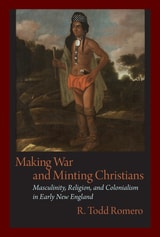
Making War and Minting Christians
Masculinity, Religion, and Colonialism in Early New EnglandR. Todd Romero
University of Massachusetts Press, 2011
In this book, R. Todd Romero traces the interaction of notions of gender, the practice of religion, and the conduct of warfare in colonial America. He shows how Native and Anglo-American ideas of manhood developed in counterpoint, in the context of Christian evangelization, colonial expansion, and recurrent armed conflict.
For the English, the cultivation of manliness became an important aspect of missionary efforts. Conversion demanded that the English “make men” of the Indians before they could “make them Christians,” a process that involved reshaping Native masculinity according to English patriarchal ideals that the colonists themselves rarely matched. For their part, Native Americans held on to older ways of understanding the divine and defining gender even as they entered English “praying towns” and negotiated the steep demands of the missionaries.
Evolving ideas of masculinity resonated with religious significance and shaped the meaning of warfare for Natives and colonists alike. Just as the English believed that their territorial expansion was divinely sanctioned, Indians attributed a string of victories in King Philip's War to “the Great God” and the perception that their enemies “were like women.” Trusting that war and manliness were necessarily linked, both groups engaged in ritual preparations for battle, believed deeply in the efficacy of the supernatural to affect the outcome of combat, and comprehended the meaning of war in distinctly religious ways.
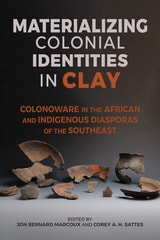
Materializing Colonial Identities in Clay
Colonoware in the African and Indigenous Diasporas of the SoutheastEdited by Jon Bernard Marcoux and Corey A. H. Sattes
University of Alabama Press, 2024
An interdisciplinary excavation of colonoware as a material archive of African, Indigenous, and colonial entanglements across the early American South.
In Materializing Colonial Identities in Clay, Jon Bernard Marcoux, Corey A. H. Sattes, and contributors examine colonoware to explore the active roles that African Americans and Indigenous people played in constructing southern colonial culture and part of their shared history with Europeans.
Colonoware was most likely produced by African and Indigenous potters and used by all colonial groups for cooking, serving, and storing food. It formed the foundation of colonial foodways in many settlements across the southeastern United States. Even so, compared with other ceramics from this period, less has been understood about its production and use because of the lack of documentation. This collection of essays fills this gap with valuable, recent archaeological data from which much may be surmised about the interaction among Europeans, Indigenous, and Africans, especially within the contexts of the African and Indigenous slave trade and plantation systems.
The chapters represent the full range of colonoware research: from the beginning to the end of its production, from urban to rural contexts, and from its intraregional variation in the Lowcountry to the broad patterns of colonialism across the early American Southeast. The book summarizes current approaches in colonoware research and how these may bridge the gaps between broader colonial American studies, Indigenous studies, and African Diaspora studies.
A concluding discussion contextualizes the chapters through the perspectives of intersectionality and Black feminist theory, drawing attention to the gendered and racialized meanings embodied in colonoware, and considering how colonialism and slavery have shaped these cultural dimensions and archaeologists’ study of them.
Messy Beginnings
Postcoloniality and Early American StudiesEdited by Malini Johar Schueller and Edward Watts
Rutgers University Press, 2003
When exploring the links between America and postcolonialism, scholars tend to think either in terms of contemporary multiculturalism, or of imperialism since 1898. This narrow view has left more than the two prior centuries of colonizing literary and political culture unexamined.
Messy Beginnings challenges the idea of early America’s immunity from issues of imperialism, that its history is not as “clean” as European colonialism. By addressing the literature ranging from the diaries of American women missionaries in the Middle East to the work of Benjamin Franklin and Nathaniel Hawthorne, and through appraisals of key postcolonial theorists such as Edward Said, Gayatri Spivak, and Homi Bhabha, the contributors to this volume explore the applicability of their models to early American culture.
Messy Beginnings argues against the simple concept that the colonization of what became the United States was a confrontation between European culture and the “other.” Contributors examine the formation of America through the messy or unstable negotiations of the idea of “nation.”
The essays forcefully show that the development of “Americanness” was a raced and classed phenomenon, achieved through a complex series of violent encounters, legal maneuvers, and political compromises. The complexity of early American colonization, where there was not one coherent “nation” to conquer, contradicts the simple label of imperialism used in other lands. The unique approach of Messy Beginnings will reshape both pre-conceived notions of postcolonialism, and how postcolonialists think about the development of the American nation.