Results by title
100 books match the query 'Commentary' and 6 start with m
Mao Zedong’s “Talks at the Yan’an Conference on Literature and Art”
A Translation of the 1943 Text with CommentaryBonnie S. McDougall
University of Michigan Press, 1980
The writings of Mao Zedong have been circulated throughout the world more widely, perhaps, than those of any other single person this century. The “Talks at the Yan’an Conference on Literature and Art” has occupied a prominent position among his many works and has been the subject of intense scrutiny both within and outside China. This text has undoubted importance to modern Chinese literature and history. In particular, it reveals Mao’s views on such questions as the relationship between writers or works of literature and their audience, or the nature and value of different kinds of literary products.
In this translation and commentary, Bonnie S. McDougall finds that Mao was in fact ahead of many of his critics in the West and his Chinese contemporaries in his discussion of literary issues. Unlike the majority of modern Chinese writers deeply influenced by Western theories of literature and society (including Marxism), Mao remained close to traditional patterns of thought and avoided the often mechanical or narrowly literal interpretations that were the hallmark of Western schools current in China in the early twentieth century.
Many of the detailed discussions on the “Talks” in the West have been concerned with their political and historical significance. However, since Mao is a literary figure of some importance in twentieth-century China, McDougall finds it worthwhile to follow up his published remarks on the nature and source of literature and the means of its evaluation. By better understanding the complex and revolutionary ideas contained in the “Talks,” McDougall suggests we may acquire the necessary analytical tools for a more fruitful investigation into contemporary Chinese literature.
[more]
Matthew 16
21–28:20: Introduction and CommentaryWarren Carter
SBL Press, 2025
In volume 2 of this remarkable two-volume commentary, Warren Carter situates Matthew 16:21–28:20 within the context of Jewish traditions and Roman power after the destruction of Jerusalem in 70 CE. Each passage is translated, with interpretation and commentary following. Carter reveals how the text illuminates the diverse ways a community of Jesus followers navigated imperial power. In addition to his thorough examination of the gospel in its historical and social context, Carter shines new light on instances of the Gospel of Matthew’s reception, illustrating how scholars have interpreted it from the era of the early church up to the present.
[more]
Matthew 1
1–16:20: Introduction and CommentaryWarren Carter
SBL Press, 2025
In volume 1 of this remarkable two-volume commentary, Warren Carter situates Matthew 1:1–16:20 within the context of Jewish traditions and Roman power after the destruction of Jerusalem in 70 CE. Each passage is translated, with interpretation and commentary following. Carter reveals how the text illuminates the diverse ways a community of Jesus followers navigated imperial power. The volume’s History of Consequences sections shine new light on instances of the Gospel of Matthew’s reception in ancient and modern media through the application of a range of methodologies, readings from different geographic locations, and social contexts.
[more]
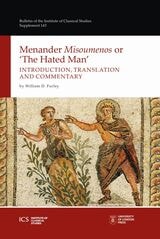
Menander "Misoumenos" or "The Hated Man"
Introduction, Translation, and CommentaryWilliam Furley
University of London Press, 2021
Based on recently discovered fragments, this is one of the most complete English-language publications of Misoumenos, or The Hated Man.
Menander’s Misoumenos, or The Hated Man, is one of his most popular plays to have survived from classical times. Dating to approximately 300 BCE, it tells the story of a mercenary soldier and the captive girl he acquires while on campaign in Cyprus. The play follows the soldier’s growing despair as the girl spurns his advances and slowly turns against him, culminating in his suicidal thoughts.
The play belongs to the ancient genre of New Comedy, of which Menander was the acknowledged master. This edition presents a significantly updated text and the fullest English language translation of the play to date. It aims to restore as much as possible of the action of Misoumenos, reconstructing the language, stagecraft, and theatrical dialogue of the original based on hypothesis and reconstruction. Some sections can be restored nearly in full, permitting access to brilliantly original theatrical dialogue which had been lost for over two millennia. Apart from meter and sophisticated idiom, the themes of love, despair, and sadness that Menander treats are utterly timeless.
[more]
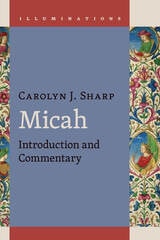
Micah
Introduction and CommentaryCarolyn J. Sharp
SBL Press, 2025
Written by Carolyn J. Sharp, a leading scholar of biblical prophetic literature, this commentary provides scholars and preachers with a thorough overview of historical, literary, and theological dimensions of the book of Micah. Sharp explores the political and economic dimensions of prophecy as well as its relevance to ecological justice. Each passage is translated and interpreted in an accessible style. The commentary also examines the reception history of Micah among Jewish and Christian interpreters in the History of Consequences section.
[more]
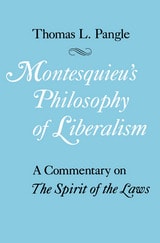
Montesquieu's Philosophy of Liberalism
A Commentary on The Spirit of the LawsThomas L. Pangle
University of Chicago Press, 1973
This first comprehensive commentary on The Spirit of the Laws uncovers and explicates the plan of Montesquieu's famous but baffling treatise. Pangle brings to light Montesquieu's rethinking of the philosophical groundwork of liberalism, showing how The Spirit of the Laws enlarges and enriches the liberal conception of natural right by means of a new appeal to History as the source of basic norms.
[more]