Results by title
173 books match the query 'Commerce' and 12 start with m

Making Money
Life, Death, and Early Modern Trade on Africa’s Guinea CoastColleen E. Kriger
Ohio University Press, 2017
A new era in world history began when Atlantic maritime trade among Africa, Asia, Europe, and the Americas opened up in the fifteenth century, setting the stage for massive economic and cultural change. In Making Money, Colleen Kriger examines the influence of the global trade on the Upper Guinea Coast two hundred years later—a place and time whose study, in her hands, imparts profound insights into Anglo-African commerce and its wider milieu.
A stunning variety of people lived in this coastal society, struggling to work together across deep cultural divides and in the process creating a dynamic creole culture. Kriger digs further than any previous historian of Africa into the records of England’s Royal African Company to illuminate global trade patterns, the interconnectedness of Asian, African, and European markets, and—most remarkably—the individual lives that give Making Money its human scale.
By inviting readers into the day-to-day workings of early modern trade in the Atlantic basin, Kriger masterfully reveals the rich social relations at its core. Ultimately, this accessible book affirms Africa’s crucial place in world history during a transitional period, the early modern era.

Mangos, Chiles, and Truckers
The Business of TransnationalismRobert Alvarez Jr.
University of Minnesota Press, 2005
Contrary to common perceptions in postnational studies, Alvarez shows how the nation-state enacts and connects with the transnational, crossing borders in ways that underwrite new technology and trade. Emphasizing the importance and control of the nation-state in the global process, Mangos, Chiles, and Truckers demonstrates how people make meaning as they struggle with the economic circumstances of their lives, creating cultural traditions and giving new value to old customs and practices.
Robert R. Alvarez Jr. is professor of ethnic studies at the University of California, San Diego.
George Lipsitz is professor of American studies at the University of California, Santa Cruz.

Market Day in Provence
Michèle de La Pradelle
University of Chicago Press, 2006
The renewal and celebration of the outdoor market culture in recent years, argues de La Pradelle, artfully masks a fierce commitment to modern-day free-market economics. Responding to consumer desire for an experience that recalls a time before impersonal supermarket chains and mass-produced products, buyers and sellers alike create an atmosphere built on various fictions. Vendors at the market at Carpentras, for example, oblige patrons by acting like lifelong acquaintances of those whom they’ve only just met as they dispense free samples and lively, witty banter. Likewise, going to the market to look for “freshness” becomes a way for the consumer to signify the product’s relation to nature—a denial of the workaday reality of growing melons under plastic sheets, then machine-sorting, crating, and transporting them.
Offering captivating descriptions of goods and the friendly and occasionally piquant exchanges between buyers and sellers, Market Day in Provence will be devoured by any reader with an interest in areas as diverse as food, ethnography, globalization, modernity, and French culture.
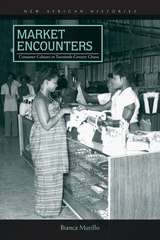
Market Encounters
Consumer Cultures in Twentieth-Century GhanaBianca Murillo
Ohio University Press, 2017
In Market Encounters, Bianca Murillo explores the shifting social terrains that made the buying and selling of goods in modern Ghana possible. Fusing economic and business history with social and cultural history, she traces the evolution of consumerism in the colonial Gold Coast and independent Ghana from the late nineteenth century through to the political turmoil of the 1970s.
Murillo brings sales clerks, market women, and everyday consumers in Ghana to the center of a story that is all too often told in sweeping metanarratives about what happens when African businesses are incorporated into global markets. By emphasizing the centrality of human relationships to Ghana’s economic past, Murillo introduces a radical rethinking of consumption studies from an Africa-centered perspective. The result is a keen look at colonial capitalism in all of its intricacies, legacies, and contradictions, including its entanglement with gender and race.
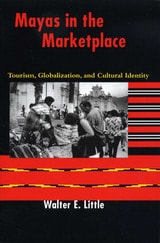
Mayas in the Marketplace
Tourism, Globalization, and Cultural IdentityBy Walter E. Little
University of Texas Press, 2004
2005 — Best Book Award – New England Council of Latin American Studies
Selling handicrafts to tourists has brought the Maya peoples of Guatemala into the world market. Vendors from rural communities now offer their wares to more than 500,000 international tourists annually in the marketplaces of larger cities such as Antigua, Guatemala City, Panajachel, and Chichicastenango. Like businesspeople anywhere, Maya artisans analyze the desires and needs of their customers and shape their products to meet the demands of the market. But how has adapting to the global marketplace reciprocally shaped the identity and cultural practices of the Maya peoples?
Drawing on over a decade of fieldwork, Walter Little presents the first ethnographic study of Maya handicraft vendors in the international marketplace. Focusing on Kaqchikel Mayas who commute to Antigua to sell their goods, he explores three significant issues:
- how the tourist marketplace conflates global and local distinctions.
- how the marketplace becomes a border zone where national and international, developed and underdeveloped, and indigenous and non-indigenous come together.
- how marketing to tourists changes social roles, gender relationships, and ethnic identity in the vendors' home communities.
Little's wide-ranging research challenges our current understanding of tourism's negative impact on indigenous communities. He demonstrates that the Maya are maintaining a specific, community-based sense of Maya identity, even as they commodify their culture for tourist consumption in the world market.

Media Between Culture and Commerce
An IntroductionEdited by Els de Bens
Intellect Books, 2007
In the face of declining newspaper sales, challenges from online competitors, and flagging ratings for broadcast news programs, media companies have struggled to maintain their relevance. Media between Culture and Commerce brings together a group of European media experts to address the consequences of a system that is increasingly powered by global media conglomerates that set the pace of news and information. As national borders blur and the corporations behind journalism and broadcasting continue to merge, this timely volume will prove a necessary resource to those interested in European media studies and globalization.

Medieval Merchants and Money
Essays in Honour of James L. BoltonEdited by Matthew Davies
University of London Press, 2016

Meetings at the Margins
Prehistoric Cultural Interactions in the Intermountain WestDavid Rhode
University of Utah Press, 2012
Environmental conditions clearly influenced the cultural development of societies in the Intermountain West, but how did interactions with neighbors living along the region’s borders affect a society’s growth and advancement, its cultural integrity, and its long-term survival? Relationships among different societies are, of course, crucial to the spread of information, innovation, and belief systems; to the maintenance of exchange and mating networks; and to the forging of ethnic identity. In these ways and others, intergroup relationships can be as strong a force in shaping a society’s identity and future as are local social and economic dynamics.
Meetings at the Margins focuses on the ways in which different societies in the Intermountain West profoundly influenced each other’s histories throughout the more than fourteen millennia of prehistoric occupation. Historically, inhabitants of this region frequently interacted with more than forty different groups—neighbors who spoke some two dozen different languages and maintained diverse economies. The contributors to this volume demonstrate that in the prehistoric Intermountain West, as elsewhere throughout the world, intergroup interactions were pivotal for the dynamic processes of cultural cohesion, differentiation, and change, and they affirm the value of a long-term, large-scale view of prehistory.

Merchant Class of Medieval London
1300-1500Sylvia L. Thrupp
University of Michigan Press, 1948

Merchants of Medicines
The Commerce and Coercion of Health in Britain’s Long Eighteenth CenturyZachary Dorner
University of Chicago Press, 2020
In Merchants of Medicines, Zachary Dorner follows the earliest industrial pharmaceuticals from their manufacture in the United Kingdom, across trade routes, and to the edges of empire, telling a story of what medicines were, what they did, and what they meant. He brings to life business, medical, and government records to evoke a vibrant early modern world of London laboratories, Caribbean estates, South Asian factories, New England timber camps, and ships at sea. In these settings, medicines were produced, distributed, and consumed in new ways to help confront challenges of distance, labor, and authority in colonial territories. Merchants of Medicines offers a new history of economic and medical development across early America, Britain, and South Asia, revealing the unsettlingly close ties among medicine, finance, warfare, and slavery that changed people’s expectations of their health and their bodies.
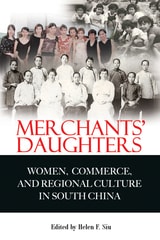
Merchants' Daughters
Women, Commerce, and Regional Culture in South ChinaEdited by Helen F. Siu
Hong Kong University Press, 2010

Money Has No Smell
The Africanization of New York CityPaul Stoller
University of Chicago Press, 2002
Blending fascinating ethnographic description with incisive social analysis, Stoller shows how these savvy West African entrepreneurs have built cohesive and effective multinational trading networks, in part through selling a simulated Africa to African Americans. These and other networks set up by the traders, along with their faith as devout Muslims, help them cope with the formidable state regulations and personal challenges they face in America. As Stoller demonstrates, the stories of these West African traders illustrate and illuminate ongoing debates about globalization, the informal economy, and the changing nature of American communities.