Results by title
319 books match the query 'Communication Studies' and 15 start with m
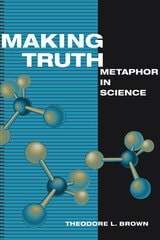
Making Truth
Metaphor in ScienceTheodore L. Brown
University of Illinois Press, 2002
To illustrate the roles of metaphor in science, Brown presents a series of studies of scientific systems. These range from the atom, historically one of the most important ideas in science, through models in chemistry and biology, including current “hot” topics such as protein folding, chaperone proteins, and global warming. The case studies in Making Truth illustrate the deeply metaphorical nature of scientific reasoning and communication. They provide the basis for far-reaching conclusions about science as an intellectual and social practice and about the nature of scientific truth.
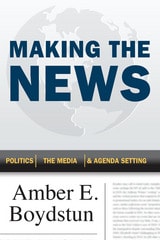
Making the News
Politics, the Media, and Agenda SettingAmber E. Boydstun
University of Chicago Press, 2013
With Making the News, Amber Boydstun offers an eye-opening look at the explosive patterns of media attention that determine which issues are brought before the public. At the heart of her argument is the observation that the media have two modes: an “alarm mode” for breaking stories and a “patrol mode” for covering them in greater depth. While institutional incentives often initiate alarm mode around a story, they also propel news outlets into the watchdog-like patrol mode around its policy implications until the next big news item breaks. What results from this pattern of fixation followed by rapid change is skewed coverage of policy issues, with a few receiving the majority of media attention while others receive none at all. Boydstun documents this systemic explosiveness and skew through analysis of media coverage across policy issues, including in-depth looks at the waxing and waning of coverage around two issues: capital punishment and the “war on terror.”
Making the News shows how the seemingly unpredictable day-to-day decisions of the newsroom produce distinct patterns of operation with implications—good and bad—for national politics.
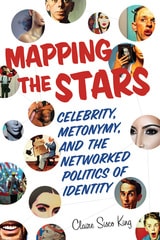
Mapping the Stars
Celebrity, Metonymy, and the Networked Politics of IdentityClaire Sisco King
The Ohio State University Press, 2023
King considers three stars with popular and controversial personas: Norman Rockwell, Will Smith, and Kim Kardashian. Working in very different contexts and with very different public images, these figures nonetheless share a consistent, if not conspicuous, interest in celebrity as a construct. Offering intertextual readings of their public images across such sites as movie posters, magazines, cinema, and social media—and deploying rhetorical theories of metonymy (a linguistic device linking signifiers by shared associations)—King argues that these stars’ self-reflexive attention to the processes by which celebrity is created and constrained creates opportunities for reframing public discourse about what it means to be famous and what it means to be a person.
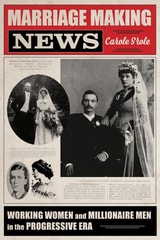
Marriage Making News
Working Women and Millionaire Men in the Progressive EraCarole Srole
University of Illinois Press, 2026
Women’s desire for autonomy, a rising divorce rate, the declining power of the upper class, new ideas of beauty and sexuality—newspaper tales of cross-class nuptials brought a host of anxieties about gender and class to the front page. Srole focuses particular attention on the economic changes faced by working-class women while also surveying newspaper attacks on their morality and womanhood, and their complicity in their own poverty. As she shows, working women and their advocates persevered by asserting an independence they pursued through union activism, professionalism, land ownership, and filling traditionally male jobs.
An engaging merger of media and women’s history, Marriage Making News looks at a rags-to-riches genre and illuminates the forces of change at work behind the stories.

Media Between Culture and Commerce
An IntroductionEdited by Els de Bens
Intellect Books, 2007
In the face of declining newspaper sales, challenges from online competitors, and flagging ratings for broadcast news programs, media companies have struggled to maintain their relevance. Media between Culture and Commerce brings together a group of European media experts to address the consequences of a system that is increasingly powered by global media conglomerates that set the pace of news and information. As national borders blur and the corporations behind journalism and broadcasting continue to merge, this timely volume will prove a necessary resource to those interested in European media studies and globalization.
Media Capital
Architecture and Communications in New York CityAurora Wallace
University of Illinois Press, 2012
Media Localism
The Policies of PlaceChristopher Ali
University of Illinois Press, 2017
Media, Geopolitics, and Power
A View from the Global SouthHerman Wasserman
University of Illinois Press, 2018
Herman Wasserman analyzes the debates surrounding South Africa's new media presence against the backdrop of rapidly changing geopolitics. His exploration reveals how South African disputes regarding access to, and representation in, the media reflect the domination and inequality in the global communication sphere. Optimists see post-apartheid media as providing a vital space that encourages exchanges of opinion in a young democracy. Critics argue the public sphere mirrors South Africa's past divisions and privileges the viewpoints of the elite. Wasserman delves into the ways these simplistic narratives obscure the country's internal tensions, conflicts, and paradoxes even as he charts the diverse nature of South African entry into the global arena.

Medical Misinformation in Early Modern Germany
Christopher Hutchinson
University of Delaware Press, 2026
Medical Misinformation in Early Modern Germany examines how doctors, writers, and printers in sixteenth-century Germany responded to the rapid expansion of print and its implications for medical knowledge. The spread of printed texts generated widespread suspicion about print’s reliability as a conduit of information and led writers to reflect on questions of audience, vernacularity, and medical authority in their responses to disease. The book investigates literary texts alongside popular vernacular medical pamphlets on the major epidemic diseases of the period––plague, syphilis, and the English sweating sickness––to reveal a widespread concern with the impact of printed texts on public health. During the 1529 outbreak of the English sweating sickness, this concern culminated in writers’ use of a “rhetoric of virality,” explicitly comparing the circulation of texts to the spread of disease, as they confronted the parallel contagions of disease and information.
Metafilm
Materialist Rhetoric and Reflexive CinemaChristopher Carter
The Ohio State University Press, 2018
Ultimately, Metafilm reframes materialism as a multimodal composing-in-action, or reflexive materialism, focusing on movies that dramatize their entanglement in economic and historical trauma while provoking forms of resistance during and after viewing. Carter contends that even as we recognize the division of social power in the films, we must also recognize how the concept is subversive and eludes control. In looking at the interplay between the films’ content and their production, circulation, and reception, Carter explores how the films persuade us to identify with onscreen worlds before probing our expectations—validating some, rejecting others, and sometimes proposing new ways of watching altogether.
Migrant World Making
Sergio F Juárez
Michigan State University Press, 2023
Mis(s) Communication
Stigma and the Miss America OrganizationRebecca J. Meisenbach
Rutgers University Press, 2026
Mis(s) Communication: Stigma and the Miss America Organization explores the one-hundred-year history of the Miss America Organization (MAO) as a site of stigma management. Through five years of ethnographic, archival, and interview-based research, Rebecca J. Meisenbach shows how pageant participation is both valorized and stigmatized—making MAO a key lens for studying stigma as a dynamic, power-laden communication process. The book examines stigma across individual, organizational, and societal levels, focusing on moments like Rule Seven, which once barred nonwhite participants, and the 1968 protest by the New York Radical Women alongside the first Miss Black America pageant. Meisenbach also investigates how contestants navigate stigma tied to intelligence, body image, and the sexualization of women. She analyzes MAO’s 2018 elimination of the swimsuit competition as a stigma management move and its recent shift to a for-profit model under Miss America Opportunity. The book ultimately argues for understanding stigma as communicative and deeply intersectional.
Misinformation Policy in Sub-Saharan Africa
From Laws and Regulations to Media LiteracyPeter Cunliffe-Jones, Assane Diagne, Alan Finlay, Sahite Gaye, Wallace Gichunge, Chido Onumah, Cornia Pretorius and Anya Schiffrin
University of Westminster Press, 2021
Misinformation Policy in Sub-Saharan Africa is a single volume containing two research reports by eight authors examining policy towards misinformation in Sub-Saharan Africa.
The volume first examines the teaching of ‘media literacy’ in state-run schools in seven Sub-Saharan African countries as of mid-2020, as relates to misinformation. It explains the limited elements of media and information literacy (MIL) that are included in the curricula in the seven countries studied and the elements of media literacy related to misinformation taught in schools in one province of South Africa since January 2020. The authors propose six fields of knowledge and skills specific to misinformation that are required in order to reduce students’ susceptibility to false and misleading claims. Identifying obstacles to the introduction and effective teaching of misinformation literacy, the authors make five recommendations for the promotion of misinformation literacy in schools, to reduce the harm misinformation causes.
The second report in the volume examines changes made to laws and regulations related to ‘false information’ in eleven countries across Sub-Saharan Africa 2016-2020 from Ethiopia to South Africa. By examining the terms of such laws against what is known of misinformation types, drivers and effects, it assesses the likely effects of punitive policies and those of more positive approaches that provide accountability in political debate by promoting access to accurate information and corrective speech. In contrast to the effects described for most recent regulations relating to misinformation, the report identifies ways in which legal and regulatory frameworks can be used to promote a healthier information environment.
Morality by Design
Technology's Challenge to Human ValuesWade Rowland
Intellect Books, 2019
In guiding the reader through Enlightenment-era rationalist thought as it pertained to human nature and the foundations of morality, Rowland provides a coherent, intellectually sound, and intuitively appealing alternative to the nihilistic views popularized by contemporary radical relativism. Morality by Design ultimately seeks to convince readers that there is such a thing as moral fact, and that they do indeed have what it takes to make robust and durable moral judgments.
Muting Israeli Democracy
How Media and Cultural Policy Undermine Free ExpressionAmit M. Schejter
University of Illinois Press, 2009