89 books match the query 'Communities' and 2 start with m
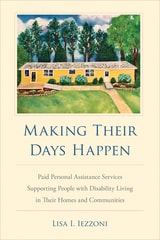
cover of Making Their Days Happen: Paid Personal Assistance Services Supporting People with Disability Living in Their Homes and Communities

Making Their Days Happen

Paid Personal Assistance Services Supporting People with Disability Living in Their Homes and Communities

Lisa I. Iezzoni

Temple University Press, 2022

Most Americans—even those with significant disability—want to live in their homes and communities. Unpaid family members or friends often work as “informal” caregivers, helping those who need assistance— and many feel they have no option but to serve. In contrast, paid personal assistance services workers (PAS) provide a lifeline to those consumers with complex needs and limited social networks. However, there is a crisis looming in the increasing needs for paid PAS and the limited available PAS workforce.

Making Their Days Happen explores disability, health, and civil rights, along with relevant federal and state labor policies related to personal assistance services. Lisa Iezzoni addresses the legal context of paid PAS as well as financing mechanisms for obtaining home-based personal assistance. She also draws upon interviews she conducted with paid PAS consumers and PAS workers to explore PAS experiences and their perspectives about their work. 

Offering recommendations for improving future experiences of PAS consumers and providers, Iezzoni emphasizes that people with disabilities want to be a part of society, and PAS workers who do this low-wage work find satisfaction in helping them achieve their goals.
[more]
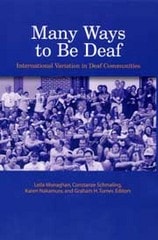
cover of Many Ways to Be Deaf: International Variation in Deaf Communities

Many Ways to Be Deaf

International Variation in Deaf Communities

Leila Monaghan

Gallaudet University Press, 2003

The recent explosion of sociocultural, linguistic, and historical research on signed languages throughout the world has culminated in Many Ways to Be Deaf, an unmatched collection of in-depth articles about linguistic diversity in Deaf communities on five continents. Twenty-four international scholars have contributed their findings from studying Deaf communities in Japan, Thailand, Viet Nam, Taiwan, Russia, Sweden, Austria, Switzerland, Great Britain, Ireland, Nigeria, South Africa, Brazil, Nicaragua, and the United States. Sixteen chapters consider the various antecedents of each country’s native signed language, taking into account the historical background of their development and also the effects of foreign influences and changes in philosophies by the larger, dominant hearing societies.
 
     The remarkable range of topics covered in Many Ways to Be Deaf will fascinate readers, from the evolution of British fingerspelling traced back to the 17th century; the comparison of Swiss German Sign Language with Rhaeto-Romansch, another Swiss minority language; the analysis of seven signed languages described in Thailand and how they differ in relation to their distance from isolated Deaf communities to Bangkok and other urban centers; to the vaulting development of a nascent sign language in Nicaragua, and much more. The diversity of background and training among the contributors to Many Ways to Be Deaf distinguishes it as a genuine and unique multicultural examination of the myriad manifestations of being Deaf in a diverse world.
[more]