Results by title
264 books match the query 'Composition' and 19 start with m
Making Administrative Work Visible
Data-Driven Advocacy for Understanding the Labor of Writing Program AdministrationLeigh Graziano
Utah State University Press, 2023
The collection has three parts, each of which focuses on the most confounding challenges facing WPAs as well as the most compelling sites of their contributions to administration, labor in higher education, and the discipline’s collective obligation to forwarding the goals of social justice and advocacy: Advocating through Representations of WPA Labor, Advocating by Accounting for Time and Labor, and Advocating in and through Complex Institutional Contexts. The chapters use data to share and track the work functions, job titles, grand narratives, program assessments, tenure and promotion, email practices, and more undertaken by WPAs in their administrative capacities. Chapters also surface narratives for future data and studies to be done by other scholars.
By taking up and answering questions about the range of WPA work—and the invisibility of much of that work—Making Administrative Work Visible creates avenues toward accounting for and acknowledging the complex activity systems in which WPAs lead the work of the university and advocate for data-driven strategies needed to sustain this foundational area of higher education.
Contributors: Kamila Albert, Brooke Anderson, Sheila Carter-Tod, Amy Cicchino, Ana Cortés Lagos, Kristi Murray Costello, Jennifer Cunningham, Ryan Dippre, Kimberly Emmons, Genevieve García de Müeller, Jill Gladstein, Caleb González, Michael Healy, Lyra Hilliard, Kristine Johnson, Seth Kahn, Rita Malenczyk, Troy Mikanovich, Lilian Mina, Angela Mitchell, Greer Murphy, Kate Navickas, Michael Neal, Patti Poblete, Jan Rieman, Heather Robinson, Katelyn Stark, Mary Stewart, Natalie Stillman-Webb, Lizbett Tinoco, Lisa Tremain, Martha Wilson Schaffer
Making Progress
Programmatic and Administrative Approaches for Multimodal Curricular TransformationLogan Bearden
Utah State University Press, 2021
MCT can be achieved at the intersection of program documents and practices. Bearden details ten composition programs that have undergone MCT, offering interview data from the directors who oversaw and/or participated within the processes. He analyzes a corpus of outcomes statements to discover ways we can “make space” for multimodality and gives instructors and programs a broader understanding of the programmatic values for which they should strive if they wish to make space for multimodal composition in curricula. Making Progress also presents how other program documents like syllabi and program websites can bring those outcomes to life and make multimodal composing a meaningful part of first-year composition curricula.
First-year composition programs that do not help their students learn to compose multimodal texts are limiting their rhetorical possibilities. The strategies in Making Progress will assist writing program directors and faculty who are interested in using multimodality to align programs with current trends in disciplinary scholarship and deal with resistance to curricular revision to ultimately help students become more effective communicators in a digital-global age.
Mapping Racial Literacies
College Students Write about Race and SegregationSophie R. Bell
Utah State University Press, 2020
This textual ethnography embeds early college students’ writing in deep historical and theoretical contexts and looks for new ways that their writing contributes to and reshapes contemporary understandings of how US and global citizens are thinking about race. The book is a teaching narrative, tracing a teaching journey that considers student writing not only in the moments it is assigned but also in continual revisions of the course, making it a useful tool in helping college-age students see, explore, and articulate the role of race in determining their life experiences and opportunities.
Sophie Bell’s work narrates the experiences of a white teacher making mistakes in teaching about race and moving forward through those mistakes, considering that process valuable and, in fact, necessary. Providing a model for future scholars on how to carve out a pedagogically responsive identity as a teacher, Mapping Racial Literacies contributes to the scholarship on race and writing pedagogy and encourages teachers of early college classes to bring these issues front and center on the page, in the classroom, and on campus.
Masking Inequality with Good Intentions
Systemic Bias, Counterspies, and Discourse Acquisition in STEM EducationHeather M. Falconer
University Press of Colorado, 2023
In Masking Inequality with Good Intentions, Heather M. Falconer examines the impact of systemic bias on disciplinary discourse acquisition and identity development by asking “How do the norms and expectations of higher education and STEM, specifically, impact the development of scientific identity and discursive skill?” and “What role do societal markers like race and gender play in the negotiation of identity in STEM learning environments?”
Drawing on the experiences and writings of six students from historically underrepresented backgrounds in STEM, each participating in an undergraduate research program, Falconer discusses how programmatic and pedagogical choices can work to either further marginalize students and disrupt their writing and identity development as scientists or create counterspaces—spaces where students can thrive and push back against dominant, oppressive forces. Practical applications for pedagogy, curriculum, and program design are included.
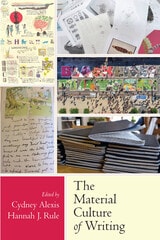
Material Culture of Writing
edited by Cydney Alexis and Hannah J. Rule
University Press of Colorado, 2022
The collection features scholars across the disciplines—such as art, art history, English, museum studies, and writing studies—who work as teachers, historians, museum curators/conservators, and faculty. Each chapter features methods and questions from contributors’ own disciplines while at the same time speaking to writing studies’ interest in writers, writing identity, and writing practice. The authors in this volume also work with a variety of methodologies, including literary analysis, archival research, and qualitative research, providing models for the types of research possible using a material culture studies framework. The collection is organized into three sections—Writing Identity, Writing Work, Writing Genre—each with a contextualizing introduction from the editors that introduces the chapters themselves and imagines possible directions for writing studies research facilitated by material culture studies.
The Material Culture of Writing serves as an accessible introduction to work in material culture studies for writing studies scholars, graduate students, and undergraduates, especially as it makes a distinctive contribution to writing studies in its material culture studies approach. Because of the interdisciplinarity of material culture studies and this volume’s contributors, this collection will appeal to a wide range of scholars and readers, including those interested in writing studies, the history of the book, print culture, genre studies, archival methods, and authorship studies.
Contributors: Cydney Alexis, Debby Andrews, Diane Ehrenpreis, Keri Epps, Desirée Henderson, Kevin James, Jenny Krichevsky, Anne Mackay, Emilie Merrigan, Laura R. Micciche, Hannah J. Rule, Kate Smith
Mentorship/Methodology
Reflections, Praxis, and FuturesLeigh Gruwell
Utah State University Press, 2024
The contributors consider how methodology informs mentorship, how mentorship activates methodology, and how to locate the future of the field in these moments of intersection. Mentorship, through the research and relationships it nourishes, creates the future of writing studies—or, conversely, reproduces the past. At the juncture where this happens, the contributors inquire, Where have current arrangements of mentorship/methodology taken writing studies? Where do these points of intersection exist in performance and practice, in theory, in research? What images of the field do they produce? How can scholars better articulate and write about these moments or spaces in which mentorship and methodology collide in productive disciplinary work?
By making the “slash” more visible, Mentorship/Methodology provides significant opportunities to support and cultivate diverse ways of knowing and being in rhetoric and composition, both locally and globally. The volume will appeal to students and scholars of rhetoric, composition, and technical and professional communication, as well as readers interested in conversations about mentorship and methodology.
Metabolizing Capital
Writing, Information, and the Biophysical EnvironmentChristian J. Pulver
Utah State University Press, 2020
The rise of the global cloud and the internet-of-things have ushered in a new stage of the internet that marks a transition from the celebrated user-generated content of Web 2.0 to the data-driven networks of Web 3.0. As social media networks have expanded, so has the amount of writing and communication we do online. This has created several valuable sub-layers of data and metadata about consumer-citizens that corporations and governments now routinely collect, store, and monetize. This frenzy to collect more data is contributing to several problematic social and environmental concerns as flows of information and capital dangerously accelerate how energy and matter move through ecosystems at every scale.
This book explores the planetary consequences of Web 3.0 and the vital role that writing and data production play in accelerating capital circulation, from concerns raised by the growing energy demands of the information industries, to growing streams of electronic waste, to the growing socioeconomic tensions arising as a result of information monopolies.
A posthuman, Marxist analysis of digital culture and writing, Metabolizing Capital contributes to and challenges current understandings of rhetorical agency and actor networks. Combining scholarship from writing studies, rhetoric, and composition with research in metabolic ecology, information theory, media studies, cognitive psychology, history, and new materialism, this book should be of interest to scholars in writing studies as well as others who study digital culture, ecological literacies, the history of writing and information, big data, and environmental concerns related to electronics and the information industries.
Methodological Matters
Narratives for Emerging Researchers in Rhetoric and CompositionErin Kathleen Bahl
Utah State University Press, 2026
Methodological Matters offers a series of investigative reflections from experienced and emerging researchers to provide guidance for researchers who are navigating important complexities early in their careers. Each chapter explores a larger research-related question by narrating how one researcher negotiated a unique methodological challenge while working on a dissertation in the field of rhetoric and composition.
Given the constraints placed on new researchers’ time and resources, one way to navigate research-related precarities is to learn from others who have successfully traversed the same investigative terrain. This volume curates investigative reflections from researchers who, at the time of writing, were in the process of completing (or had just completed) their dissertations. Three parts explore issues of identity, craft, and practice in conducting research as an emerging scholar in rhetoric and composition, and the collection concludes with critical reflections on the role of precarity in conducting research.
Both a curated series of investigative reflections from emerging researchers and a resource guide with tangible tools for use in graduate seminars and fieldwork, Methodological Matters amplifies voices of those who learned how to do research in precarious contexts while simultaneously situated within the sometimes frustrating developmental phase located between “student” and “practitioner.”
Methods and Methodologies for Research in Digital Writing and Rhetoric, Volume 1
Centering Positionality in Computers and Writing ScholarshipCrystal VanKooten
University Press of Colorado, 2023
Methods and Methodologies for Research in Digital Writing and Rhetoric, Volume 2
Centering Positionality in Computers and Writing ScholarshipVictor Del Hierro
University Press of Colorado, 2023
Methods and Methodologies explores how researchers theorize, design, enact, reflect on, and revise digital writing research. The contributors to the two volumes of this edited collection explore how digital technologies can be used to solve problems, challenge the status quo, and address inequities. In some cases, they do so by using familiar digital technologies in novel ways. In other cases, they explain the use of relatively new or less familiar technologies such as digital mapping apps, Twitter bots, audio-visual captions, and computer programming code. By reflecting on the lessons that emerged from their work—and in particular on their own positionality—the authors provide methodological narratives that are personal, professional, and individual yet foundational. By combining attention to human positionality and digital technology, Methods and Methodologies addresses important social issues and questions related to writing and rhetoric.

Microhistories of Composition
Bruce Mccomiskey
Utah State University Press, 2016
Writing studies has been dominated throughout its history by grand narratives of the discipline, but in this volume Bruce McComiskey begins to explore microhistory as a way to understand, enrich, and complicate how the field relates to its past. Microhistory investigates the dialectical interaction of social history and cultural history, enabling historians to examine uncommon sites, objects, and agents of historical significance overlooked by social history and restricted to local effects by cultural history. This approach to historical scholarship is ideally suited for exploring the complexities of a discipline like composition.
Through an introduction and eleven chapters, McComiskey and his contributors—including major figures in the historical research of writing studies, such as Louise Wetherbee Phelps, Kelly Ritter, and Neal Lerner—develop focused narratives of particular significant moments or themes in disciplinary history. They introduce microhistorical methodologies and illustrate their application and value for composition historians, contributing to the complexity and adding momentum to the emerging trend within writing studies toward a richer reading of the field’s past and future. Scholars and historians of both composition and rhetoric will appreciate the fresh perspectives on institutional and disciplinary histories and larger issues of rhetorical agency and engagement enacted in writing classrooms that are found in Microhistories of Composition.
Other contributors include Cheryl E. Ball, Suzanne Bordelon, Jacob Craig, Matt Davis, Douglas Eyman, Brian Gogan, David Gold, Christine Martorana, Bruce McComiskey, Josh Mehler, Annie S. Mendenhall, Kendra Mitchell, Antony N. Ricks, David Stock, Kathleen Blake Yancey, Bret Zawilski, and James T. Zebroski.
Mobility Work in Composition
Bruce Horner
Utah State University Press, 2020
Both established and up-and-coming scholars bring a diversity of geographic, institutional, and research-based perspectives to the volume, which includes in-depth investigations of specific forms of mobility work in composition, as well as responses to and reflections on those explorations. Eight chapters present specific cases or issues of this work and twelve shorter response chapters follow, identifying key points of intersection and conflict in the arguments and posing new questions and directions to pursue.
Addressing matters of knowledge transfer and meaning translation, immigrant literacy practices, design pedagogy, academic career changes, student websites, research methodologies, school literacy programs, and archives, Mobility Work in Composition asks what mobility in composition means and how, why, and for whom it might work. It will be of broad interest to students and scholars in rhetoric and composition.
Contributors: Anis Bawarshi, Elizabeth Chamberlain, Patrick Danner, Christiane Donahue, Keri Epps, Eli Goldblatt, Rachel Gramer, Timothy Johnson, Jamila Kareem, Carmen Kynard, Rebecca Lorimer Leonard, Andrea Olinger, John Scenters-Zapico, Khirsten L. Scott, Mary P. Sheridan, Jody Shipka, Ann Shivers-McNair, Scott Wible, Rick Wysocki
More than a Moment
Contextualizing the Past, Present, and FutureSteven D. Krause
Utah State University Press, 2019
Krause writes about his own experiences as a participant in several MOOCs and the experiences of faculty who developed and taught MOOCs. Contrary to many early claims from educational entrepreneurs, they were never entirely “new,” and MOOCs and their aftermath are still at the heart of the tensions between nonprofit universities and for-profit entities, particularly online program management firms, in delivering distance education.
While MOOCs are no longer a threat to education in the United States, they are part of the ongoing corporatization of education and remain part of conversations about experienced-based credit, corporate training, and open education. Presenting historical, student, teacher, and administrative perspectives, More than a Moment is a well-rounded treatment that will be of interest to academics and entrepreneurs interested in distance education, online pedagogy, online program management, and public-private partnerships in higher education.
Multilingual Contributions to Writing Research
Towards an Equal Academic Exchangeedited by Natalia Ávila Reyes
University Press of Colorado, 2022
This edited collection offers chapters based on presentations at the Second Latin American Association of Writing Studies in Higher Education and Professional Contexts International Congress (II ALES) held in Santiago, Chile, in 2018. Together, the contributors to the collection—drawn from nine countries and writing in three languages—highlight the many perspectives, resources, and traditions that enrich and expand international conversations about writing, writing instruction, and writing research. The multiple locations from which the chapters in this collection emerge contribute significantly to the situated findings and concerns they address, with the authors of each chapter considering the social, lingual, and institutional contexts shaping their work. Drawing on both robust traditions and cutting-edge research, this collection makes a distinctive contribution to discussions of writing in and beyond Latin America.
This book is also available as an open access ebook through the WAC Clearinghouse.
Multilingual Writing in Entanglement
Becoming With Others Through Chronotopic Figuring and Unpredictable EncountersXiqiao Wang
Utah State University Press, 2025
This longitudinal qualitative study follows Morgan and Leo through their undergraduate careers, collecting rich ethnographic data across private, academic, and digital spaces. The resulting theoretical framework conceptualizes multilingual writing as simultaneously strategic, agentive, creative, diffused, contingent, and messy—a phenomenon shaped by dynamic interplay between ephemeral encounters and established practices. Employing chronotopic figuring as a methodological tool, Wang illuminates aspects of multilingual writing often elided in research: fleeting encounters that energize composition, reciprocal relationships that distribute writing labor, unexpected detours that redirect the writing process, and the layering of writing and identity practices across multiple historical trajectories. This approach moves beyond examining writing in isolated moments to trace how meaning emerges across languages, modes, and spacetimes.
Multilingual Writing in Entanglement offers crucial insights into how international students strategically and improvisationally reconfigure their semiotic and rhetorical repertoires to write multilingual lives into meaning. This work is influential for scholars and educators in composition, literacy studies, multilingual education, ESL, and linguistics.
Multimodal Composing and Writing Transfer
Kara Poe Alexander
Utah State University Press, 2024
Over the past two decades the concepts of multimodal composing and writing transfer have grown and reshaped the nature of writing studies, but rarely have the ways in which these areas overlap been studied. This collection shows how this shift in writing studies has been mutually informative, covering a wider range of contexts for multimodality and writing transfer than just in first-year composition courses. It places composition teaching practices and multimodal research in conversation with learning transfer theory to provide an in-depth examination of how they influence one another.
Multimodal Composing and Writing Transfer develops these intersections to connect multimodal composition and writing practices across a wide array of fields and contexts. Scholars across disciplines, postsecondary writing teachers, writing program administrators, writing center directors, and graduate students will find this collection indispensable.
Multimodal Transfer Pedagogy
Applications for InstructionRyan P. Shepherd
Utah State University Press, 2027
Multimodal Transfer Pedagogy provides practical methods and materials for composition teachers and directors to facilitate multimodal transfer. This rich collection of resources presents new ways of incorporating digital texts, exploring modes of meaning beyond traditional print and encouraging students to think about rhetorical approaches to meaning making.
Together with its online companion materials, the book delivers a distinctive synthesis of multimodal composing practices, writing transfer research, and theory to provide clear, actionable guidance to teachers and directors to apply multimodal composition pedagogy effectively. Twenty-three chapters cover multimodal transfer pedagogy—including social media, composing with AI, visual rhetoric and design, public advocacy, tabletop games, podcasting, and more.
Multimodal Transfer Pedagogy is built from contextualized pedagogical approaches and course materials—syllabi, assignments, assessment documents—that specifically direct pedagogical application toward multimodal transfer in a range of contexts, from first-year writing to the science writing classroom and writing center. A natural follow-up to Multimodal Composition and Writing Transfer, the book introduces a unique practical-pedagogical model for implementing multimodal work in the classroom.
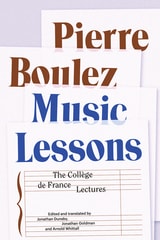
Music Lessons
The Collège de France LecturesPierre Boulez
University of Chicago Press, 2018
Music Lessons marks the first publication in English of Pierre Boulez’s Collège de France lectures, written while he held the chair of Invention, Technique and Language in Music at the Collège between 1976 and 1995. Representing Boulez’s most significant writings from the period, the lectures offer a sustained intellectual engagement with one of the dominant figures of twentieth-century music, a consummate composer-conductor who remained central to the conversation around contemporary music until his death in 2016. Boulez explores, among other topics, the process through which a musical idea is realized in a full-fledged composition, the complementary roles of craft and inspiration and the degree to which the memory of other musical works can influence and change the act of creation. Boulez also gives a penetrating account of problems in classical music that are still present today, such as the conservatism of a musical community fixated on the repertory of the past. Woven into the discussion are stories of his own compositions and those of fellow composers whose work he engaged with in his many roles as teacher, thinker, and conductor: from Stravinsky to Stockhausen and Varèse, from Bartók to Berg, Debussy to Mahler and Wagner, and all the way back to his beloved J. S. Bach.
Including a foreword by semiologist Jean-Jacques Nattiez, who was for years close to the composer, this edition is also enriched by an illuminating preface by Jonathan Goldman. With an authoritative translation retaining Boulez’s fierce convictions, cutting opinions and signature wit, Music Lessons is an essential and entertaining volume.
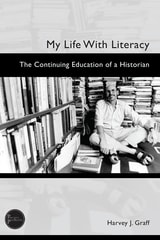
My Life with Literacy
The Continuing Education of a HistorianHarvey J. Graff
University Press of Colorado, 2025