Results by title
103 books match the query 'Conservation' and 4 start with m
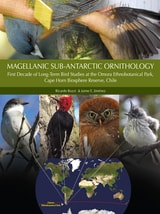
Magellanic Sub-Antarctic Ornithology
First Decade of Long-Term Bird Studies at the Omora Ethnobotanical Park, Cape Horn Biosphere Reserve, ChileRicardo Rozzi
University of North Texas Press, 2014
[more]
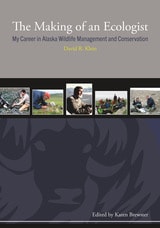
Making of an Ecologist
My Career in Alaska Wildlife Management and ConservationDavid R. Klein
University of Alaska Press, 2019
This is an innovative and collaborative life history of one of Alaska’s pioneering wildlife biologists. David R. Klein has been a leader in promoting habitat studies across wildlife research in Alaska, and this is his first-hand account of how science and biological fieldwork has been carried out in Alaska in the last sixty years. This book tells the stories of how Klein did his science and the inspiration behind the research, while exposing the thinking that underlies particular scientific theories. In addition, this book shows the evolution of Alaska’s wildlife management regimes from territorial days to statehood to the era of big oil.
The first portion of the book is comprised of stories from Klein’s life collected during oral history interviews, while the latter section contains essays written by Klein about philosophical topics of importance to him, such as eco-philosophy, the definition of wilderness, and the morality of hunting.
Many of Klein’s graduate students have gone on to become successful wildlife managers themselves, in Alaska and around the globe. Through The Making of an Ecologist, Klein’s outlook, philosophy, and approach toward sustainability, wildlife management, and conservation can now inspire even more readers to ensure the survival of our fragile planet in an ever-changing global society.
[more]
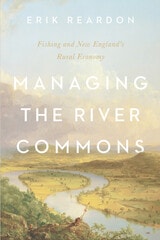
Managing the River Commons
Fishing and New England's Rural EconomyErik Reardon
University of Massachusetts Press, 2021
New England once hosted large numbers of anadromous fish, which migrate between rivers and the sea. Salmon, shad, and alewives served a variety of functions within the region's preindustrial landscape, furnishing not only maritime areas but also agricultural communities with an important source of nutrition and a valued article of rural exchange.
Historian Erik Reardon argues that to protect these fish, New England's farmer-fishermen pushed for conservation measures to limit commercial fishing and industrial uses of the river. Beginning in the colonial period and continuing to the mid-nineteenth century, they advocated for fishing regulations to promote sustainable returns, compelled local millers to open their dams during seasonal fish runs, and defeated corporate proposals to erect large-scale dams. As environmentalists work to restore rivers in New England and beyond in the present day, Managing the River Commons offers important lessons about historical conservation efforts that can help guide current campaigns to remove dams and allow anadromous fish to reclaim these waters.
Historian Erik Reardon argues that to protect these fish, New England's farmer-fishermen pushed for conservation measures to limit commercial fishing and industrial uses of the river. Beginning in the colonial period and continuing to the mid-nineteenth century, they advocated for fishing regulations to promote sustainable returns, compelled local millers to open their dams during seasonal fish runs, and defeated corporate proposals to erect large-scale dams. As environmentalists work to restore rivers in New England and beyond in the present day, Managing the River Commons offers important lessons about historical conservation efforts that can help guide current campaigns to remove dams and allow anadromous fish to reclaim these waters.
[more]
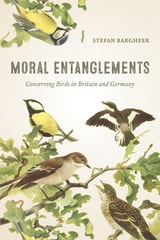
Moral Entanglements
Conserving Birds in Britain and GermanyStefan Bargheer
University of Chicago Press, 2018
At the center of Stefan Bargheer’s account of bird watching, field ornithology, and nature conservation in Britain and Germany stands the question of how values change over time and how individuals develop moral commitments. Using life history data derived from written narratives and oral histories, Moral Entanglements follows the development of conservation from the point in time at which the greatest declines in bird life took place to the current efforts in large-scale biodiversity conservation and environmental policy within the European Union. While often depicted as the outcome of an environmental revolution that has taken place since the 1960s, Bargheer demonstrates to the contrary that the relevant practices and institutions that shape contemporary conservation have evolved gradually since the early nineteenth century. Moral Entanglements further shows that the practices and institutions in which bird conservation is entangled differ between the two countries. In Britain, birds derived their meaning in the context of the game of bird watching as a leisure activity. Here birds are now, as then, the most popular and best protected taxonomic group of wildlife due to their particularly suitable status as toys in a collecting game, turning nature into a playground. In Germany, by contrast, birds were initially part of the world of work. They were protected as useful economic tools, rendering services of ecological pest control in a system of agricultural production modeled after the factory shop floor. Based on this extensive analysis, Bargheer formulates a sociology of morality informed by a pragmatist theory of value.
[more]