Results by title
75 books match the query 'Construction' and 3 start with m

Michigan's Capitol
Construction and RestorationWilliam Seale
University of Michigan Press, 1995
Michigan's Capitol: Construction and Restoration is the history of a great American landmark, one among fifty statehouses. Construction of Michigan's State Capitol began in 1871, six years after the close of the Civil War, and was brought to completion less than a decade later. It has survived for more than a century to become the object of one of America's most authentic restorations. This volume allows the reader to chronicle the building and restoration of Michigan's Capitol through words and magnificent color and black-and-white photographs. An archive of treasured historical images, beginning with a group scene at the time the cornerstone was placed, is also included alongside original architectural drawings and sketches.
Michigan's Capitol: Construction and Restoration is not only the history of a great vision realized, but a celebration of the rediscovery and revival of that vision in the 1980s and 1990s culminating in one of the most comprehensive restorations ever carried out on an American building. The author, William Seale, a part of the restoration team for Michigan's Capitol from the start, has written extensively about many American buildings, including the White House.
Written in a lively, narrative style accessible to readers of all ages, Michigan's Capitol: Construction and Restoration is an especially useful introduction to the art of building as well as the politics of public building.
Misplacing Ogden, Utah
Race, Class, Immigration, and the Construction of Urban ReputationsPepper Glass
University of Utah Press, 2020
Ogden, a working-class city with a history of racial and immigrant diversity, has long held a reputation among Utahns as a “sin city” in the middle of an entrenched religious culture. Glass blends ethnographic research with historical accounts, census reports, and other secondary sources to provide insight into Ogden’s reputation, past and present. Capturing residents’ perceptions of an entire city, as opposed to only some of its neighborhoods, and exploring the regional contexts shaping these views, is rare among urban researchers. Glass’s unique approach suggests we can better confront urban problems by rethinking assumptions about place and promoting interventions that break down boundaries.
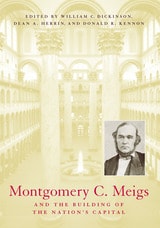
Montgomery C. Meigs and the Building of the Nation’s Capital
William C. Dickinson
Ohio University Press, 2001
At the age of thirty-six, in 1852, Lt. Montgomery Cunningham Meigs of the Army Corps of Engineers reported to Washington, D.C., for duty as a special assistant to the chief army engineer, Gen. Joseph G. Totten. It was a fateful assignment, both for the nation’s capital and for the bright, ambitious, and politically connected West Point graduate.
Meigs's forty-year tenure in the nation's capital was by any account spectacularly successful. He surveyed, designed, and built the Washington water supply system, oversaw the extension of the U.S. Capitol and the erection of its massive iron dome, and designed and supervised construction of the Pension Building, now the home of the National Building Museum. The skills he exhibited in supervising engineering projects were carefully noted by political leaders, including president-elect Abraham Lincoln, who named Meigs quartermaster general of the Union Army, the most important position he held during his long and active military career.
Meigs believed Washington, D.C., should be the reincarnation of Rome, the ancient capital of the Roman Empire. He endeavored to memorialize the story of the American nation in all the structures he built, expressing these ideas in murals, sculpture, and monumental design.
Historians have long known Meigs for the organizational genius with which he fulfilled his duty as quartermaster general during the Civil War and for his unwavering loyalty to Lincoln and Secretary of War Edwin Stanton. This volume establishes his claim as one of the major nineteenth-century contributors to the built environment of the nation's capital.