Results by title
143 books match the query 'Crisis' and 6 start with m
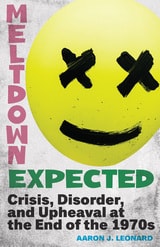
Meltdown Expected
Crisis, Disorder, and Upheaval at the end of the 1970sAaron J. Leonard
Rutgers University Press, 2024
Meltdown Expected tells the story of the power shifts from late 1978 through 1979 whose repercussions are still being felt. Iran’s revolution led to a hostage crisis while neighbouring Afghanistan became the site of a proxy war between the USSR and the US, who supplied aid to Islamic mujahideen fighters that would later form the Taliban. Meanwhile, as tragedies like the Jonestown mass suicide and the assassination of Harvey Milk captured the nation’s attention, the government quietly reasserted and expanded the FBI’s intelligence powers. Drawing from recently declassified government documents and covering everything from Three Mile Island to the rise of punk rock, Aaron J. Leonard paints a vivid portrait of a tumultuous yet pivotal time in American history.
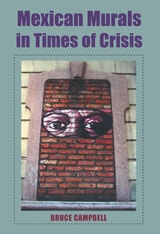
Mexican Murals in Times of Crisis
Bruce Campbell
University of Arizona Press, 2003
This book traces the ongoing critical contributions of mural arts to public life in Mexico to show how postrevolutionary murals have been overshadowed both by the Mexican School and by the exclusionary nature of official public arts. By documenting a range of mural practices—from fixed-site murals to mantas (banner murals) to graffiti—Bruce Campbell evaluates the ways in which the practical and aesthetic components of revolutionary Mexican muralism have been appropriated and redeployed within the context of Mexico's ongoing economic and political crisis. Four dozen photographs illustrate the text. Blending ethnography, political science, and sociology with art history, Campbell traces the emergence of modern Mexican mural art as a composite of aesthetic, discursive, and performative elements through which collective interests and identities are shaped.
He focuses on mural activists engaged combatively with the state—in barrios, unions, and street protests—to show that mural arts that are neither connected to the elite art world nor supported by the government have made significant contributions to Mexican culture. Campbell brings all previous studies of Mexican muralism up to date by revealing the wealth of art that has flourished in the shadows of official recognition. His work shows that interpretations by art historians preoccupied with contemporary high art have been incomplete—and that a rich mural tradition still survives, and thrives, in Mexico.
Models of Resistance for a Democracy in Crisis
Geoff Eley
Disobedience Press, 2026
Models of Resistance for a Democracy in Crisis features three historians who examine how political opposition, anti-racist struggle, and artistic intervention serve as vital blueprints for safeguarding our precarious democracy.
Geoff Eley deconstructs Trump-era politics by identifying a dual crisis: the withering of democratic practices and a pervasive cynicism toward government. By analyzing how Germans of the 1930s might have resisted fascism, he reveals the specific forms of opposition needed to uphold democratic accountability today.
Jamon Jordan traces a lineage of anti-racist protest, from the rebellions of the enslaved to the legal and moral defiance of the abolitionist movement. By weaving public tactics, such as demonstrations and boycotts, with the enduring labor of building Black-led institutions and preserving cultural traditions, Jordan reveals a comprehensive framework for contemporary activists.
Megan Flattley examines how artworks challenge repressive regimes. These creative interventions bear witness to traumatic and unjust conditions, use cultural institutions as cover for political action, and stage provocations in public spaces to reveal latent violence and advocate for social change.
Modernity At Sea
Melville, Marx, Conrad In CrisisCesare Casarino
University of Minnesota Press, 2002
Analyzes nineteenth-century seafaring narratives and their importance to ideas of modernity
At once a literary-philosophical meditation on the question of modernity and a manifesto for a new form of literary criticism, Modernity at Sea argues that the nineteenth-century sea narrative played a crucial role in the emergence of a theory of modernity as permanent crisis.
In a series of close readings of such works as Herman Melville’s White-Jacket and Moby Dick, Joseph Conrad’s The Nigger of the "Narcissus” and The Secret Sharer, and Karl Marx’s Grundrisse, Cesare Casarino draws upon the thought of twentieth-century figures including Giorgio Agamben, Louis Althusser, Walter Benjamin, Leo Bersani, Gilles Deleuze, Félix Guattari, and Antonio Negri to characterize the nineteenth-century ship narrative as the epitome of Michel Foucault’s "heterotopia"—a special type of space that simultaneously represents, inverts, and contests all other spaces in culture.Elaborating Foucault’s claim that the ship has been the heterotopia par excellence of Western civilization since the Renaissance, Casarino goes on to argue that the nineteenth-century sea narrative froze the world of the ship just before its disappearance—thereby capturing at once its apogee and its end, and producing the ship as the matrix of modernity.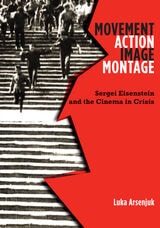
Movement, Action, Image, Montage
Sergei Eisenstein and the Cinema in CrisisLuka Arsenjuk
University of Minnesota Press, 2018
A major new study of Sergei Eisenstein delivers fresh, in-depth analyses of the iconic filmmaker’s body of work
What can we still learn from Sergei Eisenstein? Long valorized as the essential filmmaker of the Russian Revolution and celebrated for his indispensable contributions to cinematic technique, Eisenstein’s relevance to contemporary culture is far from exhausted. In Movement, Action, Image, Montage, Luka Arsenjuk considers the auteur as a filmmaker and a theorist, drawing on philosophers such as Georg Wilhelm Friedrich Hegel and Gilles Deleuze—as well as Eisenstein’s own untranslated texts—to reframe the way we think about the great director and his legacy.
Focusing on Eisenstein’s unique treatment of the foundational concepts of cinema—movement, action, image, and montage—Arsenjuk invests each aspect of the auteur’s art with new significance for the twenty-first century. Eisenstein’s work and thought, he argues, belong as much to the future as the past, and both can offer novel contributions to long-standing cinematic questions and debates.
Movement, Action, Image, Montage brings new elements of Eisenstein’s output into academic consideration, by means ranging from sustained and comprehensive theorization of Eisenstein’s practice as a graphic artist to purposeful engagement with his recently published, unfinished book Method, still unavailable in English translation. This tour de force offers new and significant insights on Eisenstein’s oeuvre—the films, the art, and the theory—and is a landmark work on an essential filmmaker.
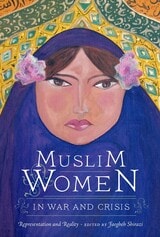
Muslim Women in War and Crisis
Representation and RealityEdited by Faegheh Shirazi
University of Texas Press, 2010
Representing diverse cultural viewpoints, Muslim Women in War and Crisis collects an array of original essays that highlight the experiences and perspectives of Muslim women—their dreams and nightmares and their daily struggles—in times of tremendous social upheaval. Analyzing both how Muslim women have been represented and how they represent themselves, the authors draw on primary sources ranging from poetry and diaries to news reports and visual media. Topics include:
- Peacebrokers in Indonesia
- Exploitation in the Islamic Republic of Iran
- Chechen women rebels
- Fundamentalism in Afghanistan, from refugee camps to Kabul
- Memoirs of Bengali Muslim women
- The 7/7 London bombings, British Muslim women, and the media
Also exploring such images in the United States, Spain, the former Yugoslavia, Tunisia, Algeria, Lebanon, and Iraq, this collection offers a chorus of multidimensional voices that counter Islamophobia and destructive clichés. Encompassing the symbolic national and religious identities of Muslim women, this study goes beyond those facets to examine the realities of day-to-day existence in societies that seek scapegoats and do little to defend the victims of hate crimes. Enhancing their scholarly perspectives, many of the contributors (including the editor) have lived through the strife they analyze. This project taps into their firsthand experiences of war and deadly political oppression.