Results by title
89 books match the query 'Curricula' and 5 start with m
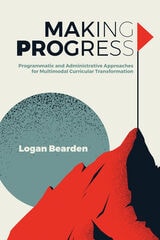
Making Progress
Programmatic and Administrative Approaches for Multimodal Curricular TransformationLogan Bearden
Utah State University Press, 2021
MCT can be achieved at the intersection of program documents and practices. Bearden details ten composition programs that have undergone MCT, offering interview data from the directors who oversaw and/or participated within the processes. He analyzes a corpus of outcomes statements to discover ways we can “make space” for multimodality and gives instructors and programs a broader understanding of the programmatic values for which they should strive if they wish to make space for multimodal composition in curricula. Making Progress also presents how other program documents like syllabi and program websites can bring those outcomes to life and make multimodal composing a meaningful part of first-year composition curricula.
First-year composition programs that do not help their students learn to compose multimodal texts are limiting their rhetorical possibilities. The strategies in Making Progress will assist writing program directors and faculty who are interested in using multimodality to align programs with current trends in disciplinary scholarship and deal with resistance to curricular revision to ultimately help students become more effective communicators in a digital-global age.
Making Sense of the College Curriculum
Faculty Stories of Change, Conflict, and AccommodationZemsky, Robert
Rutgers University Press, 2018
Making the Radical University
Identity and Politics on the American College Campus, 1966–1991Elizabeth M. Kalbfleisch
University of Massachusetts Press, 2024
In the 1960s, professors, students, and activists on the political Left viewed college curricula as useful sites for political transformation. They coordinated efforts to alter general education requirements at the college level to foster change in American thought, with greater openness toward people who had previously been excluded, including women, people of color, the poor and working classes, people with disabilities, and members of the LGBTQ community. Their work reshaped American culture and politics, while prompting a significant backlash from conservatives attempting to, in their view, protect classical education from modern encroachment.
Elizabeth M. Kalbfleisch details how American universities became a battleground for identity politics from the 1960s through the 1980s. Focusing on two case studies at Stanford University and the University of Texas at Austin, Making the Radical University examines how curricular changes led to polarizing discussions nationwide around academic standards and identity politics, including the so-called canon wars. Today, these debates have only become more politically charged, complex, and barbed.

Microcomputers and Education
Edited by Jack Culbertson and Luvern L. Cunningham
University of Chicago Press, 1986
Music Education in the United States
Contemporary IssuesJ. Terry Gates
University of Alabama Press, 1988
Exploring the ideas, innovations, and challenges shaping the future of music education.
This solid collection of essays, written by outstanding American music educators, reflects the current issues in music education and the ongoing attempt to overcome obstacles to excellence in teaching music. It stands as the most important and far-ranging professional overview of the discipline since the publication of the landmark Basic Concepts in Music Education in 1958, and early reviews indicate that it will generate both critical discussion and acclaim.
Several themes recur:(1) that music and, therefore, music education exist in a variety of social and cultural contexts, even when examined in controlled situations; (2) that music teaching has not yet freed itself from its traditional over-reliance on technical training, in spite of attention to aesthetic education; and (3) that there is a remarkable undercurrent of agreement among this diverse group of authors concerning the profession’s basic obligation to expand and refine the musical sensitivity of all age group of Americans. This book reflects some advanced thinking about these themes, which establishes new foundations for next generation theorizing and research.