Results by title
104 books match the query 'Deconstruction' and 3 start with m
Margins of Philosophy
Jacques Derrida
University of Chicago Press, 1982
Material Events
Paul de Man and the Afterlife of TheoryTom Cohen
University of Minnesota Press, 2000
Renowned contributors use the late work of this crucial figure to open new speculations on "materiality."
A "material event," in one of Paul de Man’s definitions, is a piece of writing that enters history to make something happen. This interpretation hovers over the publication of this volume, a timely reconsideration of de Man’s late work in its complex literary, critical, cultural, philosophical, political, and historical dimensions.
A distinguished group of scholars responds to the problematic of "materialism" as posed in Paul de Man’s posthumous final book, Aesthetic Ideology. These contributors, at the forefront of critical theory, productive thinking, and writing in the humanities, explore the question of "material events" to illuminate not just de Man’s work but their own. Prominent among the authors here is Jacques Derrida, whose extended essay “Typewriter Ribbon: Limited Inc (2)” returns to a celebrated episode in Rousseau’s Confessions that was discussed by de Man in Allegories of Reading.
The importance of de Man’s late work is related to a broad range of subjects and categories and-in Derrida’s provocative reading of de Man’s concept of "materiality"-the politico-autobiographical texts of de Man himself. This collection is essential reading for all those interested in the present state of literary and cultural theory.
Contributors: Judith Butler, UC Berkeley; T. J. Clark, UC Berkeley; Jacques Derrida, École des Hautes Études en Sciences Sociales and UC Irvine; Barbara Johnson, Harvard U; Ernesto Laclau, U of Essex; Arkady Plotnitsky, Purdue U; Laurence A. Rickels, UC Santa Barbara; and Michael Sprinker.
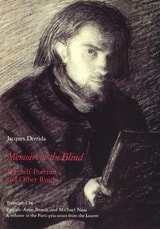
Memoirs of the Blind
The Self-Portrait and Other RuinsJacques Derrida
University of Chicago Press, 1993
vision, blindness, self-representation, and their relation to
drawing, while offering detailed readings of an extraordinary
collection of images. Selected by Derrida from the prints
and drawings department of the Louvre, the works depict
blindness—fictional, historical, and biblical. From Old
and New Testament scenes to the myth of Perseus and the
Gorgon and the blinding of Polyphemus, Derrida uncovers in
these images rich, provocative layers of interpretation.
For Derrida drawing is itself blind; as an act rooted in
memory and anticipation, drawing necessarily replaces one
kind of seeing (direct) with another (mediated). Ultimately,
he explains, the very lines which compose any drawing are
themselves never fully visible to the viewer since they exist
only in a tenuous state of multiple identities: as marks on
a page, as indicators of a contour. Lacking a "pure"
identity, the lines of a drawing summon the supplement of the
word, of verbal discourse, and, in doing so, obscure the
visual experience. Consequently, Derrida demonstrates, the
very act of depicting a blind person undertakes multiple
enactments and statements of blindness and sight.
Memoirs of the Blind is both a sophisticated
philosophical argument and a series of detailed readings.
Derrida provides compelling insights into famous and lesser
known works, interweaving analyses of texts—including
Diderot's Lettres sur les aveugles, the notion of
mnemonic art in Baudelaire's The Painter of Modern
Life, and Merleau-Ponty's The Visible and the
Invisible. Along with engaging meditations on the history
and philosophy of art, Derrida reveals the ways viewers
approach philosophical ideas through art, and the ways art
enriches philosophical reflection.
An exploration of sight, representation, and art,
Memoirs of the Blind extends and deepens the
meditation on vision and painting presented in Truth and
Painting. Readers of Derrida, both new and familiar, will
profit from this powerful contribution to the study of the
visual arts.