Results by title
628 books match the query 'Democracy' and 18 start with m
Madison's Nightmare
How Executive Power Threatens American DemocracyPeter M. Shane
University of Chicago Press, 2009
The George W. Bush administration’s ambitious—even breathtaking—claims of unilateral executive authority raised deep concerns among constitutional scholars, civil libertarians, and ordinary citizens alike. But Bush’s attempts to assert his power are only the culmination of a near-thirty-year assault on the basic checks and balances of the U.S. government—a battle waged by presidents of both parties, and one that, as Peter M. Shane warns in Madison’s Nightmare, threatens to utterly subvert the founders’ vision of representative government.
Tracing this tendency back to the first Reagan administration, Shane shows how this era of "aggressive presidentialism" has seen presidents exerting ever more control over nearly every arena of policy, from military affairs and national security to domestic programs. Driven by political ambition and a growing culture of entitlement in the executive branch—and abetted by a complaisant Congress, riven by partisanship—this presidential aggrandizement has too often undermined wise policy making and led to shallow, ideological, and sometimes outright lawless decisions. The solution, Shane argues, will require a multipronged program of reform, including both specific changes in government practice and broader institutional changes aimed at supporting a renewed culture of government accountability.
From the war on science to the mismanaged war on terror, Madison’s Nightmare outlines the disastrous consequences of the unchecked executive—and issues a stern wake-up call to all who care about the fate of our long democratic experiment.
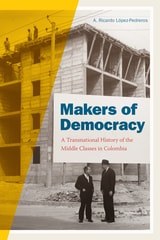
Makers of Democracy
A Transnational History of the Middle Classes in ColombiaA. Ricardo López-Pedreros
Duke University Press, 2019
Making Constituencies
Representation as Mobilization in Mass DemocracyLisa Jane Disch
University of Chicago Press, 2021
Since the turn of the twenty-first century, the idea of a divided United States has become commonplace. In the wake of the 2020 election, some commentators warned that the American public was the most divided it has been since the Civil War. Political scientists, political theorists, and public intellectuals have suggested that uninformed, misinformed, and disinformed voters are at the root of this division. Some are simply unwilling to accept facts or science, which makes them easy targets for elite manipulation. It also creates a grass-roots political culture that discourages cross-partisan collaboration in Washington.
Yet, manipulation of voters is not as grave a threat to democracy in America as many scholars and pundits make it out to be. The greater threat comes from a picture that partisans use to rally their supporters: that of an America sorted into opposing camps so deeply rooted that they cannot be shaken loose and remade. Making Constituencies proposes a new theory of representation as mobilization to argue that divisions like these are not inherent in society, but created, and political representatives of all kinds forge and deploy them to cultivate constituencies.

Making Institutions Work in Peru
Democracy, Development and Inequality Since 1980Edited by John Crabtree
University of London Press, 2006
Contributors include Paulo Drino (University of Manchester), Cynthia Sanborn (Centro de Investigaciones, Universidad del Pacifico, Lima), Carlos Monge (Participacion Ciudadana, Lima), Fernando Rospigliosi (Instituto de Estudios Peruanos, Lima), Pedro Franck (Departamento de Economia, Universidad Catolica, Lima), Fernando Eguren (Centro Peruano de Ciencias Sociales, Lima), Rosemary Thorp (Queen Elizabeth House/St Antony's College, Oxford), Eduardo Dargent (University of Texas,Austin), Coletta Youngers (Washington Office on Latin America,Washington D.C.), Francisco Durand (University of Texas, San Antonio), Jose Tavara (Departamento de Economia, Universidad Catolica, Lima, and OSIPTEL), and Richard Webb (Instituto Cuanto and Central Bank of Peru).
Man and the State
Jacques Maritain
Catholic University of America Press, 1998

March to Independence
The Revolutionary War in the Southern Colonies, 1775–1776Michael Cecere
Westholme Publishing, 2027
The Independence Trilogy
The American Revolutionary War began when Massachusetts militiamen and British troops clashed at Lexington and Concord on April 19, 1775. Two months later, a much larger engagement occurred at Bunker Hill in Boston. The conflict then expanded into a continent-wide war for independence from Great Britain. Or so we are taught. A closer look at events in the South in the eighteen months following Lexington and Concord tells different story. The practice of teaching the Revolutionary War as one generalized conflict between the American colonies and Great Britain assumes the South’s support for the Revolutionary War was a foregone conclusion. However, once shots were fired, it was not certain that the southern colonies would support the independence movement. What is clear is that both the fledgling American republic and the British knew that the southern colonies were critical to any successful prosecution of the war by either side.
In March to Independence: The American Revolution in the Southern Colonies, 1775–1776, historian Michael Cecere, consulting primary source documents, examines how Virginia, North Carolina, South Carolina, and Georgia ended up supporting the colonies to the north, while East Florida remained within the British sphere. South Carolina, Georgia, and East Florida all retained their royal governors through the summer of 1775, and no military engagements occurred in any of the southern colonies in the six months following the battles in Massachusetts. The situation changed significantly in the fall, however, with armed clashes in Virginia and South Carolina; by early 1776 the war had spread to all of the southern colonies except East Florida. Although their march to independence did not follow the exact route as the colonies to the north, events in the South pulled the southern colonists in the same direction, culminating with a united Declaration of Independence on July 4, 1776. This book explores the crucial events in the southern colonies that led all but East Florida to support the American cause.
Mass–Elite Representation Gap in Old and New Democracies
Critical Junctures and Elite AgencyEdited by Jaemin Shim
University of Michigan Press, 2024
Materializing Democracy
Toward a Revitalized Cultural PoliticsRuss Castronovo and Dana D. Nelson, eds.
Duke University Press, 2002
Covering topics ranging from rights discourse to Native American performance, from identity politics to gay marriage, and from rituals of public mourning to the Clinton-Lewinsky affair, the contributors seek to understand the practices, ideas, and material conditions that enable or foreclose democracy’s possibilities. Through readings of subjects as diverse as Will Rogers, Alexis de Tocqueville, slave narratives, interactions along the Texas-Mexico border, and liberal arts education, the contributors also explore ways of making democracy available for analysis. Materializing Democracy suggests that attention to disparate narratives is integral to the development of more complex, vibrant versions of democracy.
Contributors. Lauren Berlant, Wendy Brown, Chris Castiglia, Russ Castronovo, Joan Dayan, Wai Chee Dimock, Lisa Duggan, Richard R. Flores, Kevin Gaines, Jeffrey C. Goldfarb, Michael Moon, Dana D. Nelson, Christopher Newfield, Donald E. Pease
Media Power in Central America
Rick Rockwell and Noreene Janus
University of Illinois Press, 2003
Rick Rockwell and Noreene Janus examine the region country by country and deal with the specific conditions of government-sponsored media repression, economic censorship, corruption, and consumer trends that shape the political landscape. Challenging the notion of the media as a democratizing force, Media Power in Central America shows how governments use the media to block democratic reforms and outlines the difficulties of playing watchdog to rulers who use the media as a tool of power.

Media, Democracy and European Culture
Edited by Ib Bondebjerg and Peter Madsen
Intellect Books, 2008
Media, Democracy and European Culture presents up-to-date and cutting-edge research on the political and cultural dimension of democracy in Europe and its representation in the media. This interdisciplinary volume brings together the work of some of the most prominent European scholars in media, political science, sociology, cultural studies and law. The contributors explore issues of globalization, the role of the media and communication policy to order to provide a comparative country-to-country look at how the media constructs European identity. This timely and forward-looking collection will be of interest to scholars of media, international and cultural studies.

Media, Market, and Democracy in China
Between the Party Line and the Bottom LineYuezhi Zhao
University of Illinois Press, 1998
How do market forces influence the media in China? How does the Party both introduce and try to contain the market's influence? How do commercial imperatives both accommodate and challenge Party control?
Yuezhi Zhao interviewed a wide range of scholars, media administrators, and media professionals to answer these and other questions. Working in China in 1994 and 1995, she monitored media content, carried out extensive documentary research in Beijing, and held off-the-record meetings with Chinese media insiders. What she found informs an in-depth look at the intertwining nature of the Communist Party and the news media in China, how they affect each other, and what the future might hold for each.
A rare on-the-ground portrait, Media, Market, and Democracy in China is must reading for scholars, media and business professionals, and policymakers who need to understand what happened to China and its mass media during a period of dynamic growth and change.
Mill on Democracy
From the Athenian Polis to Representative GovernmentNadia Urbinati
University of Chicago Press, 2002
Redirecting attention to Mill as a political thinker, Nadia Urbinati argues that this claim misrepresents Mill's thinking. Although he did not elaborate a theory of democracy, Mill did devise new avenues of democratic participation in government that could absorb the transformation of politics engendered by the institution of representation. More generally, Urbinati assesses Mill's contribution to modern democratic theory by critiquing the dominant "two liberties" narrative that has shaped Mill scholarship over the last several decades. As Urbinati shows, neither Isaiah Berlin's theory of negative and positive freedom nor Quentin Skinner's theory of liberty as freedom from domination adequately captures Mill's notion of political theory.
Drawing on Mill's often overlooked writings on ancient Greece, Urbinati shows that Mill saw the ideal representative government as a "polis of the moderns," a metamorphosis of the unique features of the Athenian polis: the deliberative character of its institutions and politics; the Socratic ethos; and the cooperative implications of political agonism and dissent. The ancient Greeks, Urbinati shows, and Athenians in particular, are the key to understanding Mill's contribution to modern democratic theory and the theory of political liberty.
Urbinati concludes by demonstrating the importance of Mill's deliberative model of politics to the contemporary debate on liberal and republican views of liberty. Her fresh and persuasive approach not only clarifies Mill's political ideas but also illustrates how they can help enrich our contemporary understanding of democracy.
Models of Resistance for a Democracy in Crisis
Geoff Eley
Disobedience Press, 2026
Models of Resistance for a Democracy in Crisis features three historians who examine how political opposition, anti-racist struggle, and artistic intervention serve as vital blueprints for safeguarding our precarious democracy.
Geoff Eley deconstructs Trump-era politics by identifying a dual crisis: the withering of democratic practices and a pervasive cynicism toward government. By analyzing how Germans of the 1930s might have resisted fascism, he reveals the specific forms of opposition needed to uphold democratic accountability today.
Jamon Jordan traces a lineage of anti-racist protest, from the rebellions of the enslaved to the legal and moral defiance of the abolitionist movement. By weaving public tactics, such as demonstrations and boycotts, with the enduring labor of building Black-led institutions and preserving cultural traditions, Jordan reveals a comprehensive framework for contemporary activists.
Megan Flattley examines how artworks challenge repressive regimes. These creative interventions bear witness to traumatic and unjust conditions, use cultural institutions as cover for political action, and stage provocations in public spaces to reveal latent violence and advocate for social change.

Modern Autocracy
The Rise of Authoritarian Economies—and Why Only Some Can SucceedSimon Commander and Saul Estrin
University of Chicago Press, 2027
Strongman governments are back. What becomes of their economies?
Autocracy has once again become a rising force. Today, two thirds of the world’s population live under regimes where electoral democracy is either absent or debased. Moreover, even many functioning democracies are now facing a significant share of their citizens who favor switching to authoritarian rule. But as states return to their old authoritarian ways, what happens to their still-modernized economies?
Simon Commander and Saul Estrin examine the scale of this change—and the unevenly distributed economic consequences that will soon accompany it. Modern Autocracy reveals how authoritarian economies generally perform worse than economies in democratic states, in part because many authoritarian states are centralized around a leader whose economic stewardship facilitates political favor and cronyism. In all, these features, combined with the likelihood of repression, sap economic vitality and stymie competition, innovation, and, ultimately, growth.
The exception, the authors reveal, is that autocracies can perform better when they’re built around an institutional framework rather than simply a leader. That is because they can pursue strategic goals, including innovation; even so, their autocratic foundations open up major vulnerabilities and tensions. Brimming with political relevance, Modern Autocracy is a defining taxonomy of economies and their natures in this century.
Modern Isonomy
Democratic Participation and Human Rights Protection as a System of Equal RightsGerald Stourzh
University of Chicago Press, 2021
The ideal, Stourzh argues, is a state, and indeed a world, in which individual rights, including the right to participate in politics equally, are clearly defined and possessed by all. Stourzh begins with ancient Greek thought contrasting isonomy—which is associated with the rule of the many—with “gradated societies,” oligarchies, and monarchies. He then discusses the American experiment with the development of representative democracy as well as the French Revolution, which proclaimed that all people are born and remain free and with equal rights. But progress on the creation and protection of rights for all has been uneven. Stourzh discusses specifically the equalization of slaves, peasants, women, Jews, and indigenous people. He demonstrates how deeply intertwined the protection of equal rights is with the development of democracy and gives particular attention to the development of constitutional adjudication, notably the constitutional complaint of individuals. He also discusses the international protection human rights. Timely and thought-provoking, Modern Isonomy is an erudite exploration of political and human rights.
Moral Politics in the Philippines
Inequality, Democracy and the Urban PoorWataru Kusaka
National University of Singapore Press, 2017
Movements in Times of Democratic Transition
Bert Klandermans
Temple University Press, 2015
The editors and contributors to Movements in Times of Democratic Transition examine in comparative detail how social movements act within the context of the democratic transitions they have been fighting for, and how they are affected by the changes they helped bring about. Offering insights into the nature of how social movements decline, radicalize, revitalize, or spark new cycles of activism, Movements in Times of Democratic Transition provides a comprehensive analysis of these key questions of mobilization research.
Contributors include: Paul Almeida, Christopher J. Colvin, Stephen Ellis, Grzegorz Ekiert, Grzegorz Forys, Krzysztof Gorlach, Camila Penna, Sebastián Pereyra, Steven Robbins, Ton Salman, Mate Szabo, Ineke van Kessel, Michal Wenzel, and the editors.
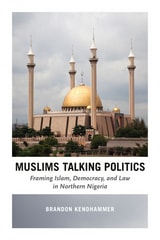
Muslims Talking Politics
Framing Islam, Democracy, and Law in Northern NigeriaBrandon Kendhammer
University of Chicago Press, 2016
Kendhammer argues that despite Nigeria’s struggles with jihadist insurgency, its recent history is really one of tenuous and fragile reconciliation between mass democratic aspirations and concerted popular efforts to preserve Islamic values in government and law. Combining an innovative analysis of Nigeria’s Islamic and political history with visits to the living rooms of working families, he sketches how this reconciliation has been constructed in the conversations, debates, and everyday experiences of Nigerian Muslims. In doing so, he uncovers valuable new lessons—ones rooted in the real politics of ordinary life—for how democracy might work alongside the legal recognition of Islamic values, a question that extends far beyond Nigeria and into the Muslim world at large.