Results by title
57 books match the query 'Discourse' and 2 start with m
Microsociology
Discourse, Emotion, and Social StructureThomas J. Scheff
University of Chicago Press, 1990
Moving beyond the traditional boundaries of sociological investigation,
Thomas J. Scheff brings together the study of communication and the social
psychology of emotions to explore the microworld of thoughts, feelings,
and moods. Drawing on strikingly diverse and rich sources—the findings of
artificial intelligence and cognitive science, and examples from literary
dialogues and psychiatric interviews—Scheff provides an inventive account
of the nature of social life and a theory of motivation that brilliantly
accounts for the immense complexity involved in understanding even the most
routine conversation.
"A major contribution to some central debates in social theory at the
present time. . . . What Thomas Scheff seeks to develop is essentially a
quite novel account of the nature of social life, its relation to language
and human reflexivity, in which he insists upon the importance of a theory
of emotion. . . . A work of true originality and jolting impact. . . .
Microsociology is of exceptional interest, which bears witness to the
very creativity which it puts at the center of human social contact."
—Anthony Giddens, from the Foreword
"Scheff provides a rich theory that can easily generate further exploration. And he drives home the message that sociological work on interaction, social bonds, and society cannot ignore human emotionality."—Candace Clark, American Journal of Sociology
"This outstanding and ground-breaking little volume contains a wealth of original ideas that bring together many insights concerning the relationship of emotion to motivation in a wide variety of social settings. It is strongly recommended to all serious students of emotion, of society, and of human nature."—Melvin R. Lansky, American Journal of Psychiatry
[more]
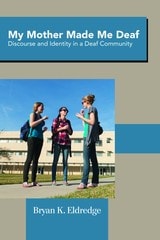
My Mother Made Me Deaf
Discourse and Identity in a Deaf CommunityBryan K. Eldredge
Gallaudet University Press, 2017
The term deaf often sparks heated debates about authority and authenticity. The concept of Deaf identity and affiliation with the DEAF-WORLD are constantly negotiated social constructions that rely heavily on the use of American Sign Language. However, given the incredible diversity of Deaf people, these constructions vary widely. From Deaf people born into culturally Deaf families and who have used ASL since birth, to those born into hearing families and for whom ASL is a secondary language (if they use it at all), to hearing children of Deaf adults whose first language is ASL, and beyond, the criteria for membership in the Deaf community is based on a variety of factors and perspectives.
Bryan K. Eldredge seeks to more precisely understand the relationship between ASL use and Deaf identity using the tools of linguistic anthropology. In this work, he presents research resulting from fieldwork with the Deaf community of Utah Valley. Through informal interactions and formal interviews, he explores the role of discourse in the projection and construction of Deaf identities and, conversely, considers how ideas about language affect the discourse that shapes identities. He finds that specific linguistic ideologies exist that valorize some forms of language over others and that certain forms of ASL serve to establish a culturally Deaf identity. My Mother Made Me Deaf demonstrates that the DEAF-WORLD consists of a multitude of experiences and ways of being even as it is bound together by certain essential elements that are common to Deaf people.
Bryan K. Eldredge seeks to more precisely understand the relationship between ASL use and Deaf identity using the tools of linguistic anthropology. In this work, he presents research resulting from fieldwork with the Deaf community of Utah Valley. Through informal interactions and formal interviews, he explores the role of discourse in the projection and construction of Deaf identities and, conversely, considers how ideas about language affect the discourse that shapes identities. He finds that specific linguistic ideologies exist that valorize some forms of language over others and that certain forms of ASL serve to establish a culturally Deaf identity. My Mother Made Me Deaf demonstrates that the DEAF-WORLD consists of a multitude of experiences and ways of being even as it is bound together by certain essential elements that are common to Deaf people.
[more]