126 books match the query 'Early modern, 1500-1700' and 4 start with m
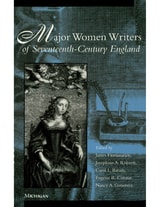
cover of Major Women Writers of Seventeenth-Century England

Major Women Writers of Seventeenth-Century England

James Fitzmaurice, Josephine A. Roberts, Carol L. Barash, Eugene R. Cunnar, and Nancy A. Gutierrez, Editors

University of Michigan Press, 1997
Many would find it difficult to name a woman writer in England before Jane Austen, even though women were writing as early as the time of Chaucer. It was during the seventeenth century, however, that women writers ceased to be viewed as odd or remarkable and became accepted as regular and often respected members of the literary world. The enormous commercial and artistic success of Aphra Behn's plays on the London stage of the 1670s and '80s marked the end of the time where only men were literary luminaries. Major Women Writers of Seventeenth-Century England brings together in one volume a rich assortment of writing by the women Behn influenced, as well as those who preceded her. Collected are works by Aphra Behn, Elizabeth Cary, Margaret Cavendish, Anne Finch, Aemelia Lanyer, Katherine Philips, Ester Sowernam, Rachel Speght, and Mary Wroth. The texts included are newly edited and rely on the best manuscripts and editions of the time. They are accompanied by clear introductions, helpful explanatory notes, and a range of illustrations from the period. Major Women Writers not only brings together the most significant women writers but also clearly shows the connections that exist between those who wrote without recognition in the earlier portions of this period and those who went on to celebrity status and sometimes financial success.
[more]
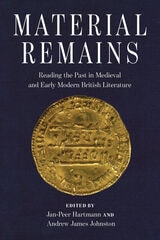
cover of Material Remains: Reading the Past in Medieval and Early Modern British Literature

Material Remains

Reading the Past in Medieval and Early Modern British Literature

Edited by Jan-Peer Hartmann and Andrew James Johnston

The Ohio State University Press, 2021
Medieval and early modern literature was fascinated with the material remains of the past. Scenes involving the discovery, description, circulation, or contemplation of archaeological objects can be found in texts ranging from hagiography to elegiac poetry, from historiography to romance—across regions and periods. This volume gathers voices to explore the ways in which these texts employ descriptions of objects from the past to produce aesthetic and literary responses to questions of historicity and the epistemological conditions of historical knowledge. The contributions to Material Remains: Reading the Past in Medieval and Early Modern British Literature examine the understanding and experience of temporality as registered through the representation of found objects. From Beowulf and King Arthur to Richard III, Roger de Norton, and more, these essays reproduce the thrill of the archaeological find and generate new forms of historical understanding beyond the established narratives that reinforce modern forms of periodizing the Middle Ages. List of Contributors Neil Cartlidge, Roberta Frank, Lori Ann Garner, Jonathan Gil Harris, Jan-Peer Hartmann, John Hines, Naomi Howell, Andrew Hui, Andrew James Johnston, Sarah Salih, Philip Schwyzer
[more]
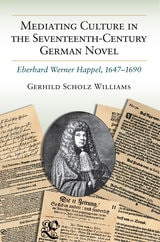
cover of Mediating Culture in the Seventeenth-Century German Novel: Eberhard Werner Happel, 1647-1690

Mediating Culture in the Seventeenth-Century German Novel

Eberhard Werner Happel, 1647-1690

Gerhild Scholz Williams

University of Michigan Press, 2014

Eberhard Happel, German Baroque author of an extensive body of work of fiction and nonfiction, has for many years been categorized as a “courtly-gallant” novelist. In Mediating Culture in the Seventeenth-Century German Novel, author Gerhild Scholz Williams argues that categorizing him thus is to seriously misread him and to miss out on a fascinating perspective on this dynamic period in German history.

Happel primarily lived and worked in the vigorous port city of Hamburg, which was a “media center” in terms of the access it offered to a wide library of books in public and private collections. Hamburg’s port status meant it buzzed with news and information, and Happel drew on this flow of data in his novels. His books deal with many topics of current interest—national identity formation, gender and sexualities, Western European encounters with neighbors to the East, confrontations with non-European and non-Western powers and cultures—and they feature multiple media, including news reports, news collections, and travel writings. As a result, Happel’s use of contemporary source material in his novels feeds our current interest in the impact of the production of knowledge on seventeenth-century narrative. Mediating Culture in the Seventeenth-Century German Novel explores the narrative wealth and multiversity of Happel’s work, examines Happel’s novels as illustrative of seventeenth-century novel writing in Germany, and investigates the synergistic relationship in Happel’s writings between the booming print media industry and the evolution of the German novel.
[more]
cover of Milton's Modernities: Poetry, Philosophy, and History from the Seventeenth Century to the Present

Milton's Modernities

Poetry, Philosophy, and History from the Seventeenth Century to the Present

Edited by Feisal G. Mohamed and Patrick Fadely

Northwestern University Press, 2017

The phrase “early modern” challenges readers and scholars to explore ways in which that period expands and refines contemporary views of the modern. The original essays in  Milton’s Modernities undertake such exploration in the context of the work of  John Milton, a poet whose prodigious energies simultaneously point to the past and future.
 
Bristling with insights on Milton’s major works, Milton’s Modernities offers fresh perspectives on the thinkers central to our theorizations of modernity: from Lucretius and Spinoza, Hegel and Kant, to Benjamin and Deleuze. At the volume's core is an embrace of the possibilities unleashed by current trends in philosophy, variously styled as the return to ethics, or metaphysics, or religion. These make all the more visible Milton’s dialogues with later modernity, dialogues that promise to generate much critical discussion in early modern studies and beyond.
 
Such approaches necessarily challenge many prevailing assumptions that have guided recent Milton criticism—assumptions about context and periodization, for instance. In this way, Milton’s Modernities powerfully broadens the historical archive beyond the materiality of events and things, incorporating as well intellectual currents, hybrids, and insights.
 
[more]