Results by title
218 books match the query 'Education, Higher' and 9 start with m
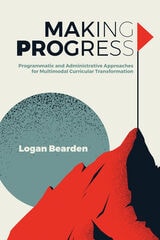
Making Progress
Programmatic and Administrative Approaches for Multimodal Curricular TransformationLogan Bearden
Utah State University Press, 2021
MCT can be achieved at the intersection of program documents and practices. Bearden details ten composition programs that have undergone MCT, offering interview data from the directors who oversaw and/or participated within the processes. He analyzes a corpus of outcomes statements to discover ways we can “make space” for multimodality and gives instructors and programs a broader understanding of the programmatic values for which they should strive if they wish to make space for multimodal composition in curricula. Making Progress also presents how other program documents like syllabi and program websites can bring those outcomes to life and make multimodal composing a meaningful part of first-year composition curricula.
First-year composition programs that do not help their students learn to compose multimodal texts are limiting their rhetorical possibilities. The strategies in Making Progress will assist writing program directors and faculty who are interested in using multimodality to align programs with current trends in disciplinary scholarship and deal with resistance to curricular revision to ultimately help students become more effective communicators in a digital-global age.
Making Reform Work
The Case for Transforming American Higher EducationZemsky, Robert
Rutgers University Press, 2009
Robert Zemsky, one of a select group of scholars who participated in Secretary of Education Margaret Spellings' 2005 Commission on the Future of Higher Education, signed off on the commission's report with reluctance. In Making Reform Work he presents the ideas he believes should have come from that group to forge a practical agenda for change. Zemsky argues that improving higher education will require enlisting faculty leadership, on the one hand, and, on the other, a strategy for changing the higher education system writ large.
Directing his attention from what can't be done to what can be done, Zemsky provides numerous suggestions. These include a renewed effort to help students' performance in high schools and a stronger focus on the science of active learning, not just teaching methods. He concludes by suggesting a series of dislodging events, for example, making a three-year baccalaureate the standard undergraduate degree, congressional rethinking of student aid in the wake of the loan scandal, and a change in the rules governing endowments that could break the gridlock that today holds higher education reform captive.
Making Reform Work offers three rules for successful college and university transformation: don't vilify, don't play games, and come to the table with a well-thought-out strategy rather than a sharply worded lamentation.
Making Sense of the College Curriculum
Faculty Stories of Change, Conflict, and AccommodationZemsky, Robert
Rutgers University Press, 2018
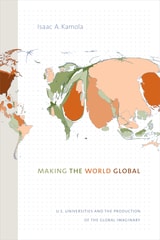
Making the World Global
U.S. Universities and the Production of the Global ImaginaryIsaac A. Kamola
Duke University Press, 2019
Mission and Margin
A Practical Guide to University FinancesDaniel Diermeier and Brett C. Sweet
University of Chicago Press, 2025
An insider’s guide to university finances, for non-insiders.
The finances of higher education have never been more challenging. From two-year institutions to the Ivy Leagues, from department chairs to provosts, administrators face revenue shortfalls and financial insecurity. A fundamental understanding of financial management is more essential than ever for university leaders at every level—as is a true partnership between academic leaders and their CFOs.
In Margin and Mission, Daniel Diermeier and Brett Sweet distill the principles for successful financial management in higher education, based on their work together at Vanderbilt University. Their concise, practical guide develops the reader’s understanding step-by-logical-step with the help of real-world examples. Margin and Mission aims to give university leaders, from board members to department chairs, the knowledge to make sound economic decisions that preserve their institutions’ purpose—even in the face of uncertainty.
Moral Problems in Higher Education
Steven Cahn
Temple University Press, 2011
Moral Problems in Higher Education brings together key essays that explore ethical issues in academia. The editor and contributors-all noted philosophers and educators-consider such topics as academic freedom and tenure, free speech on campus, sexual harassment, preferential student admissions, affirmative action in faculty appointments, and the ideal of a politically neutral university. Chapters address possible restrictions on research because of moral concerns, the structure of peer review, telling the truth to colleagues and students, and concerns raised by intercollegiate athletics.
Cahn selects two key readings in each area to offer a readable introductory guide to these critical subjects for students studying academic ethics and higher education policy. In addition to the selections and a general introduction, Cahn provides study questions for use in the classroom.
Contributors include Scott F. Aikin, Derek Bok, William G. Bowen, Myles Brand, Richard T. DeGeorge, Paul D. Eisenberg, Leslie Pickering Francis, Martin P. Golding, Philip Kitcher, Charles R. Lawrence III, David Lewis, Paul J. Olscamp, Nancy Tuana, David Shatz, George Sher, Robert L. Simon, Robert B. Talisse, Stephan Thernstrom, Abigail Thernstrom, Laurence Thomas, Robert Paul Wolff, and the editor.
More than a Moment
Contextualizing the Past, Present, and FutureSteven D. Krause
Utah State University Press, 2019
Krause writes about his own experiences as a participant in several MOOCs and the experiences of faculty who developed and taught MOOCs. Contrary to many early claims from educational entrepreneurs, they were never entirely “new,” and MOOCs and their aftermath are still at the heart of the tensions between nonprofit universities and for-profit entities, particularly online program management firms, in delivering distance education.
While MOOCs are no longer a threat to education in the United States, they are part of the ongoing corporatization of education and remain part of conversations about experienced-based credit, corporate training, and open education. Presenting historical, student, teacher, and administrative perspectives, More than a Moment is a well-rounded treatment that will be of interest to academics and entrepreneurs interested in distance education, online pedagogy, online program management, and public-private partnerships in higher education.
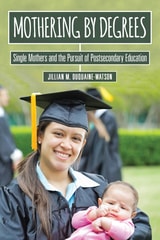
Mothering by Degrees
Single Mothers and the Pursuit of Postsecondary EducationDuquaine-Watson, Jillian M.
Rutgers University Press, 2017
In Mothering by Degrees, Jillian Duquaine-Watson shows how single mothers pursuing college degrees must navigate a difficult course as they attempt to reconcile their identities as single moms, college students, and in many cases, employees. They also negotiate a balance between what they think a good mother should be, and what society is telling them, and how that affects their choices to go to college, and whether to stay in college or not.
The first book length study to focus on the lives and experiences of single mothers who are college students, Mothering by Degrees points out how these women are influenced by dominant American ideologies of motherhood, and the institutional parameters of the schools they attend, and argues for increased attention to the specific ways in which the choices, challenges, and opportunities available to mothers are shaped within their specific environments, as well as the ways in which mothers help shape those environments...
Moving Beyond Academic Discourse
Composition Studies and the Public SphereChristian R. Weisser. Foreword by Gary A. Olson
Southern Illinois University Press, 2002
Moving student writing beyond academic discourse and into larger public spheres is a difficult task, but Christian R. Weisser’s study challenges composition instructors to do just that. This highly accessible book does what no other study has attempted to do: place the most current, cutting-edge theories and pedagogies in rhetoric and composition in their intellectual and historical contexts, while at the same time offering a unique, practical theory and pedagogy of public writing for use both inside and outside of the classroom.
By positing a theory of the public for composition studies, one which envisions the public sphere as a highly contested, historically textured, multilayered, and sometimes contradictory site, Weisser offers a new approach to the roles that compositionists might assume in their attempts to initiate progressive political and social change.
After first providing a historical context that situates composition’s recent interest in public writing, Weisser next examines recent theories in composition studies that consider writing an act of social engagement before outlining a more complex theory of the public based on the work of Jürgen Habermas. The resulting re-envisioning of the public sphere expands current conversations in rhetoric and composition concerning the public.
Weisser concludes with a holistic vision that places greater political and social import on addressing public issues and conversations in the composition classroom and that elucidates the role of the public intellectual as it relates specifically to compositionists in postmodern society.