Results by title
72 books match the query 'English drama' and 2 start with m
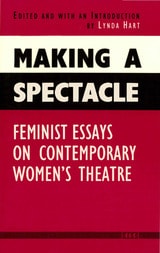
Making a Spectacle
Feminist Essays on Contemporary Women's TheatreEdited and with an Introduction by Lynda Hart
University of Michigan Press, 1988
Making a Spectacle: Feminist Essays on Contemporary Women's Theatre, edited by Lynda Hart, illuminates the dynamic intersection of feminism and theatre. This volume brings together scholars and practitioners to analyze, theorize, and celebrate the rich diversity and subversive power of contemporary women’s playwriting and performance.Spanning theoretical essays, close readings, and case studies, the book confronts both the historical marginalization and the creative strategies of women playwrights from the late twentieth century. Contributors explore how women have challenged patriarchal norms, re-envisioned dramatic structures, politicized theatrical space, and foregrounded issues of gender, sexuality, race, and class. Essays address influential artists and movements in American and British theatre, highlighting voices such as Caryl Churchill, Ntozake Shange, Maria Irene Fornes, Tina Howe, and groups like the WOW Café.From interrogating the male gaze and the politics of representation to celebrating collectivity and experimenting with language, Making a Spectacle considers the ways women theatre artists resist and reinvent the conventions of stage and story. Insightful, provocative, and accessible, this collection is essential reading for scholars, students, theatre-makers, and anyone interested in feminist performance, cultural criticism, or the artistry of women who have reclaimed the stage.
[more]
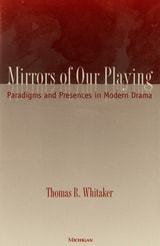
Mirrors of Our Playing
Paradigms and Presences in Modern DramaThomas R. Whitaker
University of Michigan Press, 1999
For centuries, theater has maintained a central role in the development and preservation of artistic, social, and political themes in society. Yet in recent decades, theater has taken an increasingly marginal role. In this book, Thomas R. Whitaker examines the reasons for the marginalization of this important and influential art form, considering not only histories of various dramatic forms, but also the individual histories of various playwrights and their times. In so doing, he explores the importance of perceiving drama in a different light: as a participatory tool, a mirror that reflects life as it unfolds and plays out before us. Whitaker's unique and comprehensive study of drama poses theater as a collaborative and interactive experience, an experience that involves not only the playwright, the text, and the artists, but the audience as well as the society and culture of that audience.Contrary to the common critical belief that drama can only be theorized as a “performed action,” Whitaker conceptualizes drama as an interaction between a “performed action” and an “action of performance.” The whole of Mirrors of Our Playing is founded on the understanding that a play is a manifold mirror of the “playing” that is our lives; therefore, the play is shaped by a complex interaction between the paradigms that make up our view of the world and the reflection of these paradigms in the “mirror” that is the play.Focusing on both scripts and performance, Mirrors of Our Playing takes a fresh look at modern English-speaking drama, from its Anglo-Irish beginnings to its contemporary cross-fertilizations and international dispersals. It shows how most important English-speaking theater has been shaped in accord with several major paradigms, while it examines four major presences in that theater: Lord Byron, Samuel Beckett, Wole Soyinka, and Peter Brook. Mirrors of Our Playing stands on the borderlands between text-oriented and performanceoriented criticism. It seeks to extend our knowledge of the history of modern drama in English as that drama has engaged certain paradigms of performance. It is therefore grounded in close textual analysis of a great many texts that are understood as scripts for performance. Its several chapters incorporate, as they proceed, a variety of subordinate strategies: the placing of theater in historical context, the comparison of closely related plays, the charting of historical sequences of development within a given genre or paradigm, examination of the influence of a historical figure or of contemporary works, and the tracing of the exploratory development of a major director.
[more]