Results by title
122 books match the query 'English poetry' and 5 start with m
Matthew Arnold and the Classical Tradition
Warren D. Anderson
University of Michigan Press, 1988
Meter Matters
Verse Cultures of the Long Nineteenth CenturyJason David Hall
Ohio University Press, 2011
Across the nineteenth century, meter mattered—in more ways and to more people than we might well appreciate today. For the period’s poets, metrical matters were a source of inspiration and often vehement debate. And the many readers, teachers, and pupils encountered meter and related topics in both institutional and popular forms.
The ten essays in Meter Matters showcase the range of metrical practice of poets from Wordsworth and Byron to Hopkins, Swinburne, and Tennyson; at the same time, the contributors bring into focus some of the metrical theorizing that shaped poetic thinking and responses to it throughout the nineteenth century. Paying close attention to the historical contours of Romantic and Victorian meters, as well as to the minute workings of the verse line, Meter Matters presents a fresh perspective on a subject that figured significantly in the century’s literature, and in its culture.
Mortal Forms
Affect and Temporality in Early English PoetryEvelyn Reynolds
The Ohio State University Press, 2026
Music at Midnight
The Life and Poetry of George HerbertJohn Drury
University of Chicago Press, 2014
As Drury writes in his preface, Herbert lived “a quiet life with a crisis in the middle of it.” Drury follows Herbert from his academic success as a young man, seemingly destined for a career at court, through his abandonment of those hopes, his devotion to the restoration of a church in Huntingdonshire, and his final years as a country parson. Because Herbert’s work was only published posthumously, it has always been difficult to know when or in what context Herbert wrote his poems. But Drury skillfully places readings of the poems into his narrative at biographically credible moments, allowing us to appreciate not only Herbert’s frame of mind while writing, but also the society that produced it. A sensitive critic of Herbert’s poems as well as a theologian, Drury does full justice to the spiritual dimension of Herbert’s work. In addition, he reveals the occasions of sorrow, happiness, regret, and hope that Herbert captured in his poetry and that led T. S. Eliot to write, “What we can confidently believe is that every poem . . . is true to the poet’s experience.”
Painting a picture of a man torn between worldly ambition and spiritual life, Music at Midnight is an eloquent biography that breathes new life into some of the greatest English poems ever written.
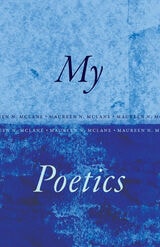
My Poetics
Maureen N. McLane
University of Chicago Press, 2024
In My Poetics, Maureen N. McLane writes as a poet, critic, theorist, and scholar—but above all as an impassioned reader. Written in an innovative, conversable style, McLane’s essays illuminate her own poetics and suggest more generally all that poetics can encompass. Ranging widely from romantic-era odes and hymns to anonymous ballads to haikus and haibuns to modernist and contemporary poetries in English, My Poetics explores poems as speculative instruments and as ways of registering our very sense of being alive. McLane pursues a number of open questions: How do poems generate modes for thinking? How does rhyme help us measure out thought? What is the relation of poetry to its surroundings, and how do specific poems activate that relation?
If, as Wallace Stevens wrote, “poetry is the scholar’s art,” My Poetics flies under a slightly different banner: study and criticism are also the poet’s art. Punctuated with McLane’s poems and drawing variously on Hannah Arendt, Percy Bysshe Shelley, Roland Barthes, Bruno Latour, and other writers and poets, My Poetics is a formally as well as intellectually adventurous work. Its artful arrangement of readings and divagations shows us a way to be with poems and poetics.