Results by title
83 books match the query 'Enlightenment' and 3 start with m
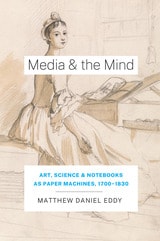
Media and the Mind
Art, Science, and Notebooks as Paper Machines, 1700-1830Matthew Daniel Eddy
University of Chicago Press, 2022
A beautifully illustrated argument that reveals notebooks as extraordinary paper machines that transformed knowledge on the page and in the mind.
We often think of reason as a fixed entity, as a definitive body of facts that do not change over time. But during the Enlightenment, reason also was seen as a process, as a set of skills enacted on a daily basis. How, why, and where were these skills learned? Concentrating on Scottish students living during the long eighteenth century, this book argues that notebooks were paper machines and that notekeeping was a capability-building exercise that enabled young notekeepers to mobilize everyday handwritten and printed forms of material and visual media in a way that empowered them to judge and enact the enlightened principles they encountered in the classroom. Covering a rich selection of material ranging from simple scribbles to intricate watercolor diagrams, the book reinterprets John Locke’s comparison of the mind to a blank piece of paper, the tabula rasa. Although one of the most recognizable metaphors of the British Enlightenment, scholars seldom consider why it was so successful for those who used it. Each chapter uses one core notekeeping skill to reveal the fascinating world of material culture that enabled students in the arts, sciences, and humanities to transform the tabula rasa metaphor into a dynamic cognitive model. Starting in the home, moving to schools, and ending with universities, the book reconstructs the relationship between media and the mind from the bottom up. It reveals that the cognitive skills required to make and use notebooks were not simply aids to reason; rather, they were part of reason itself.
We often think of reason as a fixed entity, as a definitive body of facts that do not change over time. But during the Enlightenment, reason also was seen as a process, as a set of skills enacted on a daily basis. How, why, and where were these skills learned? Concentrating on Scottish students living during the long eighteenth century, this book argues that notebooks were paper machines and that notekeeping was a capability-building exercise that enabled young notekeepers to mobilize everyday handwritten and printed forms of material and visual media in a way that empowered them to judge and enact the enlightened principles they encountered in the classroom. Covering a rich selection of material ranging from simple scribbles to intricate watercolor diagrams, the book reinterprets John Locke’s comparison of the mind to a blank piece of paper, the tabula rasa. Although one of the most recognizable metaphors of the British Enlightenment, scholars seldom consider why it was so successful for those who used it. Each chapter uses one core notekeeping skill to reveal the fascinating world of material culture that enabled students in the arts, sciences, and humanities to transform the tabula rasa metaphor into a dynamic cognitive model. Starting in the home, moving to schools, and ending with universities, the book reconstructs the relationship between media and the mind from the bottom up. It reveals that the cognitive skills required to make and use notebooks were not simply aids to reason; rather, they were part of reason itself.
[more]
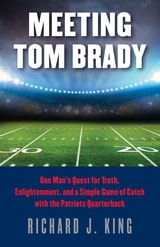
Meeting Tom Brady
One Man's Quest for Truth, Enlightenment, and a Simple Game of Catch with the Patriots QuarterbackRichard J. King
University Press of New England, 2015
Imagine that you are an average American man. You work hard and love football. Your present is a highway of unbounded opportunity, your future a far horizon unclouded by doubt. Then comes middle age. Who can you look to when the highway begins to crack, when opportunity shrinks to the size of a cubicle, and the horizon looms close? For Richard J. King, the answer is clear: Tom Brady. The legendary quarterback of the New England Patriots is not just a four-time Super Bowl champion, three-time MVP, and certain Hall of Famer. He is a male epitome. Gifted but humble. Driven but balanced. Aging but youthful. Devoted to both career and family. At the pinnacle of success but somehow still one of us. If anyone can point the way to living a worthy life, Tom Brady can. And so, at the start of the 2013 football season, King sets off in an ’88 Volkswagen minibus in a time-honored quest to answer life’s pressing questions—and to meet his hero. From training camp to the playoffs, from Spy-gate to Deflate-gate, King takes us on a tour of stadiums and bars across the country. Along the way he talks with players, sportswriters, and Patriots management, and poses the existential question, “What would you ask Tom Brady?” Meeting Tom Brady is funny and wise, a memoir of an eventful season in both King’s life and Brady’s—a determined pursuit, with uncertain results.
[more]
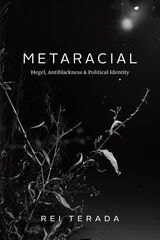
Metaracial
Hegel, Antiblackness, and Political IdentityRei Terada
University of Chicago Press, 2023
A formidable critical project on the limits of antiracist philosophy.
Exploring anxieties raised by Atlantic slavery in radical enlightenment literature concerned about political unfreedom in Europe, Metaracial argues that Hegel's philosophy assuages these anxieties for the left. Interpreting Hegel beside Rousseau, Kant, Mary Shelley, and Marx, Terada traces Hegel's transposition of racial hierarchy into a hierarchy of stances toward reality. By doing so, she argues, Hegel is simultaneously antiracist and antiblack. In dialogue with Black Studies, psychoanalysis, and critical theory, Metaracial offers a genealogy of the limits of antiracism.
Exploring anxieties raised by Atlantic slavery in radical enlightenment literature concerned about political unfreedom in Europe, Metaracial argues that Hegel's philosophy assuages these anxieties for the left. Interpreting Hegel beside Rousseau, Kant, Mary Shelley, and Marx, Terada traces Hegel's transposition of racial hierarchy into a hierarchy of stances toward reality. By doing so, she argues, Hegel is simultaneously antiracist and antiblack. In dialogue with Black Studies, psychoanalysis, and critical theory, Metaracial offers a genealogy of the limits of antiracism.
[more]