Results by title
733 books match the query 'Environmental Conservation & Protection' and 22 start with m
Make Waves
Water in Contemporary Literature and FilmPaula Anca Farca
University of Nevada Press, 2019
In this edited collection, contributors tackle current water issues in the era of climate change using a wide variety of recent literature and film. At its core, this collection demonstrates that water is an immense reservoir of artistic potential and an agent of historical and cultural exchange. Creating familiar and relatable contexts for water dilemmas, authors and directors of contemporary literary texts and films present compelling stories of our relationships to water, water health, ecosystems, and conservation. They also explore how global water problems affect local communities around the world and intersect with social and cultural aspects such as health, citizenship, class, gender, race, and ethnicity.
This transformative work highlights the cultural significance of water—the source of life and a powerful symbol in numerous cultures. It also raises awareness about global water debates and crises.
Making Peace with Nature
Ecological Encounters along the Korean DMZEleana J. Kim
Duke University Press, 2022
Making a Green Machine
The Infrastructure of Beverage Container RecyclingJørgensen, Finn Arne
Rutgers University Press, 2011
Mammals Of Nevada
E. Raymond Hall
University of Nevada Press, 1995
First published in 1946, Mammals of Nevada is a monumental work. Hall and a team of more than sixty scientists, graduate students, and staff members of the Museum of Vertebrate Zoology in Kansas spent innumerable hours trapping, preparing, studying, and documenting thousands of specimens found within the state. This long out-of-print reference contains extensive examinations of the topography, climate, life zones, and floral and faunal areas. Hundreds of illustrations enhance the work. This updated edition features a new foreword and updated taxonomy by Timothy Lawlor.

Mammals of the Pacific Northwest
From the Coast to the High CascadesChis Maser
Oregon State University Press, 1998
Mapping And Imagination In The Great Basin
A Cartographic HistoryRichard V. Francaviglia
University of Nevada Press, 2005
The Great Basin was the last region of continental North America to be explored and mapped, and it remained largely a mystery to Euro-Americans until well into the nineteenth century. In Mapping and Imagination in the Great Basin, geographer-historian Richard Francaviglia shows how the Great Basin gradually emerged from its “cartographic silence” as terra incognita and how this fascinating process both paralleled the development of the sciences of surveying, geology, hydrology, and cartography and reflected the changing geopolitical aspirations of the European colonial powers and the United States. Francaviglia’s interdisciplinary account of the mapping of the Great Basin combines a chronicle of the exploration of the region with a history of the art and science of cartography and of the political, economic, and cultural contexts in which maps are created. It also offers a compelling, wide-ranging discussion that combines a description of the daunting physical realities of the Great Basin with a cogent examination of the ways humans, from early Native Americans to nineteenth-century surveyors to twentieth-century highway and air travelers, have understood, defined, and organized this space, psychologically and through the medium of maps. Mapping and Imagination in the Great Basin continues Francaviglia’s insightful, richly nuanced meditation on the Great Basin landscape that began in Believing in Place.
Marketing the Wilderness
Outdoor Recreation, Indigenous Activism, and the Battle over Public LandsJoseph Whitson
University of Minnesota Press, 2025
How outdoor industry marketing promotes an image of “the wilderness” as an unpeopled haven
Marketing the Wilderness analyzes the relationship between the outdoor recreation industry, public lands in the United States, and Indigenous sovereignty and representation in recreational spaces. Combining social media analysis, digital ethnography, and historical research, Joseph Whitson offers nuanced insights into more than a century of the outdoor recreation industry’s marketing strategies, unraveling its complicity in settler colonialism.
Complicating the narrative of outdoor recreation as a universal good, Whitson introduces the concept of “wildernessing” to describe the physical, legal, and rhetorical production of pristine, empty lands that undergirds the outdoor recreation industry, a process that further disenfranchises Indigenous people from whom these lands were stolen. He demonstrates how companies such as Patagonia and REI align with the mining and drilling industries in their need to remove Indigenous peoples and histories from valuable lands. And he describes the ways Indigenous and decolonial activists are subverting and resisting corporate marketing strategies to introduce new narratives of place.
Through the lens of environmental justice activism, Marketing the Wilderness reconsiders the ethics of recreational land use, advocating for engagement with issues of cultural representation and appropriation informed by Indigenous perspectives. As he discusses contemporary public land advocacy around places such as Bears Ears National Monument, Whitson focuses on the deeply fraught relationship between the outdoor recreation industry and Indigenous communities. Emphasizing the power of the corporate system and its treatment of land as a commodity under capitalism, he shows how these tensions shape the American idea of “wilderness” and what it means to fight for its preservation.
Retail e-book files for this title are screen-reader friendly with images accompanied by short alt text and/or extended descriptions.
Mass Destruction
The Men and Giant Mines That Wired America and Scarred the PlanetTimothy J. LeCain
Rutgers University Press, 2009
Mass destruction mining soon spread around the nation and the globe, providing raw materials essential to the mass production and mass consumption that increasingly defined the emerging "American way of life." At the dawn of the last century, Jackling's open pit replaced immense but constricted underground mines that probed nearly a mile beneath the earth, to become the ultimate symbol of the modern faith that science and technology could overcome all natural limits. A new culture of mass destruction emerged that promised nearly infinite supplies not only of copper, but also of coal, timber, fish, and other natural resources.
But, what were the consequences? Timothy J. LeCain deftly analyzes how open-pit mining continues to affect the environment in its ongoing devastation of nature and commodification of the physical world. The nation's largest toxic Superfund site would be one effect, as well as other types of environmental dead zones around the globe. Yet today, as the world's population races toward American levels of resource consumption, truly viable alternatives to the technology of mass destruction have not yet emerged.
Meander Scars
Reflections on Healing the Willamette RiverAbby Phillips Metzger
Oregon State University Press, 2013
Yet, through canoe trips and intimate explorations of the river, Metzger discovers glints of resiliency: a beaver trolling through a slough, native fish in quiet backwaters, and strong currents that carry undertones of the wild Willamette. Together with tales from farmers and scientists alike, these experiences lead Metzger to ask whether something scarred can fully heal, and whether a disjointed river can be whole again.
A story of re-discovery as told by a learner, Meander Scars will appeal to readers of literary nonfiction, river advocates, naturalists, and outdoor enthusiasts interested in sustaining healthy river systems for themselves, their children, and beyond.
Measuring and Accounting for Environmental Public Goods
A National Accounts PerspectiveEdited by Nicholas Z. Muller, Eli P. Fenichel, and Mary Bohman
University of Chicago Press, 2025
Provides strategies and approaches for integrating natural capital into environmental statistics.
While the importance of natural resources and the contributions of the environment to welfare are apparent, traditional national income and wealth accounting practices do not measure or value environmental public goods. This volume examines the conceptual and empirical basis for integrating natural capital—forests, oceans, and air—into the economic and environmental statistics that inform public policy. It offers innovative approaches to valuing nonmarket environmental goods and services, including strategies for capturing heterogeneity in measurement across types of capital, geography, and individuals.
The chapters focus on measuring productivity with adjustments for pollution damage, developing a microdata infrastructure to advance our understanding of the distribution of environmental amenities and hazards, and estimating long-run sustainable development indicators. Case studies consider coastal assets, forests, and marine ecosystems, and develop strategies for implementing specific environmental-economic accounts such as environmental activity accounts and natural capital accounts for forests and the marine economy. As national income accounting standards are updated to incorporate expanded guidance on issues related to natural capital, this timely book will help inform decisions on the measurement and treatment of climate, air, water, and other public goods.
Meetings with Remarkable Mushrooms
Forays with Fungi across HemispheresAlison Pouliot
University of Chicago Press, 2023
A whirlwind journey through fungus frontiers that underscores how appreciating fungi is key to understanding our planet’s power and fragility.
What can we learn from the lives of fungi? Splitting time between the northern and southern hemispheres, ecologist Alison Pouliot ensures that she experiences two autumns per year in the pursuit of fungi—from Australia’s deserts to Iceland’s glaciers to America’s Cascade Mountains. In Meetings with Remarkable Mushrooms, we journey alongside Pouliot, magnifiers in hand, as she travels the world.
With Pouliot as our guide, we smell fire-loving truffles that transform their scent after burning to lure mammals who eat them and, ultimately, spread their spores. We spot the eerie glow of the ghost fungus, a deceptive entity that looks like an edible oyster mushroom but will soon heave back out—along with everything else in your stomach—if you take a bite. And we crawl alongside vegetable caterpillars, which are neither vegetable nor caterpillar but a fungus that devours insects from the inside out.
Featuring stunning color photographs of these mycological miracles, Meetings with Remarkable Mushrooms shows that understanding fungi is fundamental for harmonizing with the natural world.
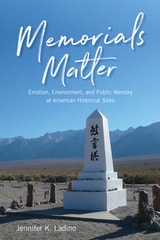
Memorials Matter
Emotion, Environment, and Public Memory at American Historical SitesJennifer K. Ladino
University of Nevada Press, 2019
In Memorials Matter, author Jennifer Ladino investigates the natural and physical environments of seven diverse National Park Service (NPS) sites in the American West and how they influence emotions about historical conflict and national identity. Chapters center around the region’s diverse inhabitants (Mexican, Chinese, Japanese, African, and Native Americans) and the variously traumatic histories these groups endured—histories of oppression, exploitation, incarceration, slavery, and genocide. Drawing on material ecocritical theory, Ladino emphasizes the ideological and political importance of memorials and how they evoke visceral responses that are not always explicitly “storied,” but nevertheless matter in powerful ways.
In this unique blend of narrative scholarship and critical theory, Ladino demonstrates how these memorial sites and their surrounding landscapes, combined with written texts, generate emotion and shape our collective memory of traumatic events. She urges us to consider our everyday environments and to become attuned to features and feelings we might have otherwise overlooked.
Memories of Earth and Sea
An Ethnographic History of the Islands of ChiloéAnton Daughters
University of Arizona Press, 2019
Staring in the 1980s, Chiloé was thrust into the global economy when major companies moved into the region to extract wild stocks of fish and to grow salmon and shellfish for export. The archipelago’s economy shifted abruptly from one of subsistence farming and fishing to wage labor in export industries. Local knowledge, traditions, memories, and identities similarly shifted, with young islanders expressing a more critical view of the rural past than their elders.
This book highlights the region’s unique past, emphasizing the generational tensions, disconnects, and continuities of the last half century. Drawing on interviews, field observations, and historical documents, Anton Daughters brings to life one of South America’s most culturally distinct regions.
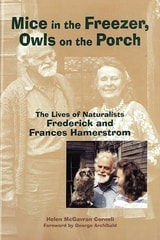
Mice in the Freezer, Owls on the Porch
The Lives of Naturalists Frederick and Francis HamerstromHelen M. Corneli
University of Wisconsin Press, 2006
Mice in the Freezer, Owls on the Porch is in many ways a love story—about a quiet scientist and his flamboyant wife, but also about their passions for hunting, for wild lands, and for the grouse and raptor species that they were instrumental in saving from destruction.
From the papers and letters of Frederick and Frances Hamerstrom, the reminiscences of contemporaries, and her own long friendship with this extraordinary couple who were her neighbors, Helen Corneli draws an intimate picture of Fran and "Hammy" from childhood through the genesis and maturation of a romantic, creative, and scientific relationship. Following the Hamerstroms as they give up a life of sophisticated convention and comfort for the more "civilized" (as Aldo Leopold would have it) pleasures of living and conducting on-the-spot research into diminishing species, Corneli captures the spirit of the Hamerstroms, their profession, and the natural and human environments in which they worked. A nuanced account of the labors, adventures, and achievements that distinguished the Hamerstroms over the years—and that inspired a generation of naturalists—this book also provides a dramatic account of conservation history over the course of the twentieth century, particularly in Wisconsin during the eventful years from the 1920s through the 1970s.
Monstrous Nature and Representations of Environmental Harms
A Green Cultural Criminological PerspectiveAvi Brisman and Nigel South
Temple University Press, 2025
The authors use examples from popular culture, including Disney and Marvel Cinematic Universe films, to consider ideas about how the environment responds to people who cause it harm. Brisman and South identify and discuss three dominant and interrelated depictions of the relationship between humans and the environment: first, nature as monstrous or fear inducing; second, nature and the Earth (or parts of it) as abject; and third, the entanglement of nature and the apocalypse, wherein nature is contributing to the end of the world, with an end point sometimes conceptualized as one without humans.
Monstrous Nature and Representations of Environmental Harms argues that such representations have material consequences. The authors make the case for challenging them so that we neither perpetuate them nor retreat into cynicism and defeatism about the future of our planet.
Montana Ghost Dance
Essays on Land and LifeBy John B. Wright
University of Texas Press, 1998
Montana has been the "last best place" for so many people. A century ago, Native Americans gathered here to perform the Ghost Dance—a last, doomed attempt to make white settlers vanish and bring back the old ways of life. Today, people are still pouring into Montana, looking for the pristine wilderness they saw in A River Runs through It.
The reality of Montana—indeed, of all the West—has never matched the myths, but this book eloquently explores how the search for a perfect place is driving growth, development, and resource exploitation in Big Sky country. In ten personal essays, John Wright looks at such things as Montana myths; old-timers; immigrants; elk; ways of seeing the landscape; land conservation and land trusts; the fate of the Blackfoot, Bitterroot, and Paradise valleys; and some means of preserving the last, best places.
These reflections offer a way of understanding Montana that goes far beyond the headlines about militia groups and celebrities' ranches. Montana never was or will be a pristine wilderness, but Wright believes that much can be saved if natives and newcomers alike see what stands to be lost. His book is a wake-up call, not a ghost dance.
More City than Water
A Houston Flood AtlasEdited by Lacy M. Johnson and Cheryl Beckett
University of Texas Press, 2022
2022 Art in Service to the Environment Award, Sierra Club Lone Star Chapter
Honorable Mention, 2022 Nonfiction Prize, Writers' League of Texas
Writers explore a city’s relationship with chronic catastrophic flooding.
Shortly after Hurricane Harvey dumped a record 61 inches of rain on Houston in 2017, celebrated writer and Bayou City resident Lacy M. Johnson began collecting flood stories. Although these stories attested to the infinite variety of experience in America’s most diverse city, they also pointed to a consistent question: What does catastrophic flooding reveal about this city, and what does it obscure?
More City than Water brings together essays, conversations, and personal narratives from climate scientists, marine ecologists, housing activists, urban planners, artists, poets, and historians as they reflect on the human geography of a region increasingly defined by flooding. Both a literary and a cartographic anthology, More City than Water features striking maps of Houston’s floodplains, waterways, drainage systems, reservoirs, and inundated neighborhoods. Designed by University of Houston seniors from the Graphic Design program, each map, imaginative and precise, shifts our understanding of the flooding, the public’s relationship to it, and the fraught reality of rebuilding. Evocative and unique, this is an atlas that uncovers the changing nature of living where the waters rise.
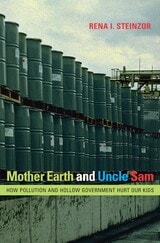
Mother Earth and Uncle Sam
How Pollution and Hollow Government Hurt Our KidsBy Rena I. Steinzor
University of Texas Press, 2007
In this compelling study, Rena Steinzor highlights the ways in which the government, over the past twenty years, has failed to protect children from harm caused by toxic chemicals. She believes these failures—under-funding, excessive and misguided use of cost/benefit analysis, distortion of science, and devolution of regulatory authority—have produced a situation in which harm that could be reduced or eliminated instead persists.
Steinzor states that, as a society, we are neglecting our children's health to an extent that we would find unthinkable as individual parents, primarily due to the erosion of the government's role in protecting public health and the environment. At this pace, she asserts, our children will inherit a planet under grave threat. We can arrest these developments if a critical mass of Americans become convinced that these problems are urgent and the solutions are near at hand.
By focusing on three specific case studies—mercury contamination through the human food chain, perchlorate (rocket fuel) in drinking water, and the effects of ozone (smog) on children playing outdoors—Steinzor creates an analysis grounded in law, economics, and science to prove her assertions about the existing dysfunctional system.
Steinzor then recommends a concise and realistic series of reforms that could reverse these detrimental trends and serve as a blueprint for restoring effective governmental intervention. She argues that these recommendations offer enough material to guide government officials and advocacy groups toward prompt implementation, for the sake of America's—and the world's—future generations.
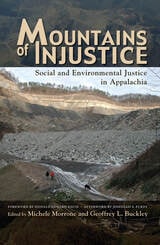
Mountains of Injustice
Social and Environmental Justice in AppalachiaMichele Morrone
Ohio University Press, 2011
Research in environmental justice reveals that low-income and minority neighborhoods in our nation’s cities are often the preferred sites for landfills, power plants, and polluting factories. Those who live in these sacrifice zones are forced to shoulder the burden of harmful environmental effects so that others can prosper. Mountains of Injustice broadens the discussion from the city to the country by focusing on the legacy of disproportionate environmental health impacts on communities in the Appalachian region, where the costs of cheap energy and cheap goods are actually quite high.
Through compelling stories and interviews with people who are fighting for environmental justice, Mountains of Injustice contributes to the ongoing debate over how to equitably distribute the long-term environmental costs and consequences of economic development.
Contributors:
Laura Allen, Brian Black, Geoffrey L. Buckley, Donald Edward Davis, Wren Kruse, Nancy Irwin Maxwell, Chad Montrie, Michele Morrone, Kathryn Newfont, John Nolt, Jedediah S. Purdy, and Stephen J. Scanlan.
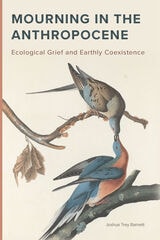
Mourning in the Anthropocene
Ecological Grief and Earthly CoexistenceJoshua Trey Barnett
Michigan State University Press, 2022
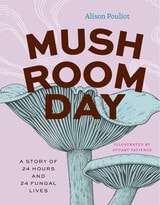
Mushroom Day
A Story of 24 Hours and 24 Fungal LivesAlison Pouliot
University of Chicago Press, 2025
On this mushroom-filled day, ecologist Alison Pouliot tours the world to introduce readers to a fascinating variety of fungi. Each chapter of Mushroom Day introduces a single fungus during a single hour, highlighting twenty-four different species.
In the dark of the night, the green glow of the ghost fungus guides us into the forest to learn about the mysteries of bioluminescence. At dawn, we awaken to find a fairy ring of mushrooms that has appeared overnight like something out of folklore. But we don’t have much time to linger, as we must reach the Italian forest before other porcino hunters forage the morning’s fattest and finest. In the heat of the afternoon, the ripe stench of the stinkhorn might send us out of the woods, while the enticing aroma of the aniseed funnel lures us back in. Late in the evening we spy a fungus known as the witches cauldron and wonder what it might tell us about the future. By the end of our mushroom day, we’ll have glimpsed the diversity of this unique kingdom, met fungus friends that feed and fascinate, and learned how humans can encourage their flourishing.
For each hour, celebrated artist Stuart Patience has depicted these scenes with evocative pen and ink illustrations. Working together to narrate and illustrate these unique moments in time, Pouliot and Patience have created an engaging read that is a perfect way to spend an hour or two—and a true gift for foragers, mycophiles, and anyone who wants to stop and appreciate fungi.
Mythical River
Chasing the Mirage of New Water in the American SouthwestMelissa L. Sevigny
University of Iowa Press, 2016
In contrast to this fantasy of abundance, Sevigny explores acts of restoration. From a dismantled dam in Arizona to an accidental wetland in Mexico, she examines how ecologists, engineers, politicians, and citizens have attempted to secure water for desert ecosystems. In a place scarred by conflict, she shows how recognizing the rights of rivers is a path toward water security. Ultimately, Sevigny writes a new map for the future of the American Southwest, a vision of a society that accepts the desert’s limits in exchange for an intimate relationship with the natural world.