Results by title
251 books match the query 'Environmental conditions' and 12 start with m
Making Peace with Nature
Ecological Encounters along the Korean DMZEleana J. Kim
Duke University Press, 2022
Making of an Ecologist
My Career in Alaska Wildlife Management and ConservationDavid R. Klein
University of Alaska Press, 2019
The first portion of the book is comprised of stories from Klein’s life collected during oral history interviews, while the latter section contains essays written by Klein about philosophical topics of importance to him, such as eco-philosophy, the definition of wilderness, and the morality of hunting.
Many of Klein’s graduate students have gone on to become successful wildlife managers themselves, in Alaska and around the globe. Through The Making of an Ecologist, Klein’s outlook, philosophy, and approach toward sustainability, wildlife management, and conservation can now inspire even more readers to ensure the survival of our fragile planet in an ever-changing global society.
Malibu Diary
Notes From An Urban RefugeePenelope O'Malley
University of Nevada Press, 2004
Meander Scars
Reflections on Healing the Willamette RiverAbby Phillips Metzger
Oregon State University Press, 2013
Yet, through canoe trips and intimate explorations of the river, Metzger discovers glints of resiliency: a beaver trolling through a slough, native fish in quiet backwaters, and strong currents that carry undertones of the wild Willamette. Together with tales from farmers and scientists alike, these experiences lead Metzger to ask whether something scarred can fully heal, and whether a disjointed river can be whole again.
A story of re-discovery as told by a learner, Meander Scars will appeal to readers of literary nonfiction, river advocates, naturalists, and outdoor enthusiasts interested in sustaining healthy river systems for themselves, their children, and beyond.
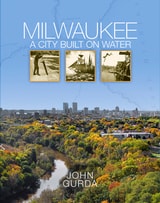
Milwaukee
A City Built on WaterJohn Gurda
Wisconsin Historical Society Press, 2026
The success and survival of Milwaukee lies in the rivers that meander through its streets and the great lake at its eastern boundary. The Indigenous peoples of the region recognized the value of an abundant, clean water supply for food and transportation. Generations of immigrants, entrepreneurs, innovators, and recreationists used the same waters to travel greater distances, power million-dollar industries, and even have a bit of fun.
In Milwaukee: A City Built on Water, celebrated historian John Gurda relates the history of the waters that gave Milwaukee life—and occasionally threatened the city through erosion, invasive species, and water-borne diseases. Telling tales of brewers, brickmakers, ecologists, and engineers, Gurda explores the city’s complicated connections with its most precious resource and greatest challenge. You’ll meet the generations of people, from a Potawatomi chief to fur traders and fishermen, who settled on the small spit of land known as Jones Island; learn how Milwaukee’s unique water composition creates its distinct cream-colored bricks; visit Wisconsin’s first waterparks; and see how city leaders transformed the Milwaukee River—once described as a “vast sewer” with an “odorous tide”—into today’s lively and lovely Riverwalk.
Now available in paperback, Milwaukee: A City Built on Water is the sweeping chronicle of a critical natural resource that has weathered heavy use and flagrant abuse to emerge as a focal point of both celebration and concern in the twenty-first century.
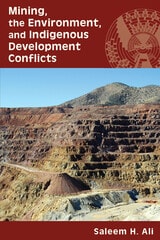
Mining, the Environment, and Indigenous Development Conflicts
Saleem H. Ali
University of Arizona Press, 2003
This book gets to the heart of resource conflicts and environmental impact assessment by asking why indigenous communities support environmental causes in some cases of mining development but not in others. Saleem Ali examines environmental conflicts between mining companies and indigenous communities and with rare objectivity offers a comparative study of the factors leading to those conflicts.
Mining, the Environment, and Indigenous Development Conflicts presents four cases from the United States and Canada: the Navajos and Hopis with Peabody Coal in Arizona; the Chippewas with the Crandon Mine proposal in Wisconsin; the Chipewyan Inuits, Déné and Cree with Cameco in Saskatchewan; and the Innu and Inuits with Inco in Labrador. These cases exemplify different historical relationships with government and industry and provide an instance of high and low levels of Native resistance in each country. Through these cases, Ali analyzes why and under what circumstances tribes agree to negotiated mining agreements on their lands, and why some negotiations are successful and others not.
Ali challenges conventional theories of conflict based on economic or environmental cost-benefit analysis, which do not fully capture the dynamics of resistance. He proposes that the underlying issue has less to do with environmental concerns than with sovereignty, which often complicates relationships between tribes and environmental organizations. Activist groups, he observes, fail to understand such tribal concerns and often have problems working with tribes on issues where they may presume a common environmental interest.
This book goes beyond popular perceptions of environmentalism to provide a detailed picture of how and when the concerns of industry, society, and tribal governments may converge and when they conflict. As demands for domestic energy exploration increase, it offers clear guidance for such endeavors when native lands are involved.
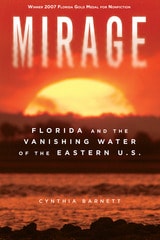
Mirage
Florida and the Vanishing Water of the Eastern U.S.Cynthia Barnett
University of Michigan Press, 2007
“Never before has the case been more compellingly made that America’s dependence on a free and abundant water supply has become an illusion. Cynthia Barnett does it by telling us the stories of the amazing personalities behind our water wars, the stunning contradictions that allow the wettest state to have the most watered lawns, and the thorough research that makes her conclusions inescapable. Barnett has established herself as one of Florida’s best journalists and Mirage is a must-read for anyone who cares about the future of the state.”
—Mary Ellen Klas, Capital Bureau Chief, Miami Herald
“Mirage is the finest general study to date of the freshwater-supply crisis in Florida. Well-meaning villains abound in Cynthia Barnett’s story, but so too do heroes, such as Arthur R. Marshall Jr., Nathaniel Reed, and Marjorie Harris Carr. The author’s research is as thorough as her prose is graceful. Drinking water is the new oil. Get used to it.”
—Michael Gannon, Distinguished Professor of history, University of Florida, and author of Florida: A Short History
“With lively prose and a journalist’s eye for a good story, Cynthia Barnett offers a sobering account of water scarcity problems facing Florida—one of our wettest states—and the rest of the East Coast. Drawing on lessons learned from the American West, Mirage uses the lens of cultural attitudes about water use and misuse to plead for reform. Sure to engage and fascinate as it informs.”
—Robert Glennon, Morris K. Udall Professor of Law and Public Policy, University of Arizona, and author of Water Follies: Groundwater Pumping and the Fate of America’s Fresh Waters
Part investigative journalism, part environmental history, Mirage reveals how the eastern half of the nation—historically so wet that early settlers predicted it would never even need irrigation—has squandered so much of its abundant freshwater that it now faces shortages and conflicts once unique to the arid West.
Florida’s parched swamps and supersized residential developments set the stage in the first book to call attention to the steady disappearance of freshwater in the American East, from water-diversion threats in the Great Lakes to tapped-out freshwater aquifers along the Atlantic seaboard.
Told through a colorful cast of characters including Walt Disney, Jeb Bush and Texas oilman Boone Pickens, Mirage ferries the reader through the key water-supply issues facing America and the globe: water wars, the politics of development, inequities in the price of water, the bottled-water industry, privatization, and new-water-supply schemes.
From its calamitous opening scene of a sinkhole swallowing a house in Florida to its concluding meditation on the relationship between water and the American character, Mirage is a compelling and timely portrait of the use and abuse of freshwater in an era of rapidly vanishing natural resources.
Modern Oceans, Ancient Sites
Archaeology and Marine Conservation on San Miguel Island, CaliforniaTodd J Braje
University of Utah Press, 2010
Montana Ghost Dance
Essays on Land and LifeBy John B. Wright
University of Texas Press, 1998
Montana has been the "last best place" for so many people. A century ago, Native Americans gathered here to perform the Ghost Dance—a last, doomed attempt to make white settlers vanish and bring back the old ways of life. Today, people are still pouring into Montana, looking for the pristine wilderness they saw in A River Runs through It.
The reality of Montana—indeed, of all the West—has never matched the myths, but this book eloquently explores how the search for a perfect place is driving growth, development, and resource exploitation in Big Sky country. In ten personal essays, John Wright looks at such things as Montana myths; old-timers; immigrants; elk; ways of seeing the landscape; land conservation and land trusts; the fate of the Blackfoot, Bitterroot, and Paradise valleys; and some means of preserving the last, best places.
These reflections offer a way of understanding Montana that goes far beyond the headlines about militia groups and celebrities' ranches. Montana never was or will be a pristine wilderness, but Wright believes that much can be saved if natives and newcomers alike see what stands to be lost. His book is a wake-up call, not a ghost dance.
Mountains of Injustice
Social and Environmental Justice in AppalachiaMichele Morrone
Ohio University Press, 2011
Research in environmental justice reveals that low-income and minority neighborhoods in our nation’s cities are often the preferred sites for landfills, power plants, and polluting factories. Those who live in these sacrifice zones are forced to shoulder the burden of harmful environmental effects so that others can prosper. Mountains of Injustice broadens the discussion from the city to the country by focusing on the legacy of disproportionate environmental health impacts on communities in the Appalachian region, where the costs of cheap energy and cheap goods are actually quite high.
Through compelling stories and interviews with people who are fighting for environmental justice, Mountains of Injustice contributes to the ongoing debate over how to equitably distribute the long-term environmental costs and consequences of economic development.
Contributors:
Laura Allen, Brian Black, Geoffrey L. Buckley, Donald Edward Davis, Wren Kruse, Nancy Irwin Maxwell, Chad Montrie, Michele Morrone, Kathryn Newfont, John Nolt, Jedediah S. Purdy, and Stephen J. Scanlan.
Mountaintop Mining in Appalachia
Understanding Stakeholders and Change in Environmental ConflictSusan F. Hirsch
Ohio University Press, 2014
Residents of the Appalachian coalfields share a history and heritage, deep connections to the land, and pride in their own resilience. These same residents are also profoundly divided over the practice of mountaintop mining—that is, the removal and disposal in nearby valleys of soil and rock in order to reach underlying coal seams. Companies and some miners claim that the practice has reduced energy prices, earned income for shareholders, and provided needed jobs. Opponents of mountaintop mining argue that it poisons Appalachia’s waters and devastates entire communities for the sake of short-term gains.
This conflict is emblematic of many other environmental disputes in the United States and around the world, disputes whose intensity derives not only from economic and environmental stakes but also from competing claims to individual and community identity. Looking beyond the slogans and seemingly irreconcilable differences, however, can reveal deeper causes of conflict, such as flawed institutions, politics, and inequality or the strongly held values of parties for whom compromise is difficult to achieve.
Mountaintop Mining in Appalachia focuses on the people of the region, the people who have the most at stake and have been the most active in trying to shift views and practices. By examining the experiences of these stakeholders and their efforts to effect change, Susan F. Hirsch and E. Franklin Dukes introduce key concepts and theories from the field of conflict analysis and resolution. They provide a compelling case study of how stakeholders challenge governance-as-usual, while offering insight into the causes of conflict over other environmental issues.
Mythical River
Chasing the Mirage of New Water in the American SouthwestMelissa L. Sevigny
University of Iowa Press, 2016
In contrast to this fantasy of abundance, Sevigny explores acts of restoration. From a dismantled dam in Arizona to an accidental wetland in Mexico, she examines how ecologists, engineers, politicians, and citizens have attempted to secure water for desert ecosystems. In a place scarred by conflict, she shows how recognizing the rights of rivers is a path toward water security. Ultimately, Sevigny writes a new map for the future of the American Southwest, a vision of a society that accepts the desert’s limits in exchange for an intimate relationship with the natural world.