Results by title
50 books match the query 'Experiments' and 3 start with m
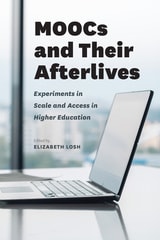
MOOCs and Their Afterlives
Experiments in Scale and Access in Higher EducationEdited by Elizabeth Losh
University of Chicago Press, 2017
Elizabeth Losh has gathered experts from across disciplines—education, rhetoric, philosophy, literary studies, history, computer science, and journalism—to tease out lessons and chart a course into the future of open, online education. Instructors talk about what worked and what didn’t. Students share their experiences as participants. And scholars consider the ethics of this education. The collection goes beyond MOOCs to cover variants such as hybrid or blended courses, SPOCs (Small Personalized Online Courses), and DOCCs (Distributed Open Collaborative Course). Together, these essays provide a unique, even-handed look at the MOOC movement and will serve as a thoughtful guide to those shaping the next steps for open education.
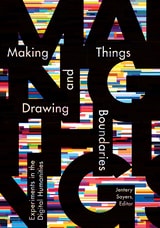
Making Things and Drawing Boundaries
Experiments in the Digital HumanitiesJentery Sayers
University of Minnesota Press, 2017
In Making Things and Drawing Boundaries, critical theory and cultural practice meet creativity, collaboration, and experimentation with physical materials as never before. Foregrounding the interdisciplinary character of experimental methods and hands-on research, this collection asks what it means to “make” things in the humanities. How is humanities research manifested in hand and on screen alongside the essay and monograph? And, importantly, how does experimentation with physical materials correspond with social justice and responsibility? Comprising almost forty chapters from ninety practitioners across twenty disciplines, Making Things and Drawing Boundaries speaks directly and extensively to how humanities research engages a growing interest in “maker” culture, however “making” may be defined.
Contributors: Erin R. Anderson; Joanne Bernardi; Yana Boeva; Jeremy Boggs; Duncan A. Buell; Amy Burek; Trisha N. Campbell; Debbie Chachra; Beth Compton; Heidi Rae Cooley; Nora Dimmock; Devon Elliott; Bill Endres; Katherine Faull; Alexander Flamenco; Emily Alden Foster; Sarah Fox; Chelsea A. M. Gardner; Susan Garfinkel; Lee Hannigan; Sara Hendren; Ryan Hunt; John Hunter; Diane Jakacki; Janelle Jenstad; Edward Jones-Imhotep; Julie Thompson Klein; Aaron D. Knochel; J. K. Purdom Lindblad; Kim Martin; Gwynaeth McIntyre; Aurelio Meza; Shezan Muhammedi; Angel David Nieves; Marcel O’Gorman; Amy Papaelias; Matt Ratto; Isaac Record; Jennifer Reed; Gabby Resch; Jennifer Roberts-Smith; Melissa Rogers; Daniela K. Rosner; Stan Ruecker; Roxanne Shirazi; James Smithies; P. P. Sneha; Lisa M. Snyder; Kaitlyn Solberg; Dan Southwick; David Staley; Elaine Sullivan; Joseph Takeda; Ezra Teboul; William J. Turkel; Lisa Tweten.
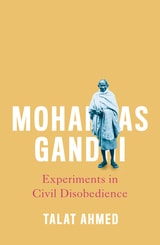
Mohandas Gandhi
Experiments in Civil DisobedienceTalat Ahmed
Pluto Press, 2016
This biography examines his campaigns from South Africa to India to evaluate the successes and failures of non-violent resistance. Seventy years after his death, his legacy remains contested: was he a saint, revolutionary, class conciliator, or self-obsessed spiritual zealot?
The contradictions of Gandhi’s politics are unpicked through an analysis of the social forces at play in the mass movement around him. Entrusted to liberate the oppressed of India, his key support base were industrialists, landlords and the rich peasantry. Gandhi’s moral imperatives often clashed with these vested material interests, as well as with more radical currents to his left.
Today, our world is scarred by permanent wars, racism and violence, environmental destruction and economic crisis. Can non-violent resistance win against state and corporate power? This book explores Gandhi’s experiments in civil disobedience to assess their relevance for struggles today.