Results by title
55 books match the query 'Fascism' and 3 start with m

Masses and Man
Nationalist and Fascist Perceptions of RealityGeorge L. Mosse
University of Wisconsin Press, 2024
In fourteen essays that speak to the full breadth of George L. Mosse’s intellectual horizons and scholarly legacy, Masses and Man explores radical nationalism, fascism, and Jewish modernity in twentieth-century Europe. Breaking from the conventions of historical analysis, Mosse shows that “secular religions” like fascism cannot be understood only as the products of socioeconomic or intellectual histories but rather must be approached first and foremost as cultural phenomena.
Masses and Man comprises three parts. The first lays out a cultural history of nationalism, essentially the first of its kind, emphasizing the importance of sacred expressions like myths, symbols, and rituals as appropriated in a political context. The second zeroes in on fascism’s most dramatic irruptions in European history in the rise of Italian Fascism and the Nazi Party in Germany, elucidating these as not just political movements but also cultural and even aesthetic ones. The third part considers nationalism and fascism from the particular standpoint of German Jews.
Taken in full, the volume offers an eloquent summation of Mosse’s groundbreaking insights into European nationalism, fascism, and Jewish history in the twentieth century. A new critical introduction by Enzo Traverso helpfully situates Mosse’s work in context and exposes the many ways in which Masses and Man, first published in 1980, remains relevant today.
[more]
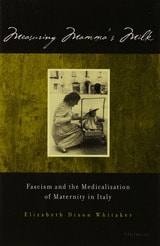
Measuring Mamma's Milk
Fascism and the Medicalization of Maternity in ItalyElizabeth Dixon Whitaker
University of Michigan Press, 2000
In Italy as in other Western societies, the medicalization of basic biological functions contributes to the loss of personal confidence in the care of the body. Measuring Mamma's Milk analyzes the medicalization of maternity through a study of breastfeeding practices over a century of changes in socioeconomic organization, family life, and health beliefs. During the pivotal interwar period in Italy, fascism changed the relationship between the state and the public and greatly tightened the state's ties with medicine and science. "Rationalized" breastfeeding was at the heart of programs to reduce infant mortality rates in order to increase the size and "quality" of the population. Highly regimented feeding schedules, still practiced today, came to represent both an eternal, natural function and the conquest of fatal maternal ignorance by modern science. They also had important consequences for fertility and for maternal and child health. Through an interdisciplinary approach, Elizabeth Whitaker shows how fascism went beneath the surface to have a lasting impact on cultural beliefs and behaviors. Measuring Mamma's Milk will appeal to readers interested in Italy, fascism, and the care of young children as well as to scholars in medical and cultural anthropology, European history, history of medicine, and women's studies. Elizabeth Dixon Whitaker received her Ph.D. in anthropology from Emory University. She is the recipient of two Fulbright grants, the second of which sent her to the University of Bologna as a Senior Scholar in 1998-99. She is currently an independent scholar living in Washington, D.C.
[more]
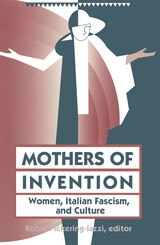
Mothers Of Invention
Women, Italian Facism, and CultureRobin Pickering-Iazzi
University of Minnesota Press, 1995
The first in-depth look at culture produced by women in Fascist Italy.
Mothers of Invention was first published in 1995. Minnesota Archive Editions uses digital technology to make long-unavailable books once again accessible, and are published unaltered from the original University of Minnesota Press editions.
To Mussolini, she was either donna-madre, the lauded domestic model, or donna-crisi, intellectual, masculine, a degenerate type. But woman, as Mothers of Invention shows, was not a category so easily defined or contained by the Italian Fascist state. This volume is the first thorough investigation of culture produced by Italian women during Fascism (1922-1943).In literature, painting, sculpture, film, and fashion, the contributors explore the politics of invention articulated by these women as they negotiated prevailing ideologies. Essays on women’s film spectatorship, on Anna Kuliscioff as the leading feminist in the Socialist party, on Teresa Labriola’s concept of Fascist feminism, on futurism and on Irene Brin’s reportage on female fashion and self-invention examine women in mass culture, political thought, and daily living. Contributors: Rosalia Colombo Ascari, Sweet Briar College; Fiora A. Bassanese, U of Massachusetts, Boston; Maurizia Boscagli, U of California, Santa Barbara; Emily Braun, Hunter College, CUNY; Carole C. Gallucci; Mariolina Graziosi, U of Milan; Clara Orban, Depaul U; Lucia Re, UCLA; Jacqueline Reich, Trinity College; and Barbara Spackman, New York University.[more]