527 books match the query 'Feminism & Feminist Theory' and 18 start with m

cover of M Archive: After the End of the World

M Archive

After the End of the World

Alexis Pauline Gumbs

Duke University Press, 2018
Following the innovative collection Spill, Alexis Pauline Gumbs's M Archive—the second book in a planned experimental triptych—is a series of poetic artifacts that speculatively documents the persistence of Black life following a worldwide cataclysm. Engaging with the work of the foundational Black feminist theorist M. Jacqui Alexander, and following the trajectory of Gumbs's acclaimed visionary fiction short story “Evidence,” M Archive is told from the perspective of a future researcher who uncovers evidence of the conditions of late capitalism, antiblackness, and environmental crisis while examining possibilities of being that exceed the human. By exploring how Black feminist theory is already after the end of the world, Gumbs reinscribes the possibilities and potentials of scholarship while demonstrating the impossibility of demarcating the lines between art, science, spirit, scholarship, and politics.
[more]
cover of Making Feminist Politics: Transnational Alliances between Women and Labor

Making Feminist Politics

Transnational Alliances between Women and Labor

Suzanne Franzway and Mary Margaret Fonow

University of Illinois Press, 2011
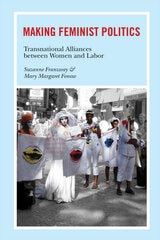
In this timely and detailed examination of the intersections of feminism, labor politics, and global studies, Suzanne Franzway and Mary Margaret Fonow reveal the ways in which women across the world are transforming labor unions in the contemporary era. Situating specific case studies within broad feminist topics, Franzway and Fonow concentrate on union feminists mobilizing at multiple sites, issues of wages and equity, child care campaigns, work-life balance, and queer organizing, demonstrating how unions around the world are broadening their focuses from contractual details to empowerment and family and feminist issues. By connecting the diversity of women's experiences around the world both inside and outside the home and highlighting the innovative ways women workers attain their common goals, Making Feminist Politics lays the groundwork for recognition of the total individual in the future of feminist politics within global union movements.
[more]
cover of Making Matters: Craft, Ethics, and New Materialist Rhetorics

Making Matters

Craft, Ethics, and New Materialist Rhetorics

Leigh Gruwell

Utah State University Press, 2022

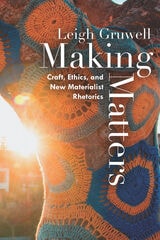
Craft is a process-oriented practice that takes seriously the relationships between bodies—both human and nonhuman—and makes apparent how these relationships are mired in and informed by power structures. Making Matters introduces craft agency, a feminist vision of new materialist rhetorics that enables scholars to identify how power circulates and sometimes stagnates within assemblages of actors and provides tools to rectify that uneven distribution.
 
To recast new materialist rhetorics as inherently crafty, Leigh Gruwell historicizes and locates the concept of craft both within rhetorical history as well as in the disciplinary history of writing studies. Her investigation centers on three specific case studies: craftivism, the fibercraft website Ravelry, and the 2017 Women’s March. These instances all highlight how a material, ecological understanding of rhetorical agency can enact political change.
 
Craft agency models how we humans might work with and alongside things—nonhuman, sometimes digital, sometimes material—to create more equitable relationships. Making Matters argues that craft is a useful starting point for addressing criticisms of new materialist rhetorics not only because doing so places rhetorical action as a product of complex relationships between a network of human and nonhuman actors, but also because it does so with an explicitly activist agenda that positions the body itself as a material interface.

 
[more]
cover of Mapping Feminist Anthropology in the Twenty-First Century

Mapping Feminist Anthropology in the Twenty-First Century

Lewin, Ellen

Rutgers University Press, 2016

Feminist anthropology emerged in the 1970s as a much-needed corrective to the discipline’s androcentric biases. Far from being a marginalized subfield, it has been at the forefront of developments that have revolutionized not only anthropology, but also a host of other disciplines. This landmark collection of essays provides a contemporary overview of feminist anthropology’s historical and theoretical origins, the transformations it has undergone, and the vital contributions it continues to make to cutting-edge scholarship. 
 
Mapping Feminist Anthropology in the Twenty-First Century brings together a variety of contributors, giving a voice to both younger researchers and pioneering scholars who offer insider perspectives on the field’s foundational moments. Some chapters reveal how the rise of feminist anthropology shaped—and was shaped by—the emergence of fields like women’s studies, black and Latina studies, and LGBTQ studies. Others consider how feminist anthropologists are helping to frame the direction of developing disciplines like masculinity studies, affect theory, and science and technology studies. 
 
Spanning the globe—from India to Canada, from Vietnam to Peru—Mapping Feminist Anthropology in the Twenty-First Century reveals the important role that feminist anthropologists have played in worldwide campaigns against human rights abuses, domestic violence, and environmental degradation. It also celebrates the work they have done closer to home, helping to explode the developed world’s preconceptions about sex, gender, and sexuality. 
 
[more]
cover of Mapping Feminist Anthropology in the Twenty-First Century

Mapping Feminist Anthropology in the Twenty-First Century

Lewin, Ellen

Rutgers University Press, 2016
Feminist anthropology emerged in the 1970s as a much-needed corrective to the discipline’s androcentric biases. Far from being a marginalized subfield, it has been at the forefront of developments that have revolutionized not only anthropology, but also a host of other disciplines. This landmark collection of essays provides a contemporary overview of feminist anthropology’s historical and theoretical origins, the transformations it has undergone, and the vital contributions it continues to make to cutting-edge scholarship. 
 
Mapping Feminist Anthropology in the Twenty-First Century brings together a variety of contributors, giving a voice to both younger researchers and pioneering scholars who offer insider perspectives on the field’s foundational moments. Some chapters reveal how the rise of feminist anthropology shaped—and was shaped by—the emergence of fields like women’s studies, black and Latina studies, and LGBTQ studies. Others consider how feminist anthropologists are helping to frame the direction of developing disciplines like masculinity studies, affect theory, and science and technology studies. 
 
Spanning the globe—from India to Canada, from Vietnam to Peru—Mapping Feminist Anthropology in the Twenty-First Century reveals the important role that feminist anthropologists have played in worldwide campaigns against human rights abuses, domestic violence, and environmental degradation. It also celebrates the work they have done closer to home, helping to explode the developed world’s preconceptions about sex, gender, and sexuality. 
 
[more]
cover of Masculine/Feminine: Practices of Difference(s)

Masculine/Feminine

Practices of Difference(s)

Nelly Richard

Duke University Press, 2004

Nelly Richard is one of the most prominent cultural theorists writing in Latin America today. As a participant in Chile’s neo-avantgarde, Richard worked to expand the possibilities for cultural debate within the constraints imposed by the Pinochet dictatorship (1973–1990), and she has continued to offer incisive commentary about the country’s transition to democracy. Well known as the founder and director of the influential Santiago-based journal Revista de crítica cultural, Richard has been central to the dissemination throughout Latin America of work by key contemporary thinkers, including Néstor García Canclini, Jacques Derrida, Fredric Jameson, and Diamela Eltit. Her own writing provides rigorous considerations of Latin American identity, postmodernism, gender, neoliberalism, and strategies of political and cultural resistance.

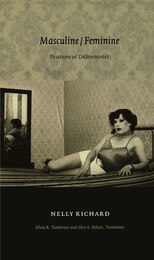
Richard helped to organize the 1987 International Conference on Latin American Women’s Literature in Santiago, one of the most significant literary events to take place under the Pinochet dictatorship. Published in Chile in 1993, Masculine/Feminine develops some of the key issues brought to the fore during that landmark meeting. Richard theorizes why the feminist movement has been crucial not only to the liberation of women but also to understanding the ways in which power operated under the military regime in Chile. In one of her most widely praised essays, she explores the figure of the transvestite, artistic imagery of which exploded during the Chilean dictatorship. She examines the politics and the aesthetics of this phenomenon, particularly against the background of prostitution and shantytown poverty, and she argues that gay culture works to break down the social demarcations and rigid structures of city life. Masculine/Feminine makes available, for the first time in English, one of Latin America’s most significant works of feminist theory.

[more]
cover of Materialist Feminism, Volume 93

Materialist Feminism, Volume 93

Toril Moi and Janice Radway, editors

Duke University Press, 0
[more]
cover of Mean Girl Feminism: How White Feminists Gaslight, Gatekeep, and Girlboss

Mean Girl Feminism

How White Feminists Gaslight, Gatekeep, and Girlboss

Kim Hong Nguyen

University of Illinois Press, 2024

White feminists performing to maintain privilege

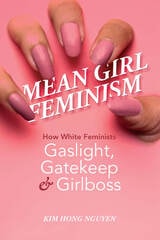
Mean girl feminism encourages girls and women to be sassy, sarcastic, and ironic as feminist performance. Yet it coopts its affect, form, and content from racial oppression and protest while aiming meanness toward people in marginalized groups.

Kim Hong Nguyen’s feminist media study examines four types of white mean girl feminism prominent in North American popular culture: the bitch, the mean girl, the power couple, and the global mother. White feminists mime the anger, disempowerment, and resistance felt by people of color and other marginalized groups. Their performance allows them to pursue and claim a special place within established power structures, present as intellectually superior, substitute nonpolitical playacting for a politics of solidarity and community, and position themselves as better, more enlightened masters than patriarchy. But, as Nguyen shows, the racialized meanness found across pop culture opens possibilities for building an intersectional feminist politics that rejects performative civility in favor of turning anger into liberation.

[more]
cover of Meat!: A Transnational Analysis

Meat!

A Transnational Analysis

Sushmita Chatterjee and Banu Subramaniam, editors

Duke University Press, 2021

What is meat? Is it simply food to consume, or a metaphor for our own bodies? Can “bloody” vegan burgers, petri dish beef, live animals, or human milk be categorized as meat? In pursuing these questions, the contributors to Meat! trace the shifting boundaries of the meanings of meat across time, geography, and cultures. In studies of chicken, fish, milk, barbecue, fake meat, animal sacrifice, cannibalism, exotic meat, frozen meat, and other manifestations of meat, they highlight meat's entanglements with race, gender, sexuality, and disability. From the imperial politics embedded in labeling canned white tuna as “the chicken of the sea” to the relationship between beef bans, yoga, and bodily purity in Hindu nationalist politics, the contributors demonstrate how meat is an ideal vantage point from which to better understand transnational circuits of power and ideology as well as the histories of colonialism, ableism, and sexism.

Contributors. Neel Ahuja, Irina Aristarkhova, Sushmita Chatterjee, Mel Y. Chen, Kim Q. Hall, Jennifer A. Hamilton, Anita Mannur, Elspeth Probyn, Parama Roy, Banu Subramaniam, Angela Willey, Psyche Williams-Forson

[more]
cover of Medical Entanglements: Rethinking Feminist Debates about Healthcare

Medical Entanglements

Rethinking Feminist Debates about Healthcare

Kristina Gupta

Rutgers University Press, 2020
Medical Entanglements uses intersectional feminist, queer, and crip theory to move beyond “for or against” approaches to medical intervention. Using a series of case studies – sex-confirmation surgery, pharmaceutical treatments for sexual dissatisfaction, and weight loss interventions – the book argues that, because of systemic inequality, most mainstream medical interventions will simultaneously reinforce social inequality and alleviate some individual suffering. The book demonstrates that there is no way to think ourselves out of this conundrum as the contradictions are a product of unjust systems. Thus, Gupta argues that feminist activists and theorists should allow individuals to choose whether to use a particular intervention, while directing their social justice efforts at dismantling systems of oppression and at ensuring that all people, regardless of race, gender, sexuality, class, or ability, have access to the basic resources required to flourish.
 
[more]
cover of Meeting the Universe Halfway: Quantum Physics and the Entanglement of Matter and Meaning

Meeting the Universe Halfway

Quantum Physics and the Entanglement of Matter and Meaning

Karen Barad

Duke University Press, 2006

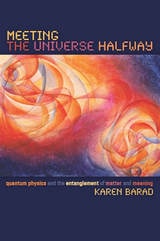
Meeting the Universe Halfway is an ambitious book with far-reaching implications for numerous fields in the natural sciences, social sciences, and humanities. In this volume, Karen Barad, theoretical physicist and feminist theorist, elaborates her theory of agential realism. Offering an account of the world as a whole rather than as composed of separate natural and social realms, agential realism is at once a new epistemology, ontology, and ethics. The starting point for Barad’s analysis is the philosophical framework of quantum physicist Niels Bohr. Barad extends and partially revises Bohr’s philosophical views in light of current scholarship in physics, science studies, and the philosophy of science as well as feminist, poststructuralist, and other critical social theories. In the process, she significantly reworks understandings of space, time, matter, causality, agency, subjectivity, and objectivity.

In an agential realist account, the world is made of entanglements of “social” and “natural” agencies, where the distinction between the two emerges out of specific intra-actions. Intra-activity is an inexhaustible dynamism that configures and reconfigures relations of space-time-matter. In explaining intra-activity, Barad reveals questions about how nature and culture interact and change over time to be fundamentally misguided. And she reframes understanding of the nature of scientific and political practices and their “interrelationship.” Thus she pays particular attention to the responsible practice of science, and she emphasizes changes in the understanding of political practices, critically reworking Judith Butler’s influential theory of performativity. Finally, Barad uses agential realism to produce a new interpretation of quantum physics, demonstrating that agential realism is more than a means of reflecting on science; it can be used to actually do science.

[more]
cover of Meghan Markle: Essays on Monarchy, Race, and Colonialism

Meghan Markle

Essays on Monarchy, Race, and Colonialism

Edited by Duchess Harris and Julie Schwietert Collazo

University of Arizona Press, 2026

This bold and timely anthology interrogates the British monarchy through the lens of race, gender, and postcolonial critique. The contributors of ten original essays use Meghan Markle’s public life and identity as a nexus for understanding the enduring legacies of empire, white supremacy, and institutional exclusion.

Each chapter blends academic analysis with the authors’ own lived experiences and identities, creating a deeply engaging and multifaceted narrative. Essays cover media representation, mental health, motherhood, and the politics of belonging. 

Written in an accessible and engaging style, this volume speaks to readers interested in the intersections of monarchy, race, feminism, and celebrity culture. Through its interdisciplinary approach and critical insight, these essays reveal how one woman’s experience within the royal family brings into focus broader social and historical processes of racial identity making and colonial power. This is essential reading for anyone seeking to understand the cultural and political significance of Meghan Markle’s story—and what it tells us about the world we live in.

Contributors
Lucca Ramone Carlson
Duchess Harris
Marissa Kessenich
Jasmine Mitchell
Sarah Olutola
Portia Owusu
Therí Pickens
Amelia Ryan
Julie Schwietert Collazo
Lily Talmont
Ariane Tulloch
Elwood Watson
Stephanie L. Williams
Sharon D. Wright Austin
[more]
cover of Melting Pots and Rainbow Nations: Conversations about Difference in the United States and South Africa

Melting Pots and Rainbow Nations

Conversations about Difference in the United States and South Africa

Jacklyn Cock and Alison Bernstein

University of Illinois Press, 2002

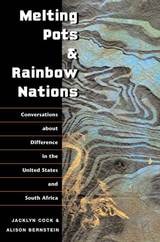
This passionate, intelligent commentary is an invigorating look at the implications of difference and diversity in two contrasting but similar societies: the United States and South Africa. Melting Pots and Rainbow Nations addresses how differences--of gender, race, culture, biology, and sexual orientation--are variously understood and acted on in both countries.

The authors argue that the concepts of difference and diversity, although valuable, are hollow if disconnected from specific social and historical contexts in which power relations create and perpetuate disadvantage. Their thoughtful exploration includes accounts of their own experiences of difference and their perspectives on such pioneering women as Elizabeth Bishop, Frene Ginwala, Audre Lorde, Ruth First, Jane Goodall, and Mamphela Ramphele.
[more]
cover of Memorializing Violence: Transnational Feminist Reflections

Memorializing Violence

Transnational Feminist Reflections

Alison Crosby

Rutgers University Press, 2025
Memorializing Violence brings together feminist and queer reflections on the transnational lives of memorialization practices, asking what it means to grapple with loss, mourning, grief, and desires to collectively remember and commemorate–as well as urges to forget–in the face of disparate yet entangled experiences of racialized and gendered colonial, imperial, militarized, and state violence. The volume uses a transnational feminist approach to ask, How do such efforts in seemingly unconnected remembrance landscapes speak to, with, and through each other in a world order inflected by colonial, imperial, and neoliberal logics, structures, and strictures? How do these memorializing initiatives not only formulate within but move through complex transnational flows and circuits, and what transpires as they do? What does it mean to inhabit loss, mourning, resistance, and refusal through memorialization at this moment, and what’s at stake in doing so? What might transnational feminist analyses of gender, race, sexuality, class, and nation have to offer in this regard?
[more]
cover of Mis(s) Communication: Stigma and the Miss America Organization

Mis(s) Communication

Stigma and the Miss America Organization

Rebecca J. Meisenbach

Rutgers University Press, 2026

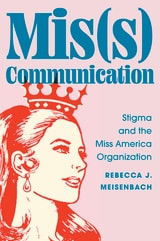
Mis(s) Communication: Stigma and the Miss America Organization explores the one-hundred-year history of the Miss America Organization (MAO) as a site of stigma management. Through five years of ethnographic, archival, and interview-based research, Rebecca J. Meisenbach shows how pageant participation is both valorized and stigmatized—making MAO a key lens for studying stigma as a dynamic, power-laden communication process. The book examines stigma across individual, organizational, and societal levels, focusing on moments like Rule Seven, which once barred nonwhite participants, and the 1968 protest by the New York Radical Women alongside the first Miss Black America pageant. Meisenbach also investigates how contestants navigate stigma tied to intelligence, body image, and the sexualization of women. She analyzes MAO’s 2018 elimination of the swimsuit competition as a stigma management move and its recent shift to a for-profit model under Miss America Opportunity. The book ultimately argues for understanding stigma as communicative and deeply intersectional.
[more]
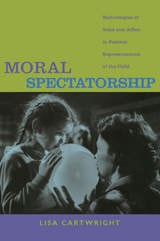
cover of Moral Spectatorship: Technologies of Voice and Affect in Postwar Representations of the Child

Moral Spectatorship

Technologies of Voice and Affect in Postwar Representations of the Child

Lisa Cartwright

Duke University Press, 2008

Why were theories of affect, intersubjectivity, and object relations bypassed in favor of a Lacanian linguistically oriented psychoanalysis in feminist film theory in the 1980s and 1990s? In Moral Spectatorship, Lisa Cartwright rethinks the politics of spectatorship in film studies. Returning to impasses reached in late-twentieth-century psychoanalytic film theory, she focuses attention on theories of affect and object relations seldom addressed during that period. Cartwright offers a new theory of spectatorship and the human subject that takes into account intersubjective and affective relationships and technologies facilitating human agency. Seeking to expand concepts of representation beyond the visual, she develops her theory through interpretations of two contexts in which adult caregivers help bring children to voice. She considers several social-problem melodramas about deaf and nonverbal girls and young women, including Johnny Belinda, The Miracle Worker, and Children of a Lesser God. Cartwright also analyzes the controversies surrounding facilitated communication, a technological practice in which caregivers help children with communication disorders achieve “voice” through writing facilitated by computers. This practice has inspired contempt among professionals and lay people who charge that the facilitator can manipulate the child’s speech.

For more than two decades, film theory has been dominated by a model of identification tacitly based on the idea of feeling what the other feels or of imagining oneself to be the other. Building on the theories of affect and identification developed by André Green, Melanie Klein, Donald W. Winnicott, and Silvan Tomkins, Cartwright develops a model of spectatorship that takes into account and provides a way of critically analyzing the dynamics of a different kind of identification, one that is empathetic and highly intersubjective.

[more]
cover of More Than an Ocean: Reflections of a Diasporic Daughter

More Than an Ocean

Reflections of a Diasporic Daughter

Alexis Pauline Gumbs

Duke University Press, 2027
More Than an Ocean brings together over two decades of thoughtful, experimental writings in Black feminist diasporic practice by Alexis Pauline Gumbs. These essays, letters, poems, and meditations question the terms of Black diaspora across geography and generations. The collected works range from some of her earliest critical engagements with the scholars who have shaped her inquiry since graduate school, including Dionne Brand and Audre Lorde, to her most recent critical writings, to letters she’s exchanged with Christina Sharpe, Torkwase Dyson, and others. In all stages, Gumbs challenges traditional tenets of Black Studies, centering the Caribbean as a nodal point of the Black diaspora and placing Black women at the center of intellectual history, artistic communities, and political movements. By transversing form and discipline, More Than an Ocean paints an image not only of a Black queer feminist thinker but of what is possible in the work of inquiry and solidarity across differences and intimacies.
[more]
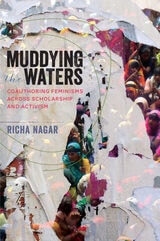
cover of Muddying the Waters: Coauthoring Feminisms across Scholarship and Activism

Muddying the Waters

Coauthoring Feminisms across Scholarship and Activism

Richa Nagar

University of Illinois Press, 2014

In Muddying the Waters, Richa Nagar embarks on an eloquent and moving exploration of the promises and pitfalls she has encountered during her two decades of transnational feminist work.

With stories, encounters, and anecdotes as well as methodological reflections, Nagar grapples with the complexity of working through solidarities, responsibility, and ethics while involved in politically engaged scholarship. Experiences that range from the streets of Dar es Salaam to farms and development offices in North India inform discussion of the labor and politics of coauthorship, translation, and genre blending in research and writing that cross multiple--and often difficult--borders. The author links the implicit assumptions, issues, and questions involved with scholarship and political action, and explores the epistemological risks and possibilities of creative research that bring these into intimate dialogue

Daringly self-conscious, Muddying the Waters reveals a politically engaged researcher and writer working to become ""radically vulnerable,"" and the ways in which such radical vulnerability can allow a re-imagining of collaboration that opens up new avenues to collective dreaming and laboring across sociopolitical, geographical, linguistic, and institutional borders.

[more]