Results by title
50 books match the query 'Feminist Criticism' and 3 start with m
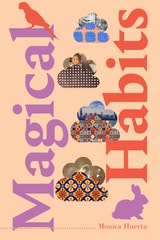
Magical Habits
Monica Huerta
Duke University Press, 2021
In Magical Habits Monica Huerta draws on her experiences growing up in her family's Mexican restaurants and her life as a scholar of literature and culture to meditate on how relationships among self, place, race, and storytelling contend with both the afterlives of history and racial capitalism. Whether dwelling on mundane aspects of everyday life, such as the smell of old kitchen grease, or grappling with the thorny, unsatisfying question of authenticity, Huerta stages a dynamic conversation among genres, voices, and archives: personal and critical essays exist alongside a fairy tale; photographs and restaurant menus complement fictional monologues based on her family's history. Developing a new mode of criticism through storytelling, Huerta takes readers through Cook County courtrooms, the Cristero Rebellion (in which her great-grandfather was martyred by the Mexican government), Japanese baths in San Francisco—and a little bit about Chaucer too. Ultimately, Huerta sketches out habits of living while thinking that allow us to consider what it means to live with and try to peer beyond history even as we are caught up in the middle of it.
[more]
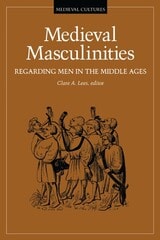
Medieval Masculinities
Regarding Men in the Middle AgesClare A. Lees
University of Minnesota Press, 1994
"Ranging from questions of epic violence and heroic embodiments of manhood to constructions of bachelorhood, husbandry, and sainthood, Medieval Masculinities is the first synthesis of medieval and gender studies to focus on masculinities."
Harry Brod, editor of The Making of Masculinities"We should not be working [exclusively] on the subjected sex any more than a historian of class can focus exclusively on peasants."-Natalie Zemon Davis, 1975 In the years since Natalie Davis made this remark, men's studies, and gender studies along with it, has earned its place in scholarship. What is often missing from such studies, however, is the insight that the concept of gender in general, and that of masculinity in particular, can be understood only in relation to individual societies, examined at specific historical and cultural moments. A brilliant application of this insight, Medieval Masculinities is the first full-length collection to explore the issues of men's studies and contemporary theories of gender within the context of the Middle Ages. Interdisciplinary and multicultural, the essays range from matrimony in medieval Italy to bachelorhood in Renaissance Venice, from friars and saints to the male animal in the fables of Marie de France, from manhood in Sir Gawain and the Green Knight, Beowulf, and the Roman d'Eneas to men as "other," whether Muslim or Jew, in medieval Castilian epic and ballad. The authors are especially concerned with cultural manifestations of masculinity that transcend this particular historical period-idealized gender roles, political and economic factors in structuring social institutions, and the impact of masculinist ideology in fostering and maintaining power. Together, their essays constitute an important reassessment of traditional assumptions within medieval studies as well as a major contribution to the evolving study of gender.ContributorsChristopher Baswell, Barnard CollegeVern L. Bullough, SUNY, BuffaloStanley Chojnacki, Michigan State UniversityJohn Coakley, New Brunswick Theological SeminaryThelma Fenster, Fordham UniversityClare Kinney, University of VirginiaClare A. Lees, University of PennsylvaniaJo Ann McNamara, Hunter CollegeLouise Mirrer, Fordham UniversityHarriet Spiegel, California State University, ChicoSusan Mosher Stuard, Haverford College[more]
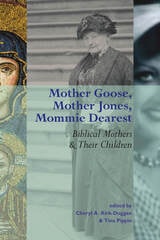
Mother Goose, Mother Jones, Mommie Dearest
Biblical Mothers and Their ChildrenCheryl A. Kirk-Duggan
SBL Press, 2009
Who are the mothers in the biblical text? What do they do? What kinds of power do they have? Issues of identity, authority, violence, gender, sexuality, race, ethnicity, sexual exploitation and rape-marriage, murder, and relation to God have haunted the characters and representations of motherhood from Eve to Mary and beyond. For better or for worse, these images speak potent messages even today. To explore biblical mothers and their relationships with their daughters and sons, the contributors to this volume participate in a comparative analysis between biblical mothers and mothers in popular media, history, literature, and the arts. The diversity of methods they employ prompts a rich discussion on the deconstruction of motherhood, offering new ways of envisioning both biblical and contemporary motherhood. The contributors are Cheryl A. Kirk-Duggan and Tina Pippin, Madeline McClenney-Sadler, Wil Gafney, Brian Britt, Frank M. Yamada, Mignon R. Jacobs, Linda S. Schering, Mark Roncace and Deborah Whitehead, Andrew M. Mbuvi, Stephanie Buckhanon Crowder, Brenda Wallace, Margaret Aymer, Tat-siong Benny Liew, and Alison Jasper.
[more]