Results by title
53 books match the query 'Film adaptations' and 3 start with m
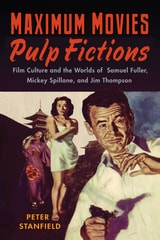
Maximum Movies—Pulp Fictions
Film Culture and the Worlds of Samuel Fuller, Mickey Spillane, and Jim ThompsonStanfield, Peter
Rutgers University Press, 2011
In the words of Richard Maltby . . . "Maximum Movies--Pulp Fictions describes two improbably imbricated worlds and the piece of cultural history their intersections provoked." One of these worlds comprises a clutch of noisy, garish pulp movies--Kiss Me Deadly, Shock Corridor, Fixed Bayonets!, I Walked with a Zombie, The Lineup, Terror in a Texas Town, Ride Lonesome--pumped out for the grind houses at the end of the urban exhibition chain by the studios' B-divisions and fly-by-night independents. The other is occupied by critics, intellectuals, cinephiles, and filmmakers such as Jean-Luc Godard, Manny Farber, and Lawrence Alloway, who championed the cause of these movies and incited the cultural guardians of the day by attacking a rigorously policed canon of tasteful, rarified, and ossified art objects. Against the legitimate, and in defense of the illegitimate, in an insolent and unruly manner, they agitated for the recognition of lurid sensational crime stories, war pictures, fast-paced Westerns, thrillers, and gangster melodramas were claimed as examples of the true, the real, and the authentic in contemporary culture--the foundation upon which modern film studies sits.
[more]
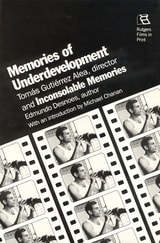
Memories Of Underdevelopment
Chanan, Michael
Rutgers University Press, 1990
Memories of Underdevelopment was the first great international success of Cuban cinema. The film provides a complex portrait of Sergio, a disaffected bourgeois intellectual who remains in Havana after the Revolution, suspended between two worlds. He can no longer accept the values of his family's reactionary past and yet boredom and the conditioning of his early life prevent him from committing himself to the new revolutionary society. Sergio's story is played out in the turbulent period of the Bay of Pigs invasion and the 1962 missile crisis, events he can only watch on his television screen or from his apartment balcony.The film, initially banned by the U.S. government as part of its trade quarantine of Cuba, was shown here five years after its original release. But American critics responded enthusiastically to it and the National Society of Film Critics bestowed an award on its director.
This double volume includes the complete continuity script of Memories, as well as the complete novel, Inconsolable Memories, upon which the film is based. An interview with Alea is reproduced here, as well as documentation of the political controversy that surrounded the film in this country. Michael Chanan's introduction places the film in the context of Cuban political and cultural history. The volume also includes a biographical sketch of Alea, a chronology of the Cuban Revolution, reviews, commentary, a filmography, and a bibliography.Michael Chanan lives in England, where he teaches and writes on film. He is the author of The Cuban Image: Cinema and Cultural Politics in Cuba.
This double volume includes the complete continuity script of Memories, as well as the complete novel, Inconsolable Memories, upon which the film is based. An interview with Alea is reproduced here, as well as documentation of the political controversy that surrounded the film in this country. Michael Chanan's introduction places the film in the context of Cuban political and cultural history. The volume also includes a biographical sketch of Alea, a chronology of the Cuban Revolution, reviews, commentary, a filmography, and a bibliography.Michael Chanan lives in England, where he teaches and writes on film. He is the author of The Cuban Image: Cinema and Cultural Politics in Cuba.
[more]
Multi-Mediated Dostoevsky
Transposing Novels into Opera, Film, and DramaAlexander Burry
Northwestern University Press, 2011
Since their publication, the works of Dostoevsky have provided rich fodder for adaptations to opera, film, and drama. While Dostoevsky gave his blessing to the idea of adapting his work to other forms, he believed that "each art form corresponds to a series of poetic thoughts, so that one idea cannot be expressed in another non-corresponding form." In Multi-Mediated Dostoevsky, Alexander Burry argues that twentieth-century adaptations (which he calls "transpositions") of four of Dostoevsky’s works—Sergei Prokofiev’s opera The Gambler, Leos Janacek’s opera From the Dead House, Akira Kurosawa’s film The Idiot, and Adrzej Wajda’s drama The Devils—follow Dostoevsky’s precept by bringing to light underdeveloped or unappreciated aspects of Dostoevsky’s texts rather than by slavishly attempting to recreate their sources. Burry’s interdisciplinary approach gives his study broad appeal to scholars as well as to students of Russian, comparative literature, music, film, drama, and cultural studies.
[more]